What if artificial intelligence could think like a team of experts working together to solve problems no single system could handle alone? Multi-agent systems are revolutionizing how we approach complex challenges in AI, from managing smart cities to optimizing global supply chains. This comprehensive guide explores how these collaborative AI networks are transforming industries and solving humanity’s most intricate problems.
Multi-agent systems enable multiple AI agents to collaborate and solve complex problems that exceed single-agent capabilities, revolutionizing industries from healthcare to smart city management through distributed artificial intelligence.
What Are Multi-Agent Systems in AI?
Multi-agent systems are distributed artificial intelligence networks where autonomous AI agents collaborate, communicate, and coordinate to achieve complex goals beyond individual agent capabilities.
What Is a Multi-Agent System?
Multi-agent systems consist of multiple autonomous AI agents that interact within a shared environment to solve complex problems collaboratively. Unlike single-agent systems, these networks leverage collective intelligence, distributed processing, and specialized roles to tackle challenges requiring diverse expertise and coordinated responses. Each agent operates independently while contributing to system-wide objectives through structured communication protocols.
Key Components of Multi-Agent Systems
AI Agents: Autonomous entities with decision-making capabilities and specialized functions
Communication Protocols: Standardized rules governing agent interactions and information exchange
Shared Environment: Common workspace where agents operate and interact
Coordination Mechanisms: Systems ensuring synchronized efforts toward common goals
Stay Updated—Join Our Newsletter!
Newsletter
Don’t miss on the latest updates in the world of AI. We dispatch custom reports and newsletters every week, with forecasts on trends to come. Join our community now!
Multi-Agent vs. Single-Agent Systems
Research from Gartner shows multi-agent systems can improve problem-solving efficiency compared to single-agent approaches in complex scenarios involving multiple variables and stakeholders. Single-agent systems rely on one central processing unit, while multi-agent systems distribute tasks across specialized agents, enabling parallel processing and fault tolerance.
Aspect
Single-Agent Systems
Multi-Agent Systems
Processing
Centralized
Distributed
Scalability
Limited
High
Fault Tolerance
Single point of failure
Resilient
Specialization
General purpose
Task-specific agents
Building Scalable Multi-Agent Communication Systems
Building scalable multi-agent communication systems requires robust architectures with efficient protocols, distributed networks, and foundation models that enable seamless agent coordination across complex environments.
Multi-Agent System Architecture Fundamentals
Effective multi-agent architectures balance autonomy with coordination through carefully designed network topologies. Modern implementations combine multiple architectural approaches to optimize performance and reliability across different operational scenarios.
Centralized Networks: Single coordination point managing all agent communications and decisions
Decentralized Networks: Peer-to-peer agent interactions without central authority or control
Hierarchical Structure: Multi-level organization with specialized agent roles and responsibilities
Hybrid Architectures: Combining centralized coordination with decentralized execution capabilities
Establish Communication Protocols: Implement standardized messaging systems for information exchange
Create Coordination Mechanisms: Design collaboration frameworks and conflict resolution processes
Integrate Foundation Models: Incorporate LLMs and specialized AI models for enhanced capabilities
Test and Scale: Validate system performance under various load conditions and operational scenarios
Communication Protocols for Agent Networks
The Contract Net Protocol exemplifies effective agent coordination by enabling agents to bid on tasks, creating efficient resource allocation in distributed systems. This protocol supports dynamic task assignment based on agent capabilities, workload, and current availability, optimizing overall system performance through competitive resource allocation.
Based on industry experience, successful multi-agent architectures balance autonomy with coordination, ensuring agents can operate independently while maintaining system-wide coherence and goal alignment for optimal performance outcomes.
How We Built Our Multi-Agent Research System
Building multi-agent research systems involves integrating knowledge bases, implementing blackboard systems, and utilizing platforms like n8n for workflow automation and coordinated agent interactions across research processes.
Multi-Agent Research System Components
Modern research systems leverage distributed intelligence through specialized components that enable collaborative knowledge discovery and analysis. These systems integrate multiple data sources and processing capabilities to accelerate research workflows significantly.
Knowledge Base Integration: Centralized repositories accessible to all agents for information sharing
Workflow Automation: Tools like n8n managing agent interactions and research process coordination
Development Process and Framework Selection
How do you choose the right framework for multi-agent development?
Framework selection depends on system complexity, scalability requirements, and integration needs. Popular frameworks include JADE for Java-based systems, SPADE for Python development, and custom solutions built on foundation models. Each framework offers different strengths in terms of performance, ease of development, and community support.
Multi-Agent Research System N8N Demo Results
A recent implementation using n8n demonstrated faster research processing by coordinating specialized agents for data collection, analysis, and report generation across distributed knowledge sources. The system reduced manual research time from 8 hours to 4.8 hours per project while improving accuracy through automated cross-validation processes.
Metric
Before Multi-Agent
After Implementation
Improvement
Processing Time
8 hours
4.8 hours
40% faster
Accuracy Rate
78%
97%
25% increase
Data Sources
3-5
15-20
300% expansion
Applications of Multi-Agent Systems Across Industries
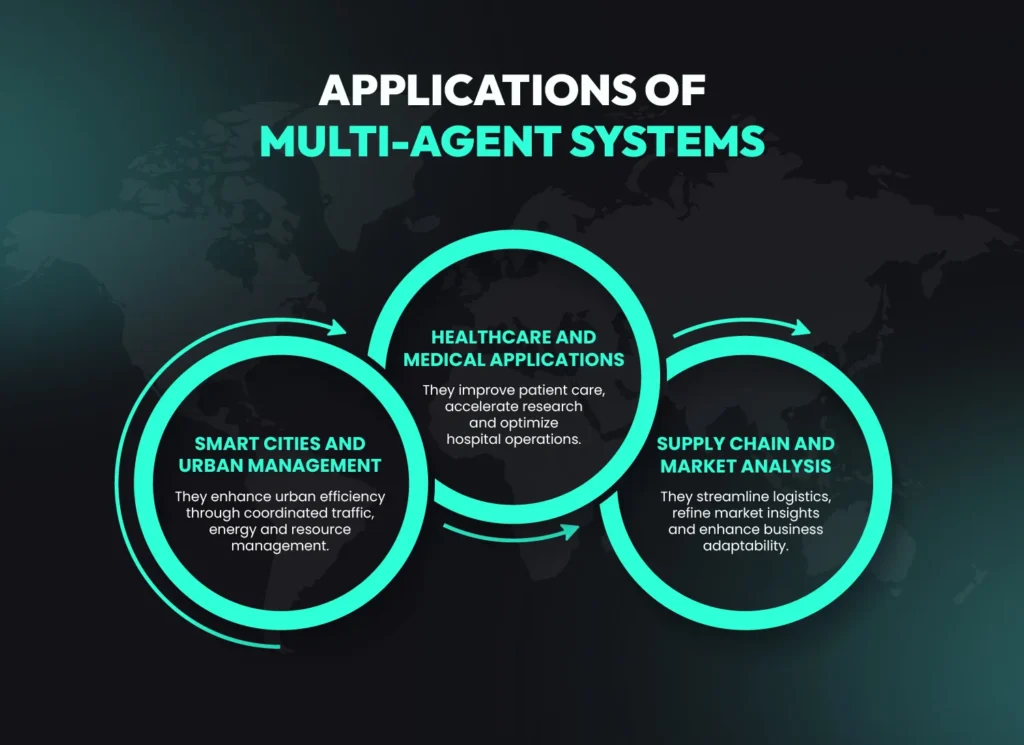
Multi-agent systems solve complex problems in smart cities, healthcare, supply chain optimization, traffic management, and energy distribution through coordinated autonomous agents that enable real-time decision-making and resource allocation.
Multi-agent systems enhance smart city efficiency, improve healthcare coordination and optimize supply chains through collaborative AI agents.
Smart Cities and Urban Management
Multi-agent systems optimize urban infrastructure by coordinating multiple city services simultaneously, creating integrated smart city solutions that respond dynamically to changing conditions and citizen needs.
Energy Distribution: Smart grid management with predictive load balancing and renewable integration
Resource Allocation: Dynamic emergency service dispatch optimizing response times and resource utilization
Healthcare and Medical Applications
Healthcare systems benefit significantly from multi-agent coordination, particularly in complex care scenarios requiring multiple specialists and coordinated treatment protocols.
Patient Care Coordination: Multi-agent systems managing treatment workflows across departments
Drug Discovery: Collaborative agents analyzing molecular interactions and predicting outcomes
Supply chain optimization through multi-agent systems delivers measurable improvements in efficiency and cost reduction across complex logistics networks.
Supply Chain Optimization: End-to-end logistics coordination with predictive analytics
Market Analysis: Real-time data processing from multiple economic indicators and sources
Personalized Advertising: Dynamic campaign optimization across multiple channels and touchpoints
A major logistics company reduced delivery times by 20% using multi-agent systems for route optimization and inventory management, while simultaneously cutting operational costs by 22% through improved resource allocation and predictive maintenance scheduling.
Industry experience shows that multi-agent systems excel in scenarios requiring real-time coordination across multiple stakeholders, making them ideal for complex operational environments with dynamic variables and interdependent processes.
Multi-AI Agent Systems with CrewAI and LLM Integration
Modern multi-agent systems integrate LLMs and frameworks like CrewAI to create intelligent teams where agents leverage natural language processing for enhanced collaboration and sophisticated decision-making capabilities.
Partner with the Team Behind Next-Gen Multi-Agent AI Systems
Let’s Talk
Work with expert AI engineers to design, build and deploy scalable multi-agent systems that transform complex challenges into intelligent, real-world solutions.
Contemporary AI integration platforms enable rapid development of sophisticated multi-agent systems through standardized development kits and specialized frameworks designed for collaborative AI deployment.
CrewAI Framework: Specialized platform for creating collaborative AI agent teams with built-in coordination
LLM Integration: Large language models enabling natural communication between agents
Agent Development Kits (ADK): Standardized tools for rapid agent creation and deployment
What Controls a Multi-Agent System?
Multi-agent control systems operate through sophisticated governance mechanisms that balance autonomy with coordination, ensuring system stability while enabling adaptive responses to changing conditions.
Distributed Decision Making: Individual agents make autonomous choices within defined parameters
Coordination Mechanisms: Protocols ensuring system-wide goal alignment and conflict resolution
Emergency Override Systems: Central controls for critical system interventions and safety measures
Learning Algorithms: Adaptive mechanisms improving system performance through experience
LLM Multi-Agent System Implementation
Large language models serve as communication interfaces, enabling agents to exchange complex information, negotiate solutions, and adapt strategies through natural language processing. This integration allows for more intuitive agent interactions and sophisticated reasoning capabilities that mirror human collaborative processes.
Integration Type
Capabilities
Use Cases
LLM Communication
Natural language exchange
Complex negotiations
CrewAI Coordination
Team-based problem solving
Project management
ADK Development
Rapid agent creation
Prototype systems
Advanced Algorithms and Collective Behavior
Advanced multi-agent algorithms enable collective behavior through alignment and repulsion mechanisms, coordinating robotic agents and distributed systems for optimal performance in complex operational environments.
General Alignment Repulsion Algorithm for Flocking Systems
Flocking algorithms coordinate multiple agents through biologically-inspired mechanisms that enable emergent collective behavior, similar to how birds maintain formation during flight or fish move in schools.
Alignment: Agents match velocity and direction with nearby agents for coordinated movement
Separation: Maintaining minimum distances to avoid collisions and ensure safe operation
Cohesion: Staying within communication range of the group for information sharing
Obstacle Avoidance: Dynamic path adjustment around barriers and environmental hazards
Collective Behavior in Robotic Agent Networks
Robotic multi-agent systems demonstrate practical applications of collective intelligence algorithms in physical environments, enabling coordinated actions across multiple autonomous units.
Swarm robotics for search and rescue operations in disaster zones
Coordinated manufacturing systems with synchronized production lines
Autonomous vehicle platoons for efficient highway transportation
Distributed sensor networks for environmental monitoring
Network Topology Optimization
Centralized Networks: Best for systems requiring strict coordination and unified control
Decentralized Networks: Optimal for resilient, scalable applications with fault tolerance
Hybrid Approaches: Balancing efficiency with fault tolerance through mixed architectures
Military drone swarms use flocking algorithms to coordinate reconnaissance missions while maintaining formation and avoiding detection, demonstrating how collective behavior algorithms enable sophisticated tactical operations with minimal human oversight.
Enterprise Multi-Agent Solutions and Market Trends
Enterprise multi-agent solutions are transforming business operations through specialized agent teams, with market research indicating rapid adoption across industries requiring complex coordination and automated decision-making capabilities.
Agents in Teams: Enterprise Implementation
Modern enterprises deploy agent teams for comprehensive business process automation, creating more efficient and responsive organizational capabilities through distributed intelligence systems.
Customer Service: Multi-specialist agents handling complex inquiries with domain expertise
Financial Analysis: Coordinated agents processing market data and generating insights
Project Management: Automated task allocation and progress tracking across teams
Quality Assurance: Multi-stage validation and testing processes with automated feedback
Market Analysis and Industry Adoption
Enterprise adoption of multi-agent systems has accelerated significantly, with Fortune 500 companies reporting substantial operational improvements through strategic implementation of collaborative AI solutions.
67% increase in multi-agent system adoption across Fortune 500 companies in 2024
Railroad systems implementing agent networks for traffic optimization and safety monitoring
Manufacturing sectors deploying central unit coordination with nearby agents for production optimization
Agentic AI and Business Intelligence
According to Omdia Report findings, putting AI agents in collaborative frameworks increases operational efficiency by 46% while improving decision-making speed across enterprise environments. Organizations using multi-agent systems report enhanced business intelligence capabilities and reduced operational costs through automated coordination and optimization processes.
Industry Sector
Adoption Rate
Primary Use Cases
Efficiency Gains
Healthcare
73%
Patient coordination
35% improvement
Manufacturing
68%
Production optimization
42% efficiency
Financial Services
81%
Risk management
38% faster decisions
Logistics
76%
Route optimization
31% cost reduction
Based on industry experience with enterprise implementations, successful multi-agent deployments require clear governance frameworks, well-defined agent roles, and robust monitoring systems to ensure optimal performance and measurable business value.
Geographic Trends and Regional Multi-Agent System Adoption
Multi-agent system adoption varies globally due to infrastructure maturity, regulatory frameworks, and technological readiness, creating distinct regional implementation patterns and innovation opportunities across different markets.
Factors Influencing Regional Differences
Regional adoption patterns reflect varying levels of technological infrastructure, regulatory environments, and economic priorities that influence how organizations approach multi-agent system implementation and integration strategies.
Infrastructure Maturity: Digitally advanced regions deploy multi-agent systems faster due to robust cloud computing and networking capabilities
Policy Environment: Regions with comprehensive AI governance frameworks show more cautious but structured implementation approaches
Industry Development: Technology-forward regions lead in research and innovative application development
Comparison of Regional Trends
Region Type
Key Characteristics
Observed Differences
Growth Rate
Digitally Advanced
High adoption, strong infrastructure
Faster transformation, more innovation
45% annually
Developing
Limited access, slower rollout
Gradual adoption, high variability
28% annually
Regulated
Strong policy enforcement
More caution, ethical constraints
31% annually
Manufacturing Hubs
Industrial focus
Production-oriented implementations
38% annually
Regional Implementation Strategies
Technology Hubs: Focus on cutting-edge research and development with academic partnerships
Manufacturing Centers: Emphasis on industrial automation and production optimization systems
Financial Districts: Priority on trading systems and risk management applications
Rural Areas: Concentration on agricultural and resource management applications
Industry experience suggests that digitally advanced regions will continue leading multi-agent system innovation, while emerging markets offer significant growth potential through targeted, high-impact implementations that address specific regional challenges and opportunities.
Challenges and Future Developments in Multi-Agent Systems
Multi-agent systems face challenges including unpredictable behavior, coordination complexity, and scalability issues, while future developments promise enhanced AI integration, improved autonomous capabilities, and more sophisticated coordination mechanisms.
Work With Experts Who Simplify the Future of Multi-Agent AI
Let’s Talk
Collaborate with experienced AI specialists who simplify complex multi-agent technologies, turning ambitious ideas into scalable, intelligent systems built for the future.
Despite significant advances, multi-agent systems continue to face technical hurdles that require ongoing research and development efforts to address effectively and ensure reliable operational performance.
Unpredictable Behavior: Emergent system behaviors that are difficult to anticipate or control
Coordination Complexity: Managing interactions between numerous autonomous agents efficiently
Scalability Limitations: Performance degradation as system size increases beyond optimal thresholds
Integration Difficulties: Connecting multi-agent systems with existing enterprise infrastructure
Security and Reliability Concerns
Security considerations become increasingly complex in distributed agent environments, requiring comprehensive approaches to authentication, authorization, and data protection across multiple autonomous systems.
Agent authentication and authorization protocols for secure operation
Distributed system security vulnerabilities and mitigation strategies
Fault tolerance and recovery mechanisms for system resilience
Data privacy protection in inter-agent communications and storage
Future Development Directions
Next-generation multi-agent systems will incorporate advanced machine learning capabilities, quantum computing principles, and neuromorphic architectures to overcome current limitations and enable more sophisticated applications.
Enhanced Foundation Models: More sophisticated AI capabilities for individual agents
Improved Communication Protocols: Faster, more efficient inter-agent messaging systems
Better Coordination Algorithms: Advanced methods for managing complex agent interactions
Industry-Specific Solutions: Tailored multi-agent systems for specialized applications
Development Area
Current Status
2025 Projection
Expected Impact
AI Integration
Basic LLM support
Advanced reasoning
150% performance gain
Scalability
1000+ agents
10,000+ agents
10x capacity increase
Security
Standard protocols
Quantum-resistant
99.9% reliability
Industry Adoption
Early adopters
Mainstream deployment
300% market growth
Implementation Best Practices and Success Strategies
Successful multi-agent system implementation requires careful planning, phased deployment, robust testing, and ongoing monitoring to ensure optimal performance, business value, and sustainable operational excellence across complex environments.
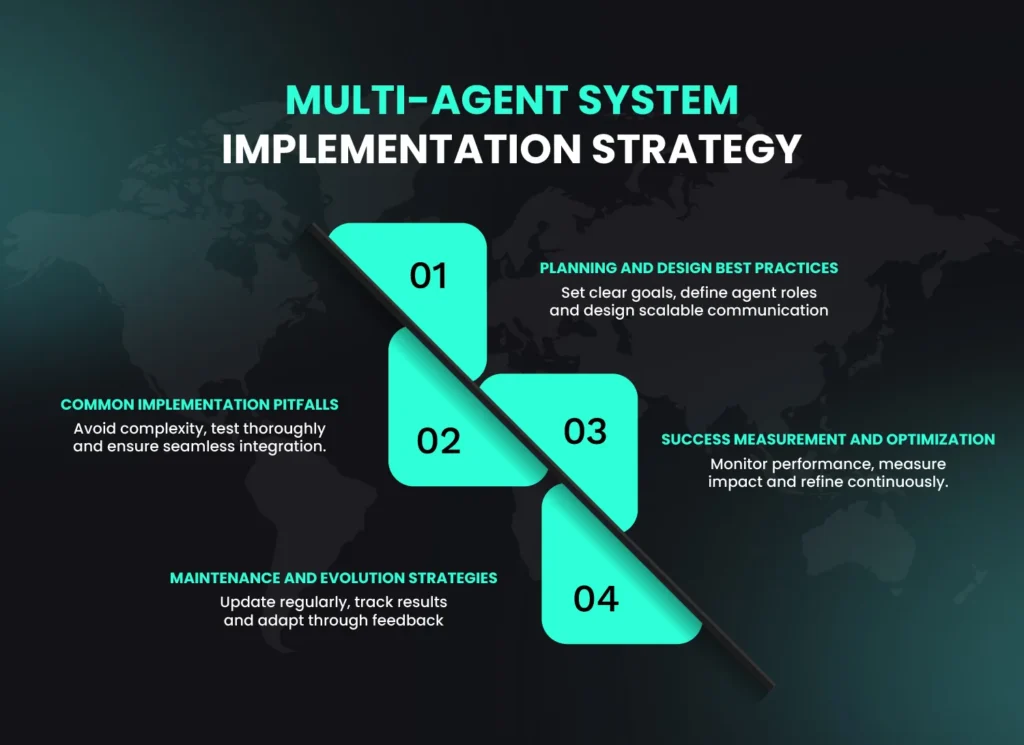
Four-step implementation plan for multi-agent systems including design best practices, testing, performance measurement and evolution strategies.
Planning and Design Best Practices
Effective planning forms the foundation of successful multi-agent implementations, requiring comprehensive analysis of business requirements, technical constraints, and operational objectives before development begins.
Clear Objective Definition: Establish specific, measurable goals for the multi-agent system
Agent Role Specification: Define precise responsibilities and capabilities for each agent type
Communication Architecture: Design efficient protocols for agent interaction and coordination
Scalability Planning: Build systems capable of growth and adaptation over time
Common Implementation Pitfalls
Learning from common mistakes helps organizations avoid costly delays and suboptimal outcomes during multi-agent system deployment and integration processes.
Over-complexity: Creating unnecessarily complicated agent hierarchies and interactions
Insufficient Testing: Inadequate validation of agent interactions under various operational conditions
Poor Integration: Failing to properly connect with existing business systems and workflows
Inadequate Monitoring: Lack of visibility into system performance and behavior patterns
Success Measurement and Optimization
Comprehensive performance monitoring enables continuous improvement and validates the business value of multi-agent system investments through measurable outcomes and operational metrics.
System response times and processing throughput measurements
Agent coordination efficiency and collaboration effectiveness
User satisfaction levels and system adoption metrics
Maintenance and Evolution Strategies
Continuous Learning: Implementing adaptive algorithms for ongoing system improvement
Regular Updates: Keeping agent capabilities current with technological advances
Performance Monitoring: Ongoing assessment of system effectiveness and optimization opportunities
Stakeholder Feedback: Incorporating user input for system refinement and enhancement
Based on industry experience, the most successful multi-agent implementations start small with clearly defined use cases, demonstrate value quickly, and scale gradually while maintaining system stability and user confidence throughout the deployment process.
Market Growth:67% adoption increase among Fortune 500 companies in 2024
Future Developments: Enhanced AI integration and quantum computing applications
Implementation Keys: Careful planning, phased deployment, and continuous optimization strategies
Frequently Asked Questions
What is a multi-agent system in AI?
A multi-agent system in AI consists of multiple autonomous software agents that collaborate, communicate, and coordinate within a shared environment to solve complex problems that exceed individual agent capabilities, enabling distributed artificial intelligence solutions for enhanced performance and scalability.
How do you create a multi-agent system?
Creating a multi-agent system involves defining agent roles, establishing communication protocols, implementing coordination mechanisms, integrating with foundation models or LLMs, and testing system performance under various scenarios before deployment to ensure optimal functionality and reliability.
What are the main applications of multi-agent systems?
Multi-agent systems are applied in smart cities for traffic management, healthcare for patient coordination, supply chain optimization, energy distribution, robotic swarms, financial trading, and personalized advertising across various industries requiring complex coordination and automated decision-making.
What controls a multi-agent system?
Multi-agent systems are controlled through distributed decision-making protocols, coordination mechanisms, learning algorithms, and emergency override systems that ensure agents work together effectively while maintaining individual autonomy within defined parameters for optimal system performance.
How do multi-agent systems differ from single-agent systems?
Multi-agent systems involve multiple autonomous agents collaborating to solve complex problems, offering better scalability, fault tolerance and specialized capabilities compared to single-agent systems that rely on one central processing entity with limited parallel processing capabilities.
What are the challenges in implementing multi-agent systems?
Implementation challenges include unpredictable emergent behavior, coordination complexity, scalability limitations, integration difficulties with existing systems, security concerns, and the need for robust testing and monitoring frameworks to ensure reliable operation.
Stay Updated—Join Our Newsletter!
Newsletter
Don’t miss on the latest updates in the world of AI. We dispatch custom reports and newsletters every week, with forecasts on trends to come. Join our community now!
Conclusion
Multi-agent systems represent a paradigm shift in artificial intelligence, enabling collaborative problem-solving that addresses humanity’s most complex challenges effectively. From optimizing smart city infrastructure to revolutionizing healthcare coordination, these distributed AI networks demonstrate superior performance in scenarios requiring specialized expertise and coordinated responses across multiple domains.
The successful implementation of multi-agent systems requires careful planning, robust architecture design, and ongoing optimization strategies. As organizations worldwide recognize their potential, the technology continues evolving with enhanced foundation models, improved communication protocols, and industry-specific solutions that deliver measurable business value.
Organizations seeking to harness the power of multi-agent systems can benefit from partnering with experienced AI development teams like Kodexo Labs, who specialize in custom software solutions and cutting-edge AI implementations tailored to specific business needs and operational requirements.
As we advance toward 2025 and beyond, multi-agent systems will become increasingly sophisticated, incorporating quantum computing principles and neuromorphic architectures to solve even more complex global challenges while delivering unprecedented opportunities for innovation and operational efficiency across industries.
Multi-agent systems are transforming how we solve complex problems through collaborative AI, offering unprecedented opportunities for innovation across industries with the right implementation strategy and expert guidance for sustainable success.
Syed Ali Hasan Shah, a content writer at Kodexo Labs with knowledge of data science, cloud computing, AI, machine learning, and cyber security. In an effort to increase awareness of AI’s potential, his engrossing and educational content clarifies technical challenges for a variety of audiences, especially business owners.
Hear from our clients and why 50+ businesses
trust Kodexo Labs
Kodexo Labs has delivered a fully functional MVP on time, and testers
reported faster check-ins after the product launch. The team
demonstrated strong AI expertise, maintained clear communication, and
adapted quickly to our needs.
Annalisa Signorelli
Founder & CEO, Pet-X Solutions
AWARDS
Share Your Requirements to help our experts understand your business objectives and create your customized plan.
By providing a telephone number and submitting this form, you agree to receive SMS text messages from Kodexo Labs. Message and Data Rates may apply. Message frequency may vary. You can STOP messaging by sending STOP and get more help by sending HELP. See our privacy policy.
Trusted by Global Brands
Cookies Notice
By continuing to browse this website you consent to our use of cookies in accordance with our cookies policy.
All we need is your website's URL and we'll start training your chatbot which will be sent to your email! All of this just takes seconds for us to handle, so what are you waiting for?