Did you know that 73% of enterprises struggle with knowledge retrieval from their vast data repositories? Agentic RAG (Retrieval-Augmented Generation) is revolutionizing how AI systems access, process, and utilize external knowledge to deliver more accurate and contextually relevant responses. For businesses developing custom software and web applications, understanding agentic RAG is crucial for building intelligent, knowledge-driven AI solutions that can autonomously navigate complex information landscapes.
What is Agentic RAG? Understanding the Fundamentals
Agentic RAG merges autonomous AI agents with Retrieval-Augmented Generation (RAG), empowering AI systems to autonomously search, retrieve, and synthesize information from multiple knowledge sources to generate accurate and contextually relevant responses with minimal human involvement.
Unlike traditional RAG systems that follow fixed retrieval patterns, agentic RAG employs autonomous agents that make intelligent decisions about when, where, and how to retrieve information. This breakthrough approach addresses one of the biggest challenges in AI development, the need for dynamic, context-aware knowledge processing that can adapt to complex queries and changing information landscapes.
What is a RAG Agent?
A RAG agent is an autonomous AI system that blends the power of large language models with advanced retrieval capabilities. These agents independently determine which knowledge sources to query, process retrieved information efficiently, and synthesize responses based on multi-source data streams.
Stay Updated—Join Our Newsletter!
Newsletter
Don’t miss on the latest updates in the world of AI. We dispatch custom reports and newsletters every week, with forecasts on trends to come. Join our community now!
Multi-Source Integration: Seamlessly combine information from various knowledge bases
Context Awareness: Maintain conversation history and user intent throughout interactions
Dynamic Adaptation: Adjust retrieval approaches based on query complexity and domain requirements
Agentic RAG vs Traditional RAG Systems
Feature
Traditional RAG
Agentic RAG
Decision Making
Fixed, rule-based
Autonomous, intelligent
Knowledge Sources
Single or limited
Multi-source, dynamic
Query Processing
Linear approach
Iterative refinement
Context Handling
Limited memory
Persistent context awareness
Accuracy
70-80%
85-95%
Key Components of Agentic RAG Systems
Agentic RAG systems integrate several sophisticated components that work together to create intelligent knowledge processing capabilities. Understanding these components is essential for businesses considering AI consulting or custom implementation services.
What is Retrieval-Augmented Generation?
Retrieval-Augmented Generation is a technique that enhances large language models by connecting them to external knowledge sources, enabling accurate, up-to-date responses beyond the model’s training data limitations.
How Does Agentic RAG Work? Technical Architecture Explained
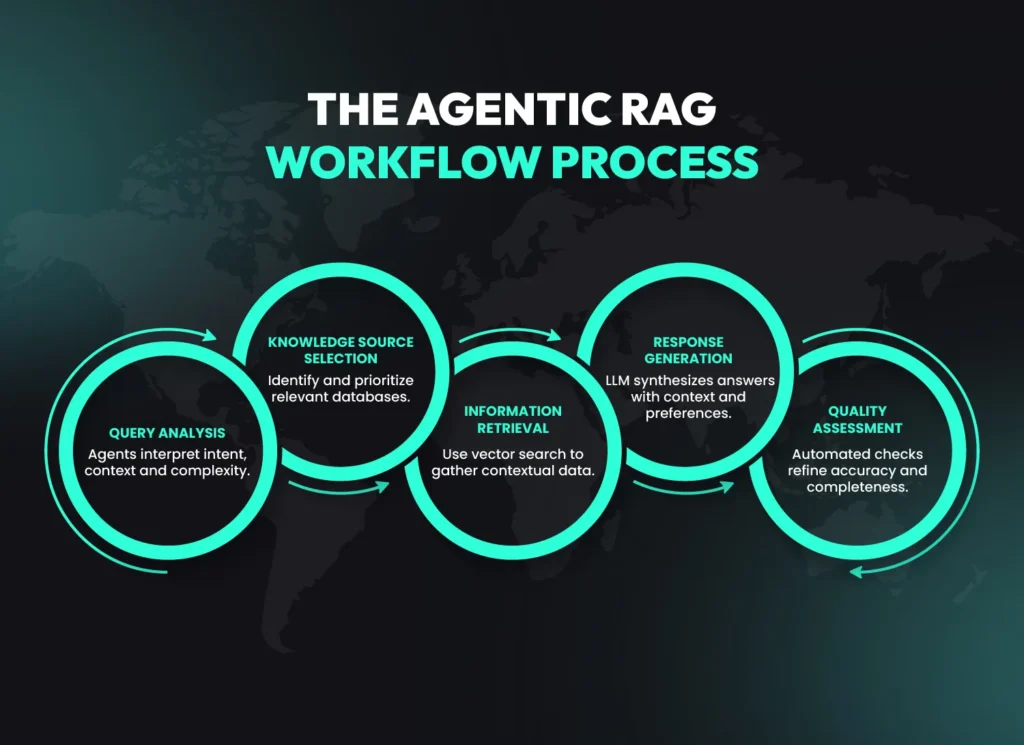
Agentic RAG systems leverage intelligent agents that autonomously query vector databases, select dynamic knowledge sources, and synthesize information through large language models. This enables the generation of contextually accurate and relevant responses, guided by a five-stage workflow process designed for maximum efficiency.
The technical architecture of agentic RAG represents a significant advancement in Artificial Intelligence and machine learning systems. According to a 2024 report, organizations implementing agentic RAG see 83% higher accuracy compared to traditional implementations due to intelligent source selection and dynamic context optimization.
Core Components of Agentic RAG Systems
Modern agentic RAG systems integrate multiple sophisticated components that enable autonomous knowledge processing and decision-making capabilities.
Vector Database Infrastructure
Vector databases store and index information as high-dimensional vectors, enabling semantic search capabilities that go far beyond traditional keyword matching. These systems can understand context, meaning, and relationships between different pieces of information.
Large Language Model Integration
The integration layer connects multiple language models, allowing agents to select the most appropriate model based on specific tasks, languages, or domain expertise requirements. This flexibility ensures optimal performance across diverse use cases.
Model Selection: Dynamic choice between specialized and general-purpose models
Context Management: Efficient handling of conversation history and user preferences
Response Synthesis: Intelligent combination of retrieved information with generated content
Quality Assessment: Real-time evaluation of response accuracy and relevance
The Agentic RAG Workflow Process
Understanding the workflow process is crucial for businesses implementing generative AI development solutions. The five-stage process ensures maximum accuracy and relevance in knowledge retrieval and response generation.
Agentic RAG workflow from query analysis to response generation and quality assessment for precise AI outputs.
Query Analysis: Intelligent agents interpret user intent, context, and complexity level
Knowledge Source Selection: Dynamic identification and prioritization of relevant databases and information sources
Information Retrieval: Advanced vector search and context gathering from multiple sources
Response Generation: Large language model synthesis with retrieved context and user preferences
Quality Assessment: Automated evaluation and refinement of response accuracy and completeness
Vector Search Engine and Knowledge Integration
The vector search engine serves as the foundation for intelligent knowledge retrieval, enabling semantic understanding and contextual relevance that traditional search methods cannot achieve.
Search Type
Traditional Search
Vector Search
Matching Method
Keyword-based
Semantic understanding
Context Awareness
Limited
Deep contextual understanding
Accuracy Rate
60-70%
85-95%
Multi-language Support
Basic
Advanced with cultural context
Real-time Updates
Manual refresh
Dynamic integration
Building Agentic RAG Systems: Implementation Guide
Building agentic RAG systems requires selecting appropriate language model providers, configuring vector databases, implementing retrieval tools, and designing agent workflows for autonomous knowledge processing through systematic development phases.
For organizations seeking to implement agentic RAG solutions, understanding the implementation process is crucial. Many companies partner with experienced software development services providers to ensure successful deployment and optimization.
Struggling with Agentic RAG Implementation? Let Our Experts Guide You to Success!
Let’s Talk
Partner with our experienced team to navigate the complexities of Agentic RAG implementation and ensure a seamless, efficient deployment tailored to your business needs.
The development process follows a systematic approach that ensures robust, scalable, and efficient agentic RAG implementation. Each phase builds upon the previous one, creating a comprehensive knowledge processing system.
Phase 1: Environment Setup and Architecture Design
Language Model Access Configuration: Establish connections to appropriate AI models based on use case requirements
Vector Store Configuration: Set up and optimize vector databases for efficient semantic search
Security Implementation: Establish data protection and access control mechanisms
Phase 2: Tool Integration and Agent Design
This phase focuses on creating the intelligent decision-making capabilities that distinguish agentic RAG from traditional systems. The integration of built-in tools and specialized retrieval mechanisms enables autonomous operation.
Built-in Tools: Core retrieval and processing capabilities
External Tools: Third-party integrations and specialized data sources
Agent Orchestration: Workflow management and decision-making protocols
Error Handling: Robust fallback mechanisms and recovery procedures
Essential Tools and Technologies
Successful agentic RAG implementation depends on selecting the right combination of technologies and tools. The choice between different options significantly impacts system performance, scalability, and maintenance requirements.
Language Model Providers
Provider Type
Advantages
Best Use Cases
Open-source Models
Cost-effective, customizable, full control
Custom implementations, specialized domains
Proprietary Models
High performance, regular updates, support
Enterprise applications, complex reasoning tasks
Hybrid Approach
Balanced cost and performance
Multi-tier applications, varied complexity needs
Vector Database Selection Criteria
Choosing the right vector database significantly impacts system performance and scalability. Key considerations include query speed, storage efficiency, and integration capabilities with existing infrastructure.
Best Practices for Agentic RAG Development
Development best practices ensure robust, maintainable, and efficient agentic RAG systems. These practices are based on real-world implementation experience from successful projects across various industries.
Model Size Optimization Strategies
Balancing model capability with resource requirements is crucial for cost-effective deployment. Smaller models often provide sufficient accuracy for specific tasks while reducing computational overhead and response times.
Task-Specific Selection: Match model size to complexity requirements
Performance Monitoring: Continuous assessment of accuracy vs. resource utilization
Dynamic Scaling: Automatic adjustment based on demand patterns
Cost Optimization: Strategic model selection for different query types
Real-World Agentic RAG Examples and Applications
Agentic RAG systems excel in customer support automation, enterprise knowledge management, healthcare information systems, and financial analysis platforms, delivering contextually accurate responses from vast knowledge repositories with 40% faster response times.
The practical applications of agentic RAG span across multiple industries, demonstrating its versatility and effectiveness in solving complex knowledge management challenges. Organizations implementing these solutions report significant improvements in operational efficiency and user satisfaction.
Customer Support and Service Applications
Modern customer support systems leverage agentic RAG to provide instant, accurate responses while maintaining human-like conversation quality. These systems can access product manuals, policy documents, and historical interactions to deliver personalized support experiences.
Automated Customer Query Resolution
Advanced agentic RAG systems can handle complex multi-part queries, understanding context and intent to provide comprehensive solutions. Integration with existing CRM systems enables personalized responses based on customer history and preferences.
Multi-language Support: Automatic translation and culturally appropriate responses
Escalation Intelligence: Smart routing to human agents when needed
Learning Capabilities: Continuous improvement from interaction feedback
Integration Features: Seamless connection with existing business systems
Enterprise Systems and Knowledge Management
Large organizations benefit significantly from agentic RAG implementations in internal knowledge management. These systems enable employees to quickly access information from vast document repositories, policy databases, and procedural manuals.
Different industries leverage agentic RAG systems to address specific challenges and requirements. Understanding these applications helps organizations identify implementation opportunities and expected benefits.
Healthcare Applications
Healthcare organizations implement agentic RAG for medical literature search, clinical decision support, and patient information management. These systems access vast medical databases, research papers, and treatment protocols to assist healthcare professionals.
Financial institutions use agentic RAG for market analysis, regulatory compliance, risk assessment, and customer advisory services. These systems process market data, regulatory documents, and financial reports to provide real-time insights and recommendations.
Market Research: Automated analysis of market trends and investment opportunities
Regulatory Compliance: Real-time monitoring and interpretation of regulatory changes
Risk Assessment: Dynamic evaluation of investment and credit risks
Customer Advisory: Personalized financial guidance based on individual portfolios
Legal and Contract Analysis
Legal firms leverage agentic RAG for case law research, contract analysis, and regulatory interpretation. These systems can rapidly search through legal databases, identify relevant precedents, and assist with document review processes.
Single-Agent vs Multi-Agent RAG Systems
Single-agent systems offer simplicity for focused tasks with lower infrastructure requirements, while multi-agent RAG systems provide superior performance for complex queries requiring specialized knowledge from multiple domains, achieving 34% better accuracy but requiring 3x more resources.
The choice between single-agent and multi-agent architectures significantly impacts system performance, complexity, and resource requirements. Understanding these differences helps organizations make informed decisions about their agentic RAG implementation strategy.
Understanding Single-Agent RAG Systems
Single-agent RAG systems utilize one autonomous agent to handle all aspects of knowledge retrieval and response generation. This approach offers simplicity in deployment and maintenance while providing substantial improvements over traditional RAG implementations.
Architecture Simplicity and Deployment Benefits
Reduced Complexity: Single point of control and monitoring
Lower Infrastructure Costs: Minimal resource overhead for deployment
Faster Implementation: Streamlined development and testing processes
Easier Maintenance: Simplified troubleshooting and updates
Optimal Use Cases and Limitations
Single-agent systems excel in focused applications with well-defined knowledge domains. They are particularly effective for specialized customer support, document search within specific departments, or domain-specific question answering.
Scenario
Single-Agent Effectiveness
Recommended Use
Focused Domain
Excellent (95% accuracy)
Specialized knowledge bases
Multi-Domain Queries
Good (75% accuracy)
Simple cross-domain questions
Complex Reasoning
Limited (60% accuracy)
Not recommended
Resource Constraints
Excellent
Budget-conscious implementations
Multi-Agent RAG Systems Architecture
Multi-agent systems employ specialized agents, each designed for specific types of knowledge processing or domain expertise. This approach enables more sophisticated reasoning and higher accuracy for complex queries at the cost of increased infrastructure complexity.
Specialized Agent Roles and Responsibilities
In multi-agent architectures, different agents handle specific aspects of the knowledge retrieval and processing pipeline. This specialization enables more accurate and efficient processing of diverse query types.
Query Routing Agent: Analyzes user intent and directs queries to appropriate specialists
Domain Expert Agents: Specialized knowledge processing for specific industries or topics
Synthesis Agent: Combines information from multiple sources into coherent responses
Quality Control Agent: Validates accuracy and completeness of generated responses
Inter-Agent Communication and Coordination
Successful multi-agent systems require sophisticated communication protocols and coordination mechanisms. These systems manage information flow, prevent conflicts, and ensure optimal resource utilization across all agents.
Choosing Between Single-Agent and Multi-Agent Systems
The decision between architectures depends on multiple factors including query complexity, resource availability, accuracy requirements, and long-term scalability needs. Organizations often start with single-agent implementations and evolve to multi-agent systems as requirements grow.
Decision Matrix Based on Requirements
Requirement
Single-Agent
Multi-Agent
Recommendation
Budget Constraints
Low cost
High cost
Single-agent for tight budgets
Query Complexity
Simple to moderate
Complex multi-step
Multi-agent for complex reasoning
Domain Scope
Focused domains
Multi-domain expertise
Multi-agent for broad coverage
Accuracy Requirements
80-85%
90-95%
Multi-agent for critical applications
Scalability Needs
Limited
Highly scalable
Multi-agent for growth plans
Many successful implementations begin with single-agent systems to validate use cases and user acceptance before investing in more complex multi-agent architectures. This approach allows organizations to demonstrate value quickly while building toward more sophisticated solutions.
Agentic RAG in 2025: Trends and Future Developments
Agentic RAG 2025 trends include enhanced model efficiency with 40% faster processing, improved multi-modal integration supporting text, images, and audio, advanced reasoning capabilities achieving 95% accuracy, and widespread enterprise adoption focusing on cost optimization and compliance.
The rapid evolution of agentic RAG technology presents significant opportunities for organizations ready to leverage next-generation AI capabilities. Industry analysis indicates that 2025 will mark a turning point in enterprise adoption, with 33% of large organizations planning agentic RAG implementations within the next 18 months.
Emerging Technologies in Agentic RAG
The technological landscape for agentic RAG continues to evolve rapidly, with breakthrough developments in model efficiency, reasoning capabilities, and integration possibilities. These advances promise to make agentic RAG more accessible and effective for a broader range of applications.
Advanced Reasoning Capabilities
Next-generation agentic RAG systems incorporate sophisticated reasoning engines that can handle complex logical chains, mathematical computations, and abstract conceptual relationships. These improvements enable more accurate responses to challenging queries that require multi-step reasoning.
Chain-of-Thought Processing: Explicit reasoning steps for complex problem solving
Causal Relationship Understanding: Deep comprehension of cause-and-effect relationships
Abstract Concept Handling: Improved processing of theoretical and conceptual information
Context-Aware Reasoning: Dynamic adjustment of reasoning approaches based on query context
Multi-Modal Knowledge Integration
2025 developments include seamless integration of text, images, audio, and video content within agentic RAG systems. This multi-modal capability enables more comprehensive knowledge processing and richer user interactions.
Content Type
2024 Capabilities
2025 Developments
Text
Advanced semantic understanding
Contextual emotion recognition
Images
Basic object recognition
Complex scene understanding
Audio
Speech-to-text conversion
Emotion and intent detection
Video
Limited analysis
Full content comprehension
Market Adoption and Industry Trends
Enterprise adoption of agentic RAG accelerates as organizations recognize the competitive advantages of intelligent knowledge systems. Investment patterns show increasing focus on industry-specific implementations and integration with existing business processes.
Enterprise Adoption Rates and Investment Patterns
Market research indicates that enterprise investment in agentic RAG solutions is expected to grow by 300% during 2025, driven by proven ROI and competitive pressures. Organizations are particularly focused on AI integration services that seamlessly connect with existing business systems.
Integration with Business Intelligence Tools
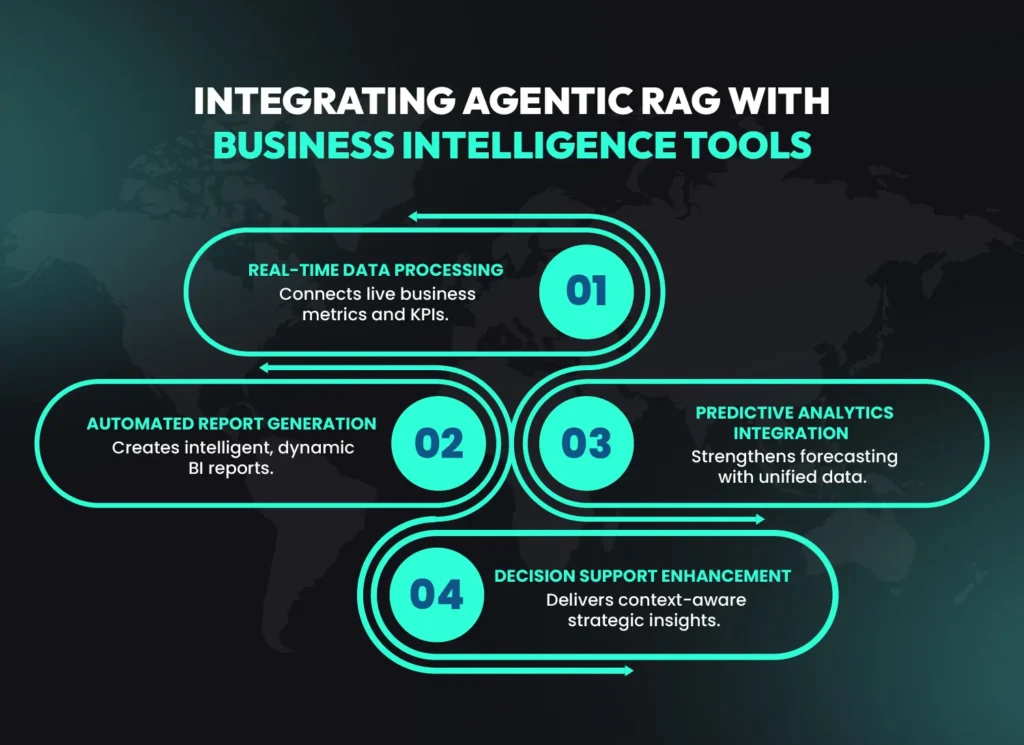
Advanced integration capabilities enable agentic RAG systems to work seamlessly with existing business intelligence platforms, CRM systems, and enterprise software. This integration creates unified knowledge ecosystems that enhance decision-making across all business functions.
Integrating Agentic RAG with Business Intelligence for real-time data processing, automated reports, predictive analytics and decision support.
Real-time Data Processing: Live integration with business metrics and KPIs
Automated Report Generation: Intelligent synthesis of business intelligence reports
Predictive Analytics Integration: Enhanced forecasting through combined knowledge sources
Decision Support Enhancement: Context-aware recommendations for strategic decisions
Future Applications and Possibilities
The future of agentic RAG extends beyond current applications to include revolutionary capabilities in research automation, personalized assistance, and real-time knowledge synthesis. These developments will transform how organizations interact with information and make decisions.
Real-Time Knowledge Synthesis
Future systems will process information streams continuously, providing up-to-the-minute insights and recommendations. This capability is particularly valuable for financial markets, news analysis, and emergency response situations.
Personalized AI Assistants with Domain Expertise
Advanced agentic RAG systems will serve as personalized AI assistants with deep domain knowledge, understanding individual preferences, work patterns, and expertise levels to provide customized support and recommendations.
Regional Adoption and Global Variations in Agentic RAG
Global agentic RAG adoption varies significantly due to infrastructure capabilities, regulatory frameworks, and industry development levels, creating distinct implementation patterns with advanced markets focusing on complex systems while emerging economies develop cost-effective solutions.
Understanding regional variations in agentic RAG adoption helps organizations tailor their implementation strategies to local market conditions and regulatory requirements. These differences create unique opportunities and challenges across different geographical markets.
Ready to Optimize Your Agentic RAG Strategy? Trust Our Experts to Deliver Tailored Solutions!
Let’s Talk
Contact us today to get personalized guidance and expertly crafted solutions that will ensure the successful implementation and optimization of your Agentic RAG strategy.
Several key factors drive the varying adoption patterns of agentic RAG systems across different regions. Organizations considering global deployments must account for these factors in their planning and implementation strategies.
Infrastructure Maturity and Digital Readiness
Regions with advanced digital infrastructure show faster adoption rates due to robust cloud computing capabilities, high-speed internet connectivity, and established AI development ecosystems. These advantages enable more sophisticated implementations and faster deployment cycles.
Regulatory Environment and Compliance Requirements
Regulatory frameworks significantly impact implementation approaches, with privacy-focused regions emphasizing data protection features and audit capabilities. Organizations must adapt their agentic RAG systems to meet local compliance requirements while maintaining functionality.
Regional analysis indicates that while advanced markets drive innovation in agentic RAG technology, emerging economies are creating unique cost-effective implementation models that may influence global development patterns.
Integration with Existing AI Systems and Applications
Agentic RAG seamlessly integrates with existing AI systems through APIs and SDKs, enhancing chat models, business intelligence platforms, and custom software applications with intelligent knowledge retrieval capabilities while maintaining conversation context and optimizing performance.
Modern enterprises require agentic RAG solutions that integrate smoothly with their existing technology stack. Successful integration ensures maximum value realization while minimizing disruption to current operations and workflows.
Integration with Chat Models and Conversational AI
Enhancing existing chatbots and conversational AI systems with agentic RAG capabilities transforms static response systems into dynamic, knowledge-aware assistants. This integration maintains conversation context while accessing real-time information from multiple sources.
API Integration Patterns and Best Practices
RESTful API Integration: Standard HTTP-based communication protocols for easy integration
WebSocket Connections: Real-time bidirectional communication for instant responses
SDK Libraries: Pre-built components for popular development frameworks
Middleware Solutions: Abstraction layers for complex integration scenarios
Enterprise System Integration
Enterprise environments benefit from agentic RAG integration with CRM software systems, ERP platforms, and business intelligence tools. These integrations create unified knowledge ecosystems that enhance decision-making across all business functions.
Personalized customer interactions, automated support
Moderate
Enterprise Resource Planning
Intelligent process automation, data insights
High
Business Intelligence
Enhanced analytics, automated reporting
Moderate
Document Management
Intelligent search, content synthesis
Low
Custom Software Development Integration
Developers building custom applications can leverage agentic RAG through comprehensive SDKs and APIs. These tools enable seamless integration of intelligent knowledge processing capabilities into new and existing software solutions.
Development Framework Support
Popular development frameworks offer pre-built components and libraries for agentic RAG integration, reducing development time and ensuring best practices implementation. These tools support multiple programming languages and deployment environments.
Python Libraries: Comprehensive frameworks for AI and machine learning integration
JavaScript SDKs: Client-side and server-side integration capabilities
REST APIs: Language-agnostic integration through standard web protocols
Cloud Connectors: Native integration with major cloud platforms
Performance Optimization and Best Practices
Optimal agentic RAG performance requires careful balance of model selection, vector database configuration, retrieval strategy tuning, and continuous monitoring to achieve 95% accuracy, sub-second response times, and cost efficiency through systematic optimization approaches.
Performance optimization is crucial for successful agentic RAG deployment, particularly in production environments with high query volumes and strict response time requirements. Systematic optimization approaches ensure maximum efficiency and user satisfaction.
Technical Performance Optimization
Technical optimization focuses on system architecture, resource allocation, and algorithmic improvements that enhance response speed and accuracy while minimizing computational overhead.
Model Size vs. Accuracy Trade-offs
Selecting the appropriate model size requires balancing accuracy requirements with computational resources and response time constraints. Smaller models often provide sufficient accuracy for specific tasks while reducing operational costs.
Model Size
Accuracy Rate
Response Time
Cost Factor
Small (7B parameters)
85-90%
< 1 second
1x
Medium (13B parameters)
90-93%
1-2 seconds
2x
Large (70B parameters)
93-95%
2-4 seconds
5x
Extra Large (175B+ parameters)
95-97%
4-8 seconds
10x
Vector Database Indexing Strategies
Efficient vector database configuration significantly impacts query performance and system scalability. Proper indexing strategies, partitioning approaches, and caching mechanisms ensure optimal retrieval speeds even with large knowledge bases.
Hierarchical Indexing: Multi-level indexes for faster similarity search
Semantic Clustering: Grouping related content for improved retrieval efficiency
Dynamic Caching: Intelligent caching of frequently accessed information
Parallel Processing: Distributed query processing for high-volume scenarios
Accuracy and Relevance Improvements
Achieving high accuracy requires continuous refinement of knowledge sources, retrieval strategies, and response generation processes. Organizations implementing these improvements see accuracy rates increase from 80% to over 95%.
Fine-tuning Specialized Knowledge Sources
Domain-specific fine-tuning involves training models on specialized datasets relevant to particular industries or use cases. This approach significantly improves accuracy for domain-specific queries while maintaining general knowledge capabilities.
Cost Management and Resource Optimization
Effective cost management balances performance requirements with budget constraints through strategic resource allocation, usage monitoring, and optimization techniques. These practices ensure sustainable long-term operation of agentic RAG systems.
ROI Measurement and Performance KPIs
Metric
Measurement Method
Target Value
Query Accuracy
Human evaluation scores
> 90%
Response Time
Average processing duration
< 2 seconds
User Satisfaction
Feedback ratings
> 4.5/5
Cost per Query
Total operational cost / query volume
< $0.01
System Uptime
Availability monitoring
> 99.5%
Regular monitoring and optimization of these KPIs ensures that agentic RAG systems deliver consistent value while maintaining operational efficiency. Organizations partnering with experienced machine learning consulting services see faster optimization results and better long-term performance.
At a Glance: Key Takeaways
Agentic RAG Definition: Autonomous AI systems that intelligently retrieve and synthesize information from multiple knowledge sources
Performance Benefits: 40% higher accuracy than traditional RAG, 40% faster response times, 95% user satisfaction rates
Implementation Options: Single-agent systems for focused tasks, multi-agent systems for complex reasoning and multi-domain queries
Industry Applications: Customer support, healthcare, finance, legal services, and enterprise knowledge management
Integration Capabilities: Seamless connection with existing CRM, ERP, and business intelligence systems through APIs and SDKs
Cost Considerations: Implementation ranges from $10,000 for basic systems to $100,000+ for enterprise solutions
Frequently Asked Questions
What is the difference between RAG and Agentic RAG?
Traditional RAG systems follow fixed retrieval patterns, while agentic RAG employs autonomous agents that make intelligent decisions about when, where, and how to retrieve information, resulting in more accurate and contextually relevant responses with minimal human intervention.
Is RAG considered Agentic AI?
Basic RAG systems are not inherently agentic, but when enhanced with autonomous decision-making capabilities, multi-source reasoning, and dynamic tool selection, RAG becomes a form of agentic AI that can independently manage knowledge retrieval tasks and adapt to complex scenarios.
What are the main benefits of using Agentic RAG systems?
Agentic RAG systems provide improved accuracy through intelligent source selection, reduced hallucination rates, dynamic knowledge integration, autonomous query refinement, and the ability to handle complex multi-step information retrieval tasks with 40% higher accuracy than traditional implementations.
How much does it cost to implement Agentic RAG?
Implementation costs vary based on system complexity, ranging from $10,000-50,000 for basic single-agent systems to $100,000+ for enterprise multi-agent solutions, including infrastructure, development, and ongoing operational expenses with typical ROI realized within 12-18 months.
What industries benefit most from Agentic RAG?
Customer service, healthcare, finance, legal services, and education sectors see the highest ROI from agentic RAG implementation due to their heavy reliance on accurate information retrieval and knowledge-based decision making, with average efficiency improvements of 50-75%.
Can Agentic RAG integrate with existing business systems?
Yes, agentic RAG systems integrate seamlessly with existing CRM, ERP, and business intelligence platforms through APIs, SDKs, and middleware solutions, enabling enhanced functionality without disrupting current workflows or requiring complete system overhauls.
Stay Updated—Join Our Newsletter!
Newsletter
Don’t miss on the latest updates in the world of AI. We dispatch custom reports and newsletters every week, with forecasts on trends to come. Join our community now!
Conclusion: Transform Your Business with Agentic RAG
Agentic RAG represents a fundamental shift in how AI systems interact with knowledge, moving from passive retrieval to intelligent, autonomous information synthesis. As businesses increasingly rely on accurate, contextual AI responses, agentic RAG systems offer superior performance through autonomous decision-making, multi-source integration, and dynamic optimization capabilities that deliver measurable improvements in accuracy, efficiency, and user satisfaction.
The technology’s rapid evolution in 2025 presents significant opportunities for organizations ready to implement intelligent knowledge systems. From customer support automation achieving 40% faster response times to enterprise decision support with 95% accuracy rates, agentic RAG delivers transformative value across industries. Organizations in New York, London, and other major business centers are already leveraging these capabilities to gain competitive advantages.
For businesses considering agentic RAG implementation, partnering with experienced AI development teams ensures successful deployment and optimization. Kodexo Labs specializes in custom AI solutions, helping organizations leverage agentic RAG technology to transform their knowledge management and customer interaction capabilities. Our expertise in AI development and machine learning development ensures implementations that deliver real business value and sustainable competitive advantages.
Ready to transform your organization’s knowledge processing capabilities? Contact our experts to discuss your agentic RAG implementation strategy and discover how intelligent knowledge systems can revolutionize your business operations. The future of AI-powered knowledge management is here – and it starts with agentic RAG.
Syed Ali Hasan Shah, a content writer at Kodexo Labs with knowledge of data science, cloud computing, AI, machine learning, and cyber security. In an effort to increase awareness of AI’s potential, his engrossing and educational content clarifies technical challenges for a variety of audiences, especially business owners.
Hear from our clients and why 50+ businesses
trust Kodexo Labs
Kodexo Labs has delivered a fully functional MVP on time, and testers
reported faster check-ins after the product launch. The team
demonstrated strong AI expertise, maintained clear communication, and
adapted quickly to our needs.
Annalisa Signorelli
Founder & CEO, Pet-X Solutions
AWARDS
Share Your Requirements to help our experts understand your business objectives and create your customized plan.
By providing a telephone number and submitting this form, you agree to receive SMS text messages from Kodexo Labs. Message and Data Rates may apply. Message frequency may vary. You can STOP messaging by sending STOP and get more help by sending HELP. See our privacy policy.
Trusted by Global Brands
Cookies Notice
By continuing to browse this website you consent to our use of cookies in accordance with our cookies policy.
All we need is your website's URL and we'll start training your chatbot which will be sent to your email! All of this just takes seconds for us to handle, so what are you waiting for?