Are you struggling to decide between a web app vs mobile app for your business in 2025? With 35% of businesses undergoing digital transformation and mobile usage continuing to dominate, this decision has never been more critical for startups, mid-sized companies, and enterprises. This comprehensive guide explores the web app vs mobile app landscape, helping you make an informed choice that aligns with your business goals, budget, and target audience.
What is a Web App vs Mobile App – Understanding the Core Difference
Web apps run through browsers and work across platforms, while mobile apps are downloaded and installed on specific devices, offering native functionality and offline capabilities.
The fundamental distinction between web apps and mobile apps lies in their architecture and delivery method. Web applications operate through web browsers, providing universal accessibility across different platforms without requiring installation. Mobile applications, conversely, are platform-specific software that users download from app stores and install directly on their devices.
Web Apps: Browser-Based Solutions
Web apps are applications accessed through web browsers, offering cross-platform compatibility without installation requirements. They leverage web technologies like HTML5, CSS3, and JavaScript to deliver interactive experiences similar to desktop software. Popular examples include Gmail, Google Docs, and Slack’s web version, demonstrating how web app development can create powerful business solutions.
Instant access through URLs without downloads
Automatic updates without user intervention
Cross-platform compatibility across devices
Lower development and maintenance costs
Stay Updated—Join Our Newsletter!
Newsletter
Don’t miss on the latest updates in the world of AI. We dispatch custom reports and newsletters every week, with forecasts on trends to come. Join our community now!
Mobile Apps: Native Device Applications
Mobile apps are platform-specific applications developed for iOS, Android, or other mobile operating systems. They’re distributed through app stores and installed directly on devices, providing access to native device features like cameras, GPS, push notifications, and offline functionality. Companies often choose mobile app development for enhanced user experiences and deeper device integration.
Superior performance through native optimization
Full access to device hardware and features
Offline functionality and data storage
Enhanced security through app store vetting
Progressive Web Apps: The Hybrid Approach
Progressive Web Apps (PWAs) represent the evolution of web applications, combining web accessibility with mobile-like functionality. PWAs offer offline capabilities, push notifications, and can be installed on devices while maintaining web app advantages. PWAs will capture 50% of the mobile market by 2025, making them increasingly relevant for business decisions.
Feature
Web App
Mobile App
PWA
Installation Required
No
Yes
Optional
Offline Functionality
Limited
Full
Yes
Device Features Access
Limited
Full
Selective
Cross-Platform
Yes
No
Yes
Which is Better – App Development or Web Development for Different Business Sizes
The choice depends on business size, budget, target audience, and goals – startups often benefit from web apps for cost-efficiency, while enterprises may need both for comprehensive market coverage.
Business size significantly influences the web app vs mobile app decision, as different organizational scales have varying resources, objectives, and market requirements. Understanding these distinctions helps align technology choices with business capabilities and growth strategies.
For Startups: Cost-Effective Solutions
Startups typically operate with limited budgets and need rapid market validation. Web applications offer significant advantages for early-stage companies, providing faster development cycles and broader accessibility. According to 2024 report, web app development costs 30-70% less than native mobile apps, making them ideal for MVP development and initial market testing.
Lower initial investment requirements
Faster time-to-market for product validation
Easier pivoting and feature iterations
Broader audience reach across devices
Building Web vs Mobile App for Startups
Startups should prioritize web development for initial product launches, allowing rapid user feedback and iterative improvements without app store constraints. Custom software development approaches can help startups create scalable web solutions that grow with their business needs.
For Medium Enterprises: Balanced Approach
Mid-sized companies with annual revenues between $10M-$1B face unique challenges balancing growth ambitions with resource constraints. These organizations benefit from hybrid strategies that leverage both web and mobile technologies strategically. Medium enterprises often choose Progressive Web Apps as a cost-effective solution providing mobile-like experiences with web development efficiency.
Mid-sized companies typically allocate 15-20% of annual revenue to digital transformation initiatives, making strategic technology choices crucial for ROI optimization. Software consulting services can help medium enterprises evaluate the best approach based on their specific market position and growth objectives.
For Large Enterprises: Comprehensive Digital Strategy
Large enterprises with substantial annual revenues require comprehensive digital strategies encompassing both web and mobile platforms. These organizations typically maintain separate teams for different platforms, enabling simultaneous development and optimization across multiple channels. Enterprise-level decisions often involve complex integrations with existing systems, requiring specialized expertise in AI and machine learning implementations.
Omnichannel customer experiences across platforms
Complex system integrations and data synchronization
Advanced security and compliance requirements
Scalability for millions of concurrent users
Business Size
Recommended Approach
Budget Range
Timeline
Startup
Web App First
$15K-$50K
3-6 months
Medium Enterprise
PWA or Hybrid
$50K-$200K
6-9 months
Large Enterprise
Both Platforms
$200K+
9-18 months
Mobile App Development vs Web Applications – Technical Considerations in 2025
Technical decisions involve development frameworks, performance requirements, device feature access, and maintenance complexity – React Native offers cross-platform efficiency while native development provides optimal performance.
The technical landscape for web app vs mobile app development has evolved significantly, with new frameworks and technologies bridging traditional gaps. Understanding these technical considerations helps businesses make informed decisions based on performance requirements, development resources, and long-term maintenance capabilities.
Development Frameworks and Technologies
Modern development frameworks have revolutionized both web and mobile app creation. React Native enables cross-platform mobile development with shared codebases, reducing development time by 30-40% compared to separate native apps. Web technologies like Angular, React, and Vue.js provide robust foundations for complex web applications with mobile-responsive designs.
React Native for Cross-Platform Development
React Native allows developers to write mobile apps using JavaScript while accessing native components and device features. This approach reduces development costs while maintaining near-native performance, making it popular among businesses seeking efficient mobile solutions.
Shared codebase for iOS and Android platforms
Access to native components and APIs
Hot reloading for faster development cycles
Strong community support and extensive libraries
Performance and User Experience Comparison
Performance differences between web apps and mobile apps have narrowed significantly with modern technologies. However, native mobile apps still maintain advantages in processing-intensive tasks and complex animations. Core Web Vitals improvements and 5G adoption have enhanced web app performance, making them viable alternatives for many use cases.
Performance Metric
Web App
Mobile App
PWA
Loading Speed
2-4 seconds
1-2 seconds
1-3 seconds
Animation Smoothness
Good
Excellent
Very Good
Memory Usage
Higher
Optimized
Moderate
Battery Impact
Higher
Lower
Moderate
Maintenance and Updates
Web applications offer significant advantages in maintenance and updates, with changes deployed instantly without user intervention. Mobile apps require app store approval processes that can delay critical updates by days or weeks. This difference impacts businesses needing rapid response capabilities or frequent feature iterations.
Companies working with dedicated development teams often find web app maintenance more straightforward, with centralized deployment and version control simplifying ongoing support and feature additions.
What is a Mobile Web App vs Native App – Technical Deep Dive
Mobile web apps run in browsers with limited device access, while native apps provide full device integration, better performance, and offline capabilities, but require separate development for each platform. Understanding these technical differences helps businesses evaluate trade-offs between development efficiency and functionality requirements.
Industry Applications and Use Cases Across Business Sectors
Different industries favor different approaches – financial services prefer secure native apps, while content businesses often choose web apps for broader accessibility and easier updates.
Industry-specific requirements significantly influence the web app vs mobile app decision. Regulatory compliance, security needs, user behavior patterns, and operational workflows vary dramatically across sectors, making industry context crucial for platform selection.
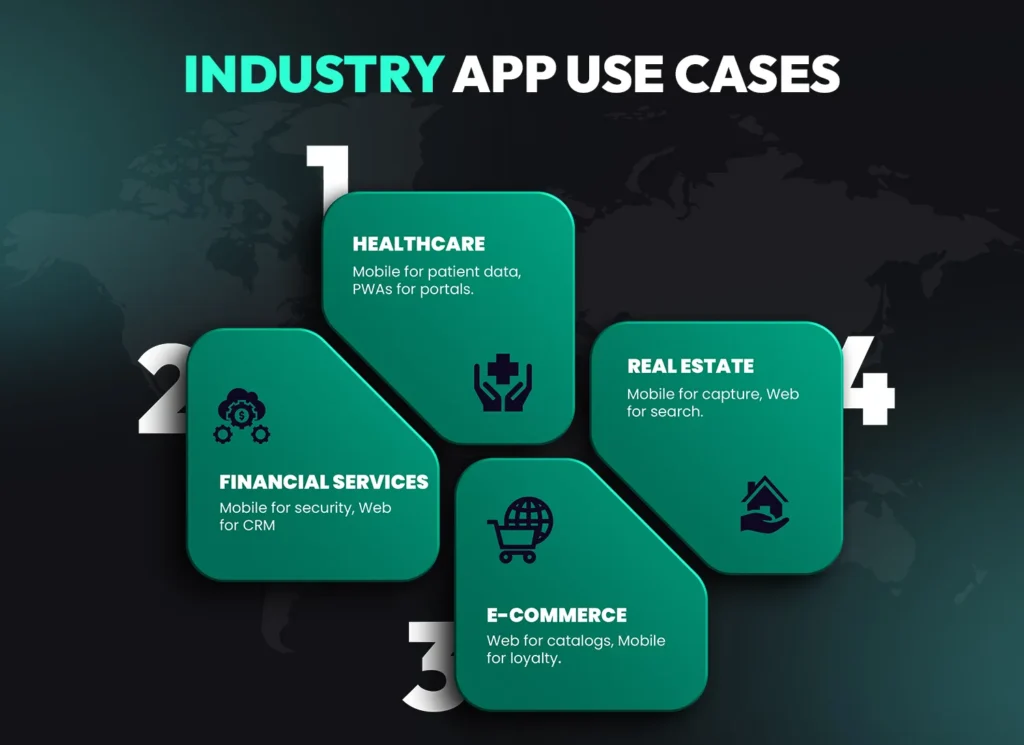
Web App vs Mobile App – Best platform choices by industry: Healthcare, Financial Services, E-commerce and Real Estate.
Healthcare and Medical Applications
Healthcare organizations require robust security, HIPAA compliance, and reliable offline functionality for critical patient data access. Medical facilities often prefer native mobile apps for their enhanced security features and device integration capabilities. Healthcare software development projects frequently involve complex regulatory requirements that influence platform choices.
Progressive Web Apps are gaining traction in healthcare for patient portals and telemedicine platforms, offering secure access across devices while maintaining compliance standards. Our Smart Medical History case study demonstrates how healthcare applications can leverage web technologies for improved patient outcomes.
Financial Services and CRM Solutions
Financial services prioritize security, real-time data processing, and regulatory compliance, typically favoring native mobile apps for consumer-facing applications. However, internal tools and CRM systems often utilize web applications for their flexibility and easier integration with existing systems. Fintech software development requires careful consideration of security protocols and user experience optimization.
AI integration in financial applications enables predictive analytics and automated decision-making. Companies implementing AI integration services often choose web platforms for easier model deployment and updates across multiple touchpoints.
E-commerce and Customer Engagement
E-commerce businesses typically need both web and mobile presence, with web applications handling the primary shopping experience while mobile apps focus on personalized engagement and push notifications. Marketing automation platforms benefit from web application flexibility, enabling rapid campaign deployment and real-time optimization.
Web apps for comprehensive product catalogs and checkout processes
Mobile apps for personalized recommendations and loyalty programs
PWAs for offline browsing and faster load times
AI-powered chatbots for customer service automation
Real Estate and Professional Services
Real estate professionals benefit from mobile apps’ location services and camera integration for property documentation, while web applications excel at comprehensive property searches and document management. Real estate app development often involves hybrid approaches combining mobile convenience with web accessibility.
Professional services firms frequently choose web applications for client portals and project management, with mobile companion apps for on-the-go access. Our Cargentur portfolio example showcases how web applications can streamline complex business processes across industries.
Industry
Preferred Platform
Key Requirements
Success Factors
Healthcare
Native/PWA
Security, Compliance
Patient Safety
Financial
Native
Security, Performance
Trust, Reliability
E-commerce
Both
Speed, Conversion
User Experience
Real Estate
Hybrid
Location, Media
Accessibility
Cost Analysis and ROI Considerations for Different Business Sizes
Web apps typically cost 30-50% less to develop and maintain, while mobile apps can generate higher user engagement and revenue but require larger upfront investment and ongoing maintenance costs.
Cost considerations extend beyond initial development to include ongoing maintenance, updates, marketing, and infrastructure expenses. Understanding the total cost of ownership helps businesses make financially sound decisions that align with their growth strategies and budget constraints.
Web App or Mobile App — What’s Truly More Cost-Effective for You? Get a Free Cost Breakdown
Let’s Talk
Stop guessing your development budget — let us analyze your requirements and show you exactly which platform saves you more in the long run.
Initial development costs vary significantly between web and mobile applications. Web app development typically ranges from $15,000 to $150,000, while native mobile apps cost $25,000 to $300,000 depending on complexity. Cross-platform solutions using React Native or Flutter can reduce mobile development costs by 20-30% while maintaining native-like performance.
Medium enterprises often benefit from software development outsourcing to optimize costs while accessing specialized expertise. This approach allows companies to allocate resources more effectively across multiple digital initiatives.
Small and Medium-Sized Business Considerations
Small and Medium-Sized Businesses must carefully balance feature requirements with budget constraints. Web applications offer attractive cost advantages for initial market entry, with the option to develop mobile apps after establishing market traction and revenue streams.
Ongoing Maintenance and Operations
Annual maintenance costs typically range from 10-20% of initial development investment. Web applications generally require lower maintenance expenses due to centralized deployment and easier bug fixes. Mobile apps require separate updates for iOS and Android platforms, increasing ongoing support complexity and costs.
Web app maintenance: 15-20% of development cost annually
Mobile app maintenance: 20-25% of development cost annually
Infrastructure costs: $50-$500 monthly depending on user volume
Security updates and compliance: $2,000-$10,000 annually
Revenue Generation Potential
Mobile apps typically generate higher user engagement and retention rates, with average retention rates of 25% after 90 days compared to 15% for web applications. However, web apps often achieve broader market reach and faster user acquisition due to lower barriers to entry.
Annual revenue impact varies significantly by industry and business model. E-commerce businesses often see 15-30% higher conversion rates through mobile apps, while service-based companies may achieve better ROI through comprehensive web platforms with mobile-responsive designs.
Cost Factor
Web App
Mobile App
PWA
Initial Development
$15K-$150K
$25K-$300K
$20K-$100K
Annual Maintenance
15-20%
20-25%
15-22%
Marketing/Acquisition
Lower
Higher
Moderate
Revenue Potential
Broader Reach
Higher Engagement
Balanced
AI Integration and Future-Ready Technologies
AI integration is easier in web apps for rapid deployment and updates, while mobile apps provide better AI performance through device-specific optimizations and advanced machine learning capabilities.
Artificial intelligence integration has become a critical factor in platform selection, with businesses leveraging AI for personalization, automation, and enhanced user experiences. The choice between web and mobile platforms significantly impacts AI implementation strategies and capabilities.
Artificial Intelligence Integration
AI integration approaches differ significantly between web and mobile platforms. Web applications excel at server-side AI processing, enabling powerful machine learning models and real-time analytics. Mobile apps leverage device-specific AI chips for enhanced performance in image recognition, natural language processing, and offline AI capabilities.
Companies implementing generative AI development often choose web platforms for easier model deployment and updates. Cloud-based AI services integrate seamlessly with web applications, providing scalable intelligence without device limitations.
Generative AI Implementation Strategies
Generative AI applications like chatbots, content creation tools, and automated analysis benefit from web platform flexibility. Real-time model updates and A/B testing of AI features are more manageable in web environments, enabling rapid iteration and improvement cycles.
Cloud-Based Solutions Architecture
Cloud integration enables scalable AI capabilities across both web and mobile platforms. Web applications naturally align with cloud architectures, providing seamless scaling and resource optimization. Mobile apps can leverage cloud AI services while maintaining local processing for performance-critical tasks.
Scalable processing power for complex AI workloads
Real-time data synchronization across devices
Cost-effective resource allocation based on demand
Enhanced security through centralized data management
Digital Transformation Impact
Digital transformation initiatives increasingly rely on AI-powered applications to automate processes and enhance decision-making. AI development strategies must consider platform capabilities, integration requirements, and long-term scalability needs.
Organizations implementing comprehensive digital transformation often benefit from hybrid approaches, combining web-based AI platforms for administrative functions with mobile AI applications for field operations and customer interactions.
Emerging Technologies Preparation
Future technology integration including IoT connectivity, augmented reality, and blockchain implementations varies by platform. Mobile apps currently lead in AR/VR integration and IoT device connectivity, while web applications excel in blockchain integration and complex data visualization.
Technology
Web App Advantage
Mobile App Advantage
AI/ML Models
Easy deployment, updates
Device optimization, offline
IoT Integration
Data aggregation, analysis
Direct device communication
AR/VR
WebXR capabilities
Native performance, sensors
Blockchain
Full node capabilities
Wallet integration
Performance, Security, and User Experience Comparison
Native mobile apps typically offer superior performance and security through platform optimization, while web apps provide consistent cross-platform experience with easier security updates and maintenance.
Performance, security, and user experience factors significantly influence platform selection, particularly for businesses handling sensitive data or requiring high-performance applications. Understanding these technical considerations helps organizations make informed decisions based on their specific requirements.
Performance Metrics Analysis
Performance differences between web and mobile applications have narrowed with modern technologies, but distinct advantages remain for each platform. Native mobile apps achieve superior performance for graphics-intensive applications and real-time processing, while web apps excel in content delivery and cross-platform consistency.
Core Web Vitals improvements have significantly enhanced web application performance, with modern frameworks achieving loading speeds comparable to mobile apps. 5G adoption further reduces performance gaps, making web applications viable for previously mobile-only use cases.
Loading Speed Optimization
Web applications can achieve sub-2-second loading times through optimization techniques like lazy loading, content delivery networks, and efficient caching strategies. Mobile apps maintain advantages in instant availability after installation, but require initial download and installation time.
Security Considerations
Security architectures differ significantly between platforms, with each offering unique advantages and challenges. Mobile apps benefit from app store security vetting and device-level security features, while web applications enable centralized security management and real-time threat response.
Enterprise security requirements often favor mobile applications for sensitive data handling, while web applications excel in compliance management and audit trails. Companies working with AI consulting services must consider data security implications of different platform architectures.
Mobile app security: App store vetting, device encryption, biometric authentication
Web app security: HTTPS encryption, centralized updates, real-time monitoring
Data protection: Platform-specific compliance requirements and certifications
User authentication: Multi-factor authentication options and integration capabilities
User Experience Factors
User experience design considerations vary significantly between platforms, with mobile apps offering native interface patterns and gestures while web applications provide universal accessibility across devices. Modern responsive design techniques enable web applications to deliver mobile-optimized experiences without platform-specific development.
Accessibility features are generally easier to implement and maintain in web applications, with standardized web technologies supporting screen readers and assistive devices. Mobile applications require platform-specific accessibility implementations but can leverage device-specific accessibility features more effectively.
UX Factor
Web App
Mobile App
Impact on Business
Interface Consistency
Cross-platform uniform
Platform-specific
Brand recognition
Accessibility
Standardized support
Device-specific
Market reach
Offline Usage
Limited capabilities
Full functionality
User retention
Update Experience
Seamless, instant
User-initiated
Feature adoption
Platform Distribution and Market Reach Strategies
Web apps offer instant global access through URLs and search engines, while mobile apps benefit from app store discovery but face approval processes and platform-specific development requirements.
Distribution strategies significantly impact user acquisition costs and market reach potential. Understanding platform-specific distribution advantages helps businesses optimize their go-to-market strategies and maximize user engagement across different channels.
Web App Distribution Advantages
Web applications benefit from immediate global accessibility through URLs, enabling instant user acquisition without installation barriers. Search engine optimization provides organic discovery opportunities, while social media integration enables viral distribution through direct link sharing.
Content marketing strategies integrate naturally with web applications, allowing businesses to demonstrate value through interactive experiences before user commitment. Marketing software development projects often leverage web platforms for their superior SEO capabilities and content integration opportunities.
Instant access through URL sharing across all channels
Search engine indexing for organic discovery
No app store approval delays or restrictions
Universal compatibility across devices and operating systems
Mobile App Store Strategies
App stores provide curated discovery experiences and user trust through review systems and security vetting. However, app store optimization requires ongoing investment and faces increasing competition with millions of available applications.
App store approval processes can delay critical updates and limit marketing flexibility, but provide quality assurance and security validation that builds user confidence. Featured placement opportunities in app stores can significantly boost user acquisition for qualifying applications.
Marketing and User Acquisition
User acquisition costs vary significantly between platforms, with web applications typically achieving lower cost-per-acquisition through organic search and social sharing. Mobile apps require higher initial marketing investment but often deliver superior long-term user retention and engagement metrics.
Digital marketing campaigns can integrate seamlessly with web applications, enabling direct conversion from advertisements to application usage. Mobile app marketing requires additional steps through app store downloads, creating conversion barriers but potentially higher-quality user acquisitions.
Distribution Channel
Web App
Mobile App
Best Use Case
Organic Search
Excellent
Limited
Content-driven businesses
Social Media
Direct linking
Store redirection
Viral marketing campaigns
Paid Advertising
Direct conversion
Two-step process
Performance marketing
Store Discovery
Not applicable
High potential
Category-specific apps
Development Timeline and Resource Planning
Web app development typically takes 3-6 months with smaller teams, while native mobile apps require 6-12 months and larger development teams, though React Native can reduce mobile development time by 30-40%.
Project timeline and resource allocation significantly impact business planning and go-to-market strategies. Understanding development phases, team requirements, and potential delays helps organizations plan realistic launch schedules and budget allocations.
Before You Start — Get a Free Project Timeline Review from Our Experts
Let’s Talk
Make sure your launch plan is realistic — our team will assess your scope, resources and goals to recommend the safest and fastest development path.
Web application development follows more predictable timelines due to unified deployment targets and fewer platform-specific considerations. Mobile app development requires separate optimization for iOS and Android platforms, extending development cycles and testing requirements.
Companies utilizing dedicated development teams often achieve faster delivery through specialized expertise and streamlined communication processes. Cross-platform frameworks like React Native can significantly reduce mobile development timelines while maintaining quality standards.
Quality Assurance Periods
Web applications enable continuous deployment and real-time bug fixes, reducing quality assurance bottlenecks. Mobile applications require comprehensive testing across multiple devices and operating system versions, extending QA timelines but ensuring broader compatibility.
Team Resource Requirements
Web development teams typically require 3-6 developers with full-stack capabilities, while native mobile development may need 4-8 specialists across iOS, Android, backend, and design disciplines. Hiring software developers with cross-platform expertise can optimize team efficiency and reduce coordination complexity.
Web development: Frontend, backend, and DevOps specialists
Mobile development: iOS, Android, backend, and UI/UX designers
Cross-platform: React Native or Flutter specialists with backend support
Quality assurance: Platform-specific testing expertise and automation skills
Technology Stack Decisions
Technology stack selection impacts long-term maintenance, scalability, and team productivity. Modern web frameworks provide comprehensive solutions for complex applications, while mobile development requires careful consideration of platform-specific capabilities and limitations.
Custom product development approaches allow businesses to optimize technology stacks for their specific requirements, balancing development efficiency with performance and scalability needs.
Development Phase
Web App Duration
Mobile App Duration
Key Activities
Planning & Design
2-4 weeks
3-6 weeks
Requirements, wireframes, design
Core Development
8-16 weeks
12-24 weeks
Feature implementation, integration
Testing & QA
2-4 weeks
4-8 weeks
Bug fixes, performance optimization
Deployment
1-2 weeks
2-4 weeks
Store approval, launch preparation
Future Trends and 2025 Predictions
2025 trends favor Progressive Web Apps (PWAs) for their native-like functionality, while 5G technology will enhance both web and mobile app performance, making the choice increasingly dependent on specific business needs rather than technical limitations.
Technology evolution continues reshaping the web app vs mobile app landscape, with emerging trends bridging traditional platform gaps. Understanding future developments helps businesses make forward-looking decisions that remain relevant as technology advances.
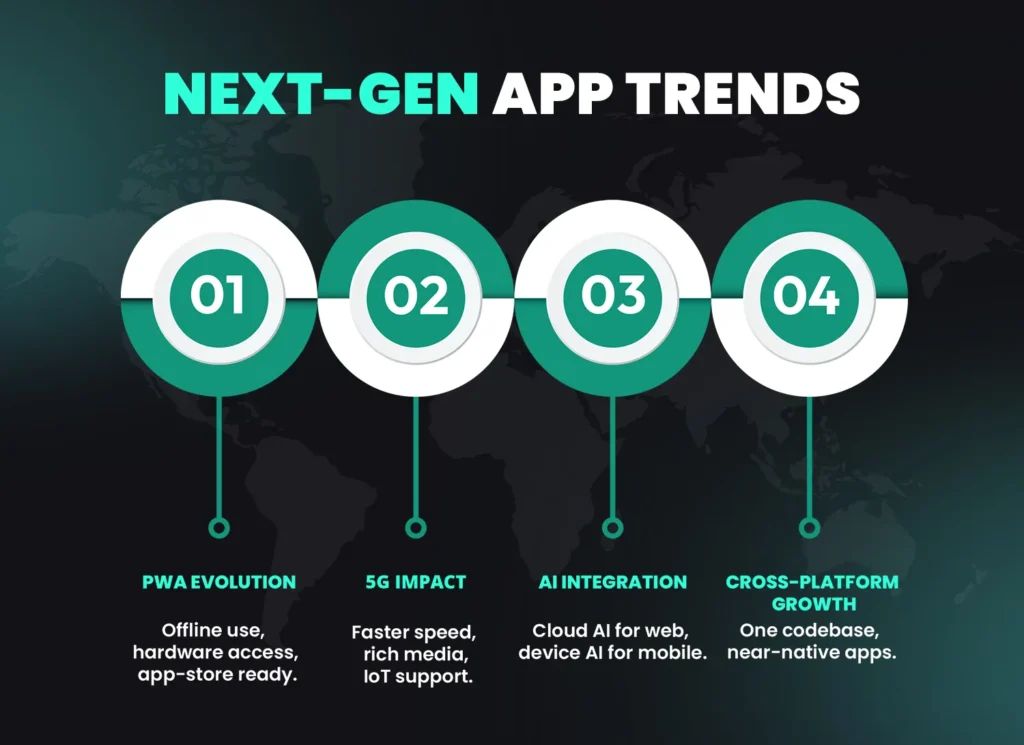
Emerging app development trends: Progressive Web Apps, 5G, AI-powered apps and cross-platform frameworks.
Progressive Web App Evolution
Progressive Web Apps represent the convergence of web and mobile technologies, offering native-like functionality with web development simplicity. PWAs will reach 55% market adoption by 2037, driven by improved capabilities and reduced development costs.
Enhanced PWA features including advanced offline functionality, file system access, and hardware integration are narrowing the gap with native mobile applications. Major platforms increasingly support PWA installation and distribution through app stores, providing hybrid distribution advantages.
5G Impact on Applications
5G technology deployment eliminates many performance advantages previously held by native mobile apps, enabling web applications to deliver real-time experiences with minimal latency. Enhanced bandwidth and reduced latency support sophisticated web-based applications previously requiring native development.
Near-zero latency enabling real-time web applications
Improved reliability for mission-critical web applications
IoT integration opportunities through web-based interfaces
Artificial Intelligence Integration Trends
AI integration continues evolving across both platforms, with web applications benefiting from cloud-based AI services and mobile apps leveraging device-specific AI processors. Edge computing capabilities enable sophisticated AI processing in web browsers, reducing the performance gap between platforms.
Companies implementing AI chatbot development services increasingly choose web platforms for easier deployment and maintenance, while mobile apps focus on specialized AI features requiring device integration.
Cross-Platform Development Future
Cross-platform development frameworks continue maturing, reducing traditional trade-offs between development efficiency and native performance. Flutter, React Native, and emerging frameworks enable single codebase solutions delivering near-native experiences across multiple platforms.
Framework evolution focuses on eliminating platform-specific limitations while maintaining development efficiency. This trend enables businesses to achieve comprehensive platform coverage without proportional increases in development complexity or costs.
2025 Trend
Impact on Web Apps
Impact on Mobile Apps
Business Implications
PWA Evolution
Enhanced capabilities
Increased competition
Reduced platform dependency
5G Adoption
Performance parity
New use cases
Platform choice flexibility
AI Integration
Cloud-based advantages
Edge processing benefits
Specialized requirements
Cross-Platform Tools
Competitive pressure
Development efficiency
Cost optimization
At a Glance: Key Takeaways
Startup Strategy: Web apps offer 30-70% lower costs and faster market validation, ideal for MVP development and initial growth phases
Enterprise Approach: Large companies benefit from omnichannel strategies combining web accessibility with mobile engagement optimization
Technical Evolution: PWAs bridge traditional gaps, offering native-like functionality with web development efficiency and maintenance advantages
Performance Parity: 5G and modern frameworks narrow performance differences, making business requirements more important than technical limitations
AI Integration: Web platforms excel at rapid AI deployment and updates, while mobile apps optimize AI performance through device-specific processing
Industry Specifics: Regulated sectors favor native mobile apps for security, while content-driven businesses benefit from web app accessibility
Future Readiness: Platform choice should consider emerging technologies like edge computing, advanced PWA capabilities, and evolving user expectations
Frequently Asked Questions
What is a web app vs mobile app for business purposes?
Web apps are browser-based applications accessible on any device with internet, while mobile apps are downloaded software specific to mobile platforms. Web apps offer broader accessibility and easier updates, while mobile apps provide better performance and offline functionality for businesses.
Which is better for startups – web development or app development?
Web development is typically better for startups due to lower costs, faster deployment, and broader market reach. Startups can validate their business model through web apps before investing in more expensive mobile app development, optimizing resource allocation effectively while testing market demand.
What is a mobile web app vs native app for enterprises?
Mobile web apps run in browsers with limited device access, while native apps offer full device integration and superior performance. Enterprises often need both: web apps for broad accessibility and administrative functions, native apps for specialized functionality and enhanced user experiences.
How do Progressive Web Apps compare to mobile apps in 2025?
Progressive Web Apps in 2025 offer near-native functionality with easier development and maintenance. They provide offline capabilities, push notifications, and device integration while maintaining web app advantages like instant updates and cross-platform compatibility, making them ideal for many business applications.
What are the cost differences between web and mobile app development?
Web app development typically costs 30-50% less than native mobile apps, with faster deployment times and lower maintenance expenses. However, mobile apps may generate higher user engagement and revenue. The choice depends on budget, timeline, target audience, and specific business objectives.
Which platform is better for AI integration – web or mobile apps?
Both platforms support AI integration effectively. Web apps offer easier AI deployment and updates through cloud-based services, while mobile apps provide better AI performance through device optimization and offline capabilities. The choice depends on AI complexity, real-time requirements, and user experience needs.
Stay Updated—Join Our Newsletter!
Newsletter
Don’t miss on the latest updates in the world of AI. We dispatch custom reports and newsletters every week, with forecasts on trends to come. Join our community now!
Conclusion: Making the Right Choice for Your Business in 2025
The web app vs mobile app decision in 2025 isn’t about choosing a universal winner—it’s about selecting the right solution for your specific business needs, audience, and growth strategy. Startups benefit from web apps’ cost-effectiveness and rapid deployment capabilities, medium enterprises can leverage Progressive Web Apps for balanced functionality, while large enterprises often require comprehensive omnichannel strategies combining both approaches for maximum market coverage.
Key factors driving your decision should include budget constraints, target audience preferences, required functionality, development timeline, and long-term business goals. As AI integration, 5G technology, and Progressive Web Apps continue evolving, the gap between web and mobile app capabilities narrows, making strategic business considerations more important than pure technical limitations.
Whether you’re a startup validating your business model, a medium enterprise expanding digital presence, or a large company optimizing customer engagement, the right choice depends on your unique circumstances and market requirements. Consider partnering with experienced development teams like Kodexo Labs, who specialize in AI-integrated custom software and web app development, to navigate this critical decision with confidence and expertise.
The future belongs to businesses that choose wisely and execute excellently—make your platform decision count in 2025 by focusing on user value, technical excellence, and sustainable growth strategies that adapt to evolving technology landscapes.
Syed Ali Hasan Shah, a content writer at Kodexo Labs with knowledge of data science, cloud computing, AI, machine learning, and cyber security. In an effort to increase awareness of AI’s potential, his engrossing and educational content clarifies technical challenges for a variety of audiences, especially business owners.
Hear from our clients and why 50+ businesses
trust Kodexo Labs
Kodexo Labs has delivered a fully functional MVP on time, and testers
reported faster check-ins after the product launch. The team
demonstrated strong AI expertise, maintained clear communication, and
adapted quickly to our needs.
Annalisa Signorelli
Founder & CEO, Pet-X Solutions
AWARDS
Share Your Requirements to help our experts understand your business objectives and create your customized plan.
By providing a telephone number and submitting this form, you agree to receive SMS text messages from Kodexo Labs. Message and Data Rates may apply. Message frequency may vary. You can STOP messaging by sending STOP and get more help by sending HELP. See our privacy policy.
Trusted by Global Brands
Cookies Notice
By continuing to browse this website you consent to our use of cookies in accordance with our cookies policy.
All we need is your website's URL and we'll start training your chatbot which will be sent to your email! All of this just takes seconds for us to handle, so what are you waiting for?