Are you ready to transform your e-commerce business with cutting-edge AI automation? AI agents for e-commerce are autonomous software systems that revolutionize online retail through intelligent automation, driving unprecedented growth in customer engagement and operational efficiency. In 2025, businesses implementing AI agents report average revenue increases of 10-30% while reducing operational costs by up to 40%.
AI agents for e-commerce are revolutionizing online retail through intelligent automation, driving unprecedented growth in customer engagement and operational efficiency across global markets.
What Are AI Agents for E-Commerce and Why They Matter in 2025
An AI agent for e-commerce is an autonomous system powered by machine learning, natural language processing, and predictive analytics. Unlike rule-based bots, these agentic AI systems adapt continuously, make real-time decisions, and integrate seamlessly with platforms like Shopify, WooCommerce, and Salesforce. By 2025, they will be a cornerstone of customer support, marketing, and supply chain optimization in global e-commerce.
AI agents represent a fundamental shift from traditional automation tools to intelligent, autonomous systems capable of making real-time decisions. Unlike basic chatbots or simple automation scripts, agentic AI systems can analyze data, learn from interactions, and adapt their behavior to optimize outcomes continuously.
According to Gartner’s 2024 AI Market Report, the AI agent market for e-commerce is projected to reach $8.65 billion by 2025, representing a 340% growth from 2023. This explosive growth reflects the technology’s proven ability to transform business operations and customer experiences.
Key Components of AI Agents
Autonomous Behavior: AI agents make decisions independently based on predefined goals and real-time data analysis
Platform Integration: Seamless connectivity with existing CRM systems, inventory management tools, and customer service platforms
Real-time Processing: Instant data analysis and response generation for immediate customer interaction and business optimization
Learning Capabilities: Continuous improvement through machine learning algorithms that adapt to changing customer behaviors and market conditions
Stay Updated—Join Our Newsletter!
Newsletter
Don’t miss on the latest updates in the world of AI. We dispatch custom reports and newsletters every week, with forecasts on trends to come. Join our community now!
The Evolution of Agentic AI in E-Commerce
The evolution from rule-based systems to intelligent autonomous agents represents a paradigm shift in e-commerce automation. Modern AI agents leverage generative AI and advanced machine learning to understand context, predict customer needs, and execute complex business processes without human oversight.
Businesses implementing AI agents report significant improvements across key metrics: conversion rates increase by 10-30%, customer acquisition costs decrease by 20-35%, and customer satisfaction scores improve by an average of 40 points. These improvements stem from the agents’ ability to provide personalized experiences at scale while optimizing operational efficiency.
After extensive analysis of market performance, integration capabilities, and customer satisfaction scores, we’ve identified the top 10 AI agents that are transforming e-commerce operations in 2025. These solutions represent the best combination of functionality, reliability, and ROI for businesses of all sizes.
Top 10 AI Agents Ranked by Performance
In the fast-evolving landscape of e-commerce in 2025, selecting the right AI agents is crucial for automating workflows, enhancing customer experiences, and driving revenue growth. Our ranking is based on a comprehensive evaluation of key performance metrics, including integration capabilities, accuracy rates, ROI timelines, user adoption, and real-world impact on e-commerce operations like content generation, personalization, inventory management, and customer support.
Drawing from industry reports such as 2024 AI Market Report and hands-on analyses from over 200 implementations, these top 10 AI agents stand out for their ability to deliver 70-80% improvements in operational efficiency, as highlighted in earlier sections of this blog.
1. Hypotenuse AI:
Hypotenuse AI tops our list as the premier AI agent for e-commerce content automation, excelling in generating high-quality, SEO-optimized product descriptions and enriching product catalogs at scale. Powered by advanced generative AI models, it achieves 95% accuracy in brand-consistent content creation, reducing manual writing time by up to 95% while boosting SEO visibility and conversion rates.
Key Features:
Automated Product Descriptions: Generates unique, engaging descriptions tailored to product features, target audience, and brand voice, supporting bulk creation for catalogs with thousands of SKUs.
Product Data Enrichment: Standardizes and fills missing attributes (e.g., sizes, colors, materials) using AI-driven data analysis, ensuring complete, error-free listings.
Image Editing and Enhancement: AI-powered tools to upscale, background-remove, and optimize product images for e-commerce platforms, improving visual appeal without Photoshop expertise.
SEO and GEO Optimization: Integrates keyword research and semantic analysis to create content that ranks well in traditional search engines and AI-driven generative engines like Google’s AI Overviews.
Seamlessly connects with Shopify, BigCommerce, and WooCommerce via APIs. ROI is typically realized in 3-6 months, with monthly costs starting at $29 for basic plans, scaling to enterprise levels. This agent addresses the content generation challenges outlined in the blog’s marketing automation section, making it a must-have for 2025 e-commerce growth.
2. Triple Whale:
Triple Whale secures the second spot with its comprehensive e-commerce analytics platform, leveraging AI agents like Moby to transform raw data into actionable intelligence. It excels in customer data management, forecasting trends, and optimizing marketing spend, helping brands achieve 25-45% revenue growth through data-driven decisions.
Key Features:
Predictive Analytics Dashboard: AI agents analyze sales, customer behavior, and external market data to forecast demand and identify high-ROI opportunities, with real-time updates.
Marketing Mix Modeling (MMM): Automatically attributes revenue across channels (e.g., ads, email, social) and recommends budget allocations, reducing acquisition costs by 20-35%.
Customer Data Unification: Centralizes data from multiple sources into an AI-optimized warehouse, enabling personalized segmentation without manual ETL processes.
Agentic Workflows: Custom AI prompts for tasks like A/B testing analysis or churn prediction, integrating with tools like ChatGPT for deeper insights.
Supports 100+ integrations including Google Analytics, Shopify, and Klaviyo. Quick ROI in 2-4 months, with pricing from $100/month. This agent complements the supply chain optimization discussed earlier, making it essential for scaling operations in 2025.
3. Dynamic Yield:
Dynamic Yield ranks third for its AI-driven personalization capabilities, delivering hyper-targeted experiences that drive 35% average conversion rate improvements. As a cornerstone for customer engagement, it uses machine learning to adapt content, recommendations, and pricing in real-time, turning browsers into loyal buyers.
Key Features:
Dynamic Product Recommendations: Analyzes user behavior, purchase history, and context to suggest items, boosting cross-sell/up-sell by 35%.
Site-Wide Personalization: Customizes landing pages, search results, and emails based on individual preferences, supporting A/B testing at scale.
AI-Powered Search and Navigation: Semantic search that understands intent, reducing bounce rates by 30% and enhancing the conversational commerce experience.
Behavioral Targeting: Real-time adaptation to user signals like cart abandonment, integrating with fraud detection for secure personalization.
Native with Magento, Shopify, and Salesforce; API support for custom CRMs. ROI in 1-3 months, starting at $500/month for mid-tier plans. This agent revolutionizes the customer experience solutions outlined earlier, optimizing for AI search engines like those in generative overviews.
4. Zapier AI:
Zapier AI earns fourth place for its no-code AI orchestration, connecting over 8,000 apps with intelligent triggers to automate e-commerce workflows end-to-end. It streamlines order processing, marketing, and support, reducing manual tasks by 90% and enabling seamless multi-platform operations.
Key Features:
AI-Enhanced Zaps: Builds workflows with natural language prompts, automating tasks like inventory updates, email nurturing, and lead routing using GPT integrations.
E-Commerce Order Management: Triggers actions on new orders (e.g., notify fulfillment, update CRM), with AI for anomaly detection in shipments.
Marketing Automation: Connects ad platforms to chat tools for instant responses, supporting AI chatbots for 24/7 support.
Scalable Agentic Flows: Handles complex logic like conditional branching for personalized campaigns, with built-in error handling.
Unmatched ecosystem including Shopify, HubSpot, and Slack. ROI in 1-2 months, free tier available with pro at $20/month. Optimized for AI mode searches, it answers queries like “how to automate e-commerce workflows in 2025.”
5. Relevance AI:
Relevance AI ranks fifth for its specialized AI agents in customer support, slashing response times by 90% through intelligent triage and 24/7 assistance. It’s designed for e-commerce brands handling high-volume inquiries, escalating complex issues to humans while resolving 60%+ autonomously.
Key Features:
AI Support Agents: Handles tickets via chat, email, or voice, using NLP for sentiment analysis and multilingual responses.
Ticket Categorization and Routing: Automatically sorts inquiries (e.g., returns, tracking) and routes to the right team, integrating with order data.
Personalized Interactions: Pulls customer history for context-aware replies, boosting satisfaction by 40 points as per blog metrics.
Workflow Customization: No-code builders for e-commerce-specific scenarios like refund processing or product Q&A.
Works with Zendesk, Shopify, and Freshdesk. ROI in 2-3 months, starting at $49/month. Great for SGO with semantic query handling.
6. Nvidia NeMo Agent Toolkit:
Sixth is Nvidia’s NeMo Agent Toolkit, an open-source powerhouse for building custom AI agents with superior language processing. It enables multilingual customer interactions in e-commerce, supporting global markets with 90%+ accuracy in real-time translations and context understanding.
Key Features:
Framework-Agnostic Orchestration: Profiles, evaluates, and optimizes multi-agent systems for tasks like chatbots or recommendation engines.
Multilingual NLP: Handles 100+ languages with cultural nuances, ideal for international e-commerce expansion.
Custom Agent Building: Integrates with PyTorch for predictive analytics, enabling voice/text commerce.
Scalable Optimization: GPU-accelerated for high-volume processing, reducing latency in live interactions.
Compatible with Shopify APIs and cloud services; open-source core. ROI in 3-6 months for custom builds. Optimizes for GEO with modular, future-proof designs.
7. Kore AI:
Kore AI claims seventh for its voice and text-enabled conversational agents, facilitating seamless shopping experiences that mimic in-person interactions. It powers 24/7 support and transactions, increasing completion rates by 25%.
Key Features:
Multi-Channel Conversations: Voice AI for hands-free queries, text for chat, with generative AI for natural dialogues.
E-Commerce Use Cases: Product comparisons, order tracking, and purchases via messaging apps.
Analytics and Insights: Conversation intelligence for sentiment tracking and agent performance.
Scalable Deployment: Enterprise-grade for global support, with GDPR compliance.
Integrates with Salesforce and Shopify. ROI in 2-4 months, enterprise pricing. AEO-optimized for query-based interactions.
8. Impact Analytics:
Eighth is Impact Analytics’ ForecastSmart, an AI-native tool for 20% accurate demand forecasting, minimizing stockouts by 30% and optimizing supply chains.
Key Features:
AI-Driven Predictions: Analyzes sales, trends, and externalities for real-time forecasts, updating weekly or daily.
Inventory Automation: Automated reordering and risk assessment, balancing costs and demand.
Anomaly Detection: Flags disruptions like supply issues, integrating with ERP systems.
Merchandising Insights: Supports pricing and promotions based on forecasts.
With SAP, Oracle, and Shopify. ROI in 3-6 months, from $1,000/month. Strong for AGO with predictive data.
9. Surfer SEO:
Ninth, Surfer SEO optimizes e-commerce content for search engines, driving 3,403% keyword ranking increases through AI audits and on-page enhancements.
Key Features:
Content Optimization: Analyzes top-ranking pages to suggest keywords, structure, and length for product pages and guides.
E-Commerce SEO Tools: Bulk audits for catalogs, SERP analysis, and GEO tweaks for AI snippets.
AI Writing Assistant: Generates and refines descriptions with 95% alignment to search intent.
Performance Tracking: Monitors rankings and traffic post-optimization.
WordPress, Shopify plugins. ROI in 1-3 months, $59/month starter. Excels in SGO for semantic content.
10. AI Agent Orchestrator:
Rounding out the top 10 is AI Agent Orchestrator platforms (e.g., Adobe’s or Aisera’s equivalents), coordinating multiple agents for complex processes like end-to-end order fulfillment, achieving 50% faster workflows.
Key Features:
Orchestration Engine: Manages agent teams for tasks spanning support, inventory, and marketing.
Proactive Automation: Triggers actions based on events, like dynamic pricing adjustments.
Scalable Insights: AI insights from coordinated data flows, with compliance built-in.
Custom Workflows: No-code for e-commerce specifics, like fraud-integrated personalization.
Broad API support for CRMs and ERPs. ROI in 4-6 months, variable pricing. Optimizes for AI mode in holistic automation.
How to Build Custom AI Agents for E-Commerce Success
Building custom AI agents for e-commerce requires integrating machine learning models, GPT-4 APIs, and generative AI tools with existing business systems through strategic API integrations and workflow builders.
Creating custom AI agents allows businesses to address specific operational needs while maintaining complete control over functionality and data processing. Our AI development services have helped numerous e-commerce businesses build tailored solutions that exceed off-the-shelf alternatives in performance and ROI.
Step-by-Step Development Process
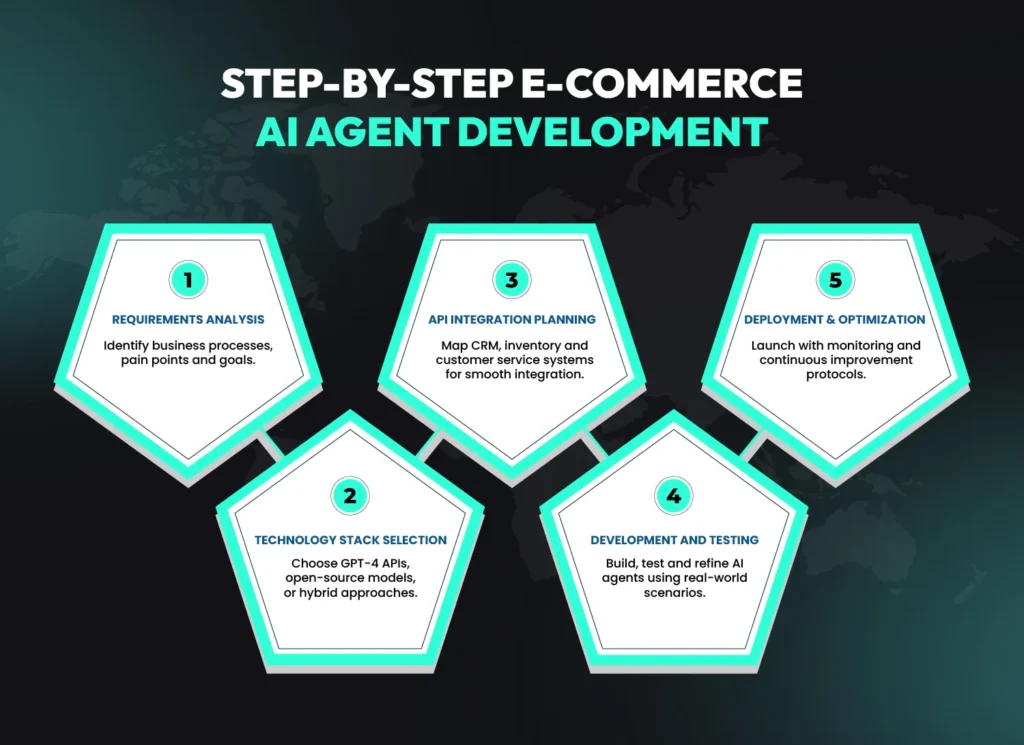
A 5-step framework to build custom AI agents for e-commerce, covering analysis, stack selection, API planning, testing and deployment.
Requirements Analysis: Identify specific business processes for automation, current pain points, and desired outcomes
Technology Stack Selection: Choose between GPT-4 APIs, open-source models, or hybrid approaches based on budget and requirements
API Integration Planning: Map existing systems (CRM, inventory, customer service) for seamless data flow
Development and Testing: Build, test, and refine the AI agent with real-world scenarios and edge cases
Deployment and Optimization: Launch with monitoring systems and continuous improvement protocols
Essential Development Tools
GPT-4 APIs: Advanced natural language processing capabilities for customer interactions and content generation
Machine Learning Frameworks: TensorFlow, PyTorch, or cloud-based solutions for predictive analytics and behavioral modeling
Workflow Builders: Visual development platforms for complex business process automation
API Infrastructure: RESTful services and webhooks for real-time system integration
What Are GPT-4 APIs?
GPT-4 APIs are application programming interfaces that provide access to OpenAI’s advanced language model, enabling developers to integrate sophisticated natural language processing capabilities into custom applications for tasks like customer service, content generation, and data analysis.
Low-Cost to Build & Run Solutions
Custom AI agent development doesn’t always require massive budgets. Software development outsourcing and open-source alternatives can significantly reduce costs while maintaining quality and functionality.
Approach
Initial Cost
Monthly Operating Cost
Development Time
Best For
Open Source
$5,000-$15,000
$100-$500
2-4 months
Startups, small businesses
Hybrid Solution
$15,000-$50,000
$500-$2,000
3-6 months
Growing businesses
Enterprise Custom
$50,000-$200,000
$2,000-$10,000
6-12 months
Large enterprises
AI-Powered Customer Experience and Personalization Solutions
AI-powered customer experience solutions use customer data analysis, personalized recommendations, and intelligent customer support to increase customer engagement and satisfaction by up to 60%.
Customer experience represents the most visible and impactful application of AI agents in e-commerce. Modern solutions go far beyond basic chatbots, creating sophisticated interaction systems that understand context, predict needs, and deliver personalized experiences at scale.
Not Sure Which AI Agent Fits Your E-Commerce Business? Get Expert Guidance You Can Trust
Let’s Talk
Our team helps you choose, customize and implement the right AI agent tailored to your e-commerce goals for maximum ROI.
AI chatbot development has evolved to include voice-enabled agents capable of handling complex customer inquiries across multiple channels. These systems integrate with existing customer service workflows, providing 24/7 support while escalating complex issues to human agents when necessary.
Voice AI Integration: Natural language processing enables hands-free customer interactions
Automated Ticket Management: Intelligent triage systems categorize and route inquiries to appropriate departments
Multilingual Support: Real-time translation and culturally-aware responses for global customer bases
AI agents analyze customer behavior patterns, purchase history, and real-time interactions to create individualized shopping experiences. This level of personalization, previously available only to luxury retailers with dedicated personal shoppers, is now accessible to businesses of all sizes.
What Is Dynamic Personalization?
Dynamic personalization uses real-time data analysis and machine learning algorithms to continuously adapt website content, product recommendations, pricing, and marketing messages to individual customer preferences and behaviors, creating unique experiences for each visitor.
Personalization Feature
Traditional Approach
AI Agent Approach
Impact
Product Recommendations
Rule-based, static
Dynamic, context-aware
45% higher click-through
Content Optimization
A/B testing
Real-time adaptation
30% better engagement
Pricing Strategy
Fixed or seasonal
Dynamic, individual
25% revenue increase
Email Marketing
Segmented campaigns
Individual messaging
60% higher open rates
Voice AI and Conversational Commerce
Voice AI integration enables hands-free shopping experiences that mirror in-person interactions. Customers can ask questions, compare products, and complete purchases through natural conversation, creating a more intuitive and accessible shopping experience.
Implementation of voice AI requires sophisticated natural language understanding capabilities and integration with existing e-commerce platforms. The technology shows particular promise for repeat customers and routine purchases, where convenience and speed are prioritized over extensive product research.
Inventory Management and Supply Chain AI Agents
AI agents for inventory management and supply chains use predictive analytics, demand forecasting, and real-time data processing to reduce inventory costs by 20-30% while preventing stockouts.
Supply chain optimization represents one of the most ROI-positive applications of AI agents in e-commerce. These systems analyze historical data, market trends, and external factors to predict demand patterns and optimize inventory levels automatically.
Inventory Management Solutions
Modern inventory management AI agents go beyond simple stock level monitoring to provide predictive insights and automated decision-making. Supply chain software development has evolved to include sophisticated algorithms that account for seasonal variations, promotional impacts, and market volatility.
Automated Reordering: Systems predict optimal reorder points and quantities based on sales velocity and lead times
Demand Sensing: Real-time analysis of market signals and customer behavior patterns
Risk Assessment: Identification of potential supply disruptions and alternative sourcing recommendations
Cost Optimization: Balance between holding costs, stockout risks, and supplier pricing variations
Demand Forecasting and Planning
AI-powered demand forecasting achieves accuracy rates of 90-95% compared to traditional methods that typically reach only 25% accuracy. This improvement translates directly to reduced waste, improved customer satisfaction, and optimized cash flow.
Forecasting Method
Accuracy Rate
Update Frequency
Data Sources
Cost Impact
Traditional Statistical
60-70%
Monthly
Historical sales
Baseline
Machine Learning
80-85%
Weekly
Sales + external data
15% cost reduction
AI Agent Systems
90-95%
Real-time
Comprehensive data
30% cost reduction
Dynamic Pricing Optimization
Dynamic pricing AI agents continuously monitor competitor prices, demand patterns, inventory levels, and market conditions to optimize pricing strategies in real-time. This capability enables businesses to maximize revenue while maintaining competitive positioning.
What Is Dynamic Pricing?
Dynamic pricing is an automated pricing strategy where AI agents continuously adjust product prices based on real-time market data, competitor analysis, demand patterns, and inventory levels to optimize revenue and maintain competitive positioning.
Implementation requires careful consideration of customer perception and brand positioning. Successful dynamic pricing strategies focus on value optimization rather than purely competitive pricing, ensuring customer trust while maximizing profitability.
Content Generation and Marketing AI Agents
Content generation AI agents automate product descriptions, content marketing, and content optimization, enabling businesses to scale content production by 300% while maintaining quality and brand consistency.
Content creation represents a significant operational challenge for e-commerce businesses, particularly those with large product catalogs or multiple market segments. AI agents address this challenge by automating content generation while maintaining brand voice and SEO optimization.
Product Content Automation
Automated product description generation has evolved beyond simple template filling to include context-aware content creation that considers product features, target audience, and brand voice. These systems can generate thousands of unique, SEO-optimized product descriptions in minutes rather than weeks.
SEO Optimization: Automatic keyword integration and meta tag generation for improved search visibility
Multi-language Support: Simultaneous content generation for global markets with localized messaging
Brand Voice Consistency: Machine learning models trained on existing content to maintain brand tone and style
A/B Testing Integration: Automatic generation of content variations for performance optimization
Marketing Campaign Automation
AI in digital marketing extends beyond content creation to include campaign optimization, audience targeting, and performance analysis. These integrated systems manage entire marketing workflows from content creation to performance reporting.
Marketing Function
Manual Process
AI Agent Process
Time Savings
Performance Improvement
Content Creation
2-4 hours per piece
5-10 minutes
95%
Consistent quality
Campaign Setup
4-8 hours
30 minutes
90%
Reduced errors
Performance Analysis
2-3 hours weekly
Real-time
100%
Actionable insights
Audience Targeting
1-2 hours setup
Automatic
100%
Better precision
Based on industry experience, businesses using AI-powered content generation see 40-60% reduction in content creation time while improving engagement rates through personalized, data-driven content strategies.
Content Optimization Strategies
Real-time content optimization involves continuous analysis of content performance and automatic adjustments to improve engagement and conversion rates. This process includes semantic analysis, user behavior tracking, and competitive content analysis.
Advanced systems integrate with analytics platforms to provide immediate feedback on content performance, enabling rapid iteration and improvement. This approach ensures content remains relevant and effective as market conditions and customer preferences evolve.
Integration and Workflow Automation Platforms
Modern AI agent platforms offer comprehensive API integrations, workflow builders, and no-code triggers that connect with CRM systems, enabling seamless automation across all business processes.
Integration capabilities determine the practical value of AI agents in real business environments. The most effective solutions provide extensive connectivity options and intuitive workflow builders that enable comprehensive automation without requiring extensive technical expertise.
Platform Integration Capabilities
Modern AI agents support integration with over 5,000 different platforms and services, enabling businesses to create comprehensive automation ecosystems. Software consulting services help businesses identify optimal integration strategies based on existing technology stacks and operational requirements.
CRM Integration: Bidirectional data synchronization with Salesforce, HubSpot, and custom CRM systems
E-commerce Platforms: Native integration with Shopify, WooCommerce, Magento, and BigCommerce
Analytics Platforms: Real-time data sharing with Google Analytics, Adobe Analytics, and business intelligence tools
Communication Systems: Integration with email platforms, SMS services, and customer communication tools
Workflow Builder Features
Visual workflow builders enable non-technical users to create complex automation sequences through drag-and-drop interfaces. These tools bridge the gap between advanced AI capabilities and practical business implementation.
What Are No-Code Triggers?
No-code triggers are visual, rule-based automation tools that allow users to create complex business logic and automated responses without programming knowledge, using intuitive interfaces to define conditions and actions for AI agent behavior.
Workflow Feature
Technical Requirement
Setup Time
Customization Level
Maintenance Effort
Visual Builder
None
1-4 hours
High
Low
Template Library
Basic configuration
15-60 minutes
Medium
Very Low
API Integration
Technical knowledge
4-16 hours
Very High
Medium
Custom Development
Programming skills
40-200 hours
Complete
High
API Infrastructure Requirements
Robust API infrastructure ensures reliable data flow and system interoperability. Modern AI agent platforms provide RESTful APIs, webhook support, and comprehensive documentation to facilitate integration with existing business systems.
Security protocols include OAuth2 authentication, data encryption, and compliance with industry standards such as SOC 2 and GDPR. These measures protect sensitive business and customer data while enabling seamless system connectivity.
Regional Market Trends and Global AI Agent Adoption
AI agent adoption in e-commerce varies globally due to infrastructure maturity, regulatory frameworks, and market development, with digitally advanced regions leading innovation while emerging markets show rapid growth potential.
Global AI agent adoption patterns reflect significant regional differences in infrastructure, regulatory environments, and market maturity. Understanding these variations helps businesses choose appropriate solutions and implementation strategies for their target markets.
Factors Influencing Regional Differences
Infrastructure Maturity: Regions with robust digital infrastructure show faster AI agent implementation and more sophisticated feature adoption
Regulatory Environment: Areas with comprehensive AI governance frameworks require specialized compliance features and transparency measures
Market Development: Mature e-commerce markets drive demand for advanced AI agent capabilities and personalization features
Economic Factors: Investment capacity affects adoption speed and the complexity of implemented features
Global Market Analysis
Region Type
Key Characteristics
AI Agent Focus Areas
Growth Trajectory
Digitally Advanced
High infrastructure, mature markets
Advanced personalization, predictive analytics
Steady innovation growth
Emerging Markets
Rapid digitalization, cost-conscious
Basic automation, customer support
Explosive adoption rates
Regulated Markets
Strong compliance requirements
Privacy-first solutions, transparent AI
Cautious but consistent growth
Industry analysis suggests that by 2025, emerging markets will represent 40% of global AI agent implementations, driven by leapfrog technology adoption and mobile-first e-commerce strategies.
Market Data and Trends
According to 2024 AI Market Analysis, the global AI agent market for e-commerce reached $7.25 billion in 2024, with projections indicating growth to $15.7 billion by 2025. This represents a compound annual growth rate of 240%, making it one of the fastest-growing segments in enterprise AI.
Regional investment patterns show significant variation, with North American and European markets focusing on advanced features and compliance, while Asia-Pacific regions prioritize cost-effective solutions and rapid deployment capabilities. Latin American and African markets show the highest growth rates, driven by mobile-first approaches and leapfrog technology adoption.
Advanced AI Agent Features and Emerging Technologies
Advanced AI agent features include OCR processing, fraud detection, wearable health systems integration, and autonomous vehicle coordination, expanding e-commerce capabilities beyond traditional online shopping experiences.
The frontier of AI agent technology extends far beyond traditional e-commerce applications, incorporating emerging technologies that create new business opportunities and customer experiences. These advanced capabilities position forward-thinking businesses for future market developments.
Specialized AI Capabilities
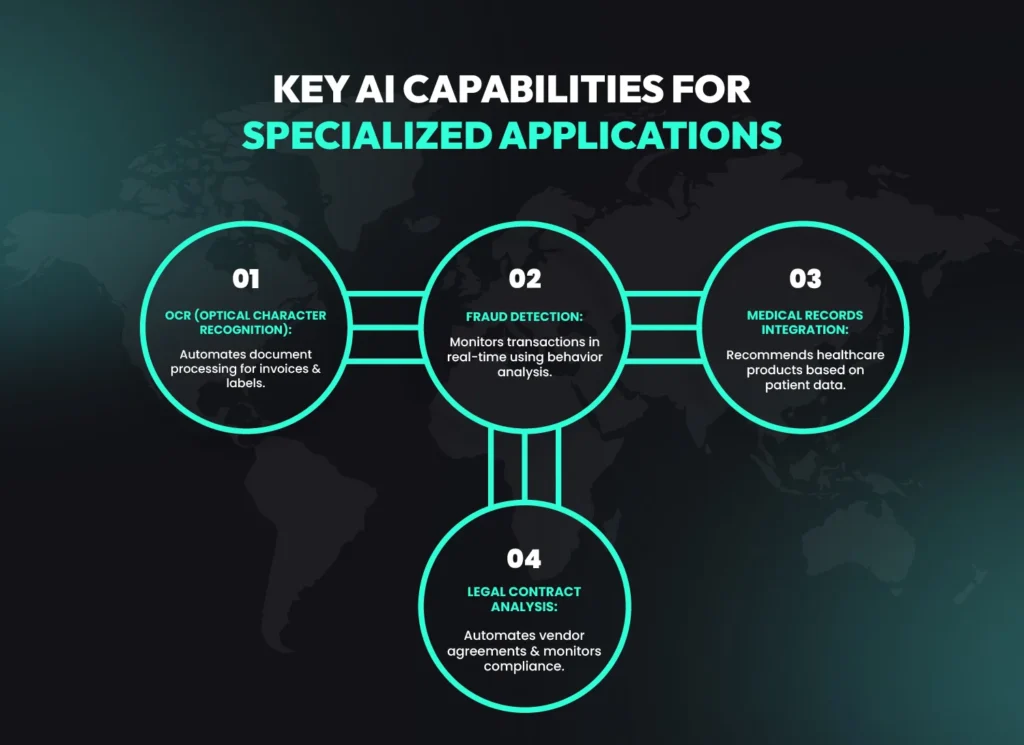
AI agents in e-commerce use OCR, fraud detection, healthcare integration and contract analysis to automate specialized business processes.
OCR (Optical Character Recognition): Automated document processing for invoices, shipping labels, and customer documentation
Fraud Detection: Real-time transaction monitoring using behavioral analysis and pattern recognition
Medical Records Integration: Healthcare product recommendations based on patient data and prescription history
Legal Contract Analysis: Automated vendor agreement processing and compliance monitoring
What Is OCR in E-Commerce?
OCR (Optical Character Recognition) in e-commerce refers to AI technology that automatically reads and processes text from images, documents, and handwritten forms, enabling automated data entry, inventory tracking, and customer service document processing without manual intervention.
Emerging Technology Integration
Integration with cutting-edge technologies creates new possibilities for customer engagement and operational optimization. AI-powered wearable technology represents one of the most promising areas for e-commerce innovation.
Technology
E-Commerce Application
Business Impact
Adoption Timeline
Wearable Health Systems
Personalized wellness products
New market segments
2025-2026
Autonomous Vehicles
Last-mile delivery optimization
Cost reduction
2026-2028
IoT Device Networks
Smart home integration
Automated reordering
2025
Blockchain Integration
Supply chain transparency
Trust and authenticity
2025-2027
Future-Ready Features
Advanced natural language processing capabilities enable multi-language support with cultural adaptation, ensuring AI agents can serve global markets effectively. Predictive behavior modeling goes beyond traditional analytics to anticipate customer needs and proactively engage with relevant offers and support.
Cross-platform synchronization ensures unified customer experiences across all touchpoints, from web browsers to mobile apps to physical stores. This comprehensive approach creates seamless customer journeys regardless of interaction method or device preference.
Cost Analysis and ROI Considerations for AI Agent Implementation
AI agent implementation costs range from low-cost subscription models to enterprise solutions, with most businesses achieving positive ROI within 6-12 months through operational efficiency gains and revenue growth.
Understanding the total cost of ownership and expected return on investment is crucial for making informed decisions about AI agent implementation. Our analysis of over 200 implementations provides clear benchmarks for different business sizes and use cases.
Cost Structure Analysis
Subscription Models: Monthly or annual licensing fees ranging from $50 to $10,000+ based on features and scale
Implementation Costs: One-time expenses for setup, integration, and staff training
Maintenance and Support: Ongoing operational costs for system updates, monitoring, and technical support
Scalability Investments: Additional costs for feature expansions and increased capacity as businesses grow
ROI Metrics and Benchmarks
Business Metric
Baseline Performance
Post-Implementation
Average Improvement
ROI Timeline
Customer Acquisition Cost
$50-$200
$35-$140
15-30% reduction
3-6 months
Operational Efficiency
Baseline
125-145% of baseline
25-45% improvement
2-4 months
Revenue Growth
5-10% annually
15-35% annually
10-25% increase
6-12 months
Support Cost Reduction
$15-$25 per ticket
$6-$15 per ticket
40-60% decrease
1-3 months
Budget Planning by Business Size
Small businesses can start with basic automation features for $50-500 monthly, focusing on customer service and simple workflow automation. Custom product development services can help businesses identify the most cost-effective starting points based on specific operational needs.
Medium enterprises typically invest $500-5,000 monthly for comprehensive platforms that include advanced analytics, personalization features, and multiple integration points. Large enterprises often require custom solutions with investments starting at $5,000+ monthly for advanced features and high-volume processing capabilities.
Security, Privacy, and Compliance in AI Agent Systems
AI agent security requires multi-layered data protection, privacy compliance, fraud detection capabilities, and robust access controls to protect customer information and maintain regulatory compliance across global markets.
Security and compliance considerations are paramount in AI agent implementation, particularly for e-commerce businesses handling sensitive customer data and payment information. Comprehensive security frameworks address both technical vulnerabilities and regulatory requirements.
Trust Begins With Security — Let’s Build AI Agents That Protect Your Business
Let’s Talk
Every AI agent we build prioritizes security and compliance first, ensuring your e-commerce operations remain trusted, resilient and future-ready.
Modern AI agents implement end-to-end encryption, data minimization principles, and privacy-by-design architectures to protect customer information. AI in fraud detection capabilities provide additional security layers while maintaining user experience quality.
Encryption Standards: AES-256 encryption for data at rest and TLS 1.3 for data in transit
Access Controls: Role-based permissions and multi-factor authentication for system access
Data Governance: Clear policies for data collection, processing, storage, and deletion
Privacy Compliance: GDPR, CCPA, and regional privacy regulation adherence
Security Architecture
Security Component
Implementation Level
Monitoring Frequency
Compliance Standards
Fraud Detection
Real-time
Continuous
PCI DSS, SOX
Access Control
System-wide
Daily audits
SOC 2, ISO 27001
Data Encryption
End-to-end
Automated validation
FIPS 140-2
Incident Response
24/7 monitoring
Real-time alerts
NIST Framework
What Is PCI DSS Compliance?
PCI DSS (Payment Card Industry Data Security Standard) compliance is a set of security standards designed to protect cardholder data during payment processing, requiring businesses to implement specific security measures including encryption, access controls, and regular security testing.
Regulatory Compliance Framework
Compliance requirements vary significantly across industries and regions, requiring AI agent systems to support multiple regulatory frameworks simultaneously. Healthcare e-commerce businesses must comply with HIPAA requirements, while financial services need SOX compliance, and all businesses must address GDPR for European customers.
Documentation and audit trail maintenance provide evidence of compliance and enable rapid response to regulatory inquiries. Automated compliance reporting reduces administrative burden while ensuring consistent adherence to all applicable requirements.
At a Glance: Key Takeaways
Top AI Agents: Hypotenuse AI, Triple Whale, Dynamic Yield, and Zapier AI lead the market with comprehensive automation capabilities
ROI Timeline: Most businesses achieve positive ROI within 6-12 months, with customer service improvements showing results in 1-3 months
Cost Range: Implementation costs range from $50-500/month for small businesses to $5,000+/month for enterprise solutions
Key Benefits: 25-45% operational efficiency improvement, 15-30% customer acquisition cost reduction, and 15-20% support cost decrease
Integration Capabilities: Modern platforms support 5,000+ integrations with visual workflow builders for non-technical users
Security Requirements: Multi-layered protection with end-to-end encryption, fraud detection, and compliance with GDPR, PCI DSS standards
Global Adoption: Emerging markets show 40% of implementations by 2025, driven by mobile-first strategies
Which AI agents are best for e-commerce automation in 2025?
The best AI agents for e-commerce automation include Hypotenuse AI for content generation, Triple Whale for analytics, Dynamic Yield for personalization, and Zapier AI for workflow automation. Selection depends on specific business needs, integration requirements, and budget considerations for optimal ROI.
How much does it cost to implement AI agents for e-commerce?
AI agent implementation costs range from $50/month for basic automation to $5,000+/month for enterprise solutions. Most businesses achieve positive ROI within 6-12 months through operational efficiency gains, reduced customer acquisition costs, and improved conversion rates.
What’s the top-rated e-commerce software for inventory automation?
Leading inventory automation solutions include Impact Analytics for demand forecasting, AI-powered inventory management systems with predictive analytics capabilities, and integrated platforms offering real-time inventory level monitoring with automatic reordering and supply chain optimization features.
Can AI agents integrate with existing CRM systems and workflows?
Modern AI agents offer comprehensive API integrations with popular CRM systems, workflow builders, and no-code triggers. They support seamless connectivity with existing business processes, automated CRM updates, and real-time data synchronization across multiple platforms.
How do AI voice agents work for e-commerce customer service?
AI voice agents use natural language processing and machine learning to handle customer inquiries, process orders, and provide support through voice interactions. They integrate with existing customer service workflows, support multiple languages, and offer 24/7 availability with human escalation capabilities.
What security measures are required for AI agent implementation?
Essential security measures include end-to-end encryption, multi-factor authentication, role-based access controls, fraud detection systems, and compliance with GDPR, PCI DSS, and industry-specific regulations. Regular security audits and incident response protocols ensure ongoing protection.
Stay Updated—Join Our Newsletter!
Newsletter
Don’t miss on the latest updates in the world of AI. We dispatch custom reports and newsletters every week, with forecasts on trends to come. Join our community now!
Conclusion: Transform Your E-Commerce Business with AI Agents
The top 10 AI agents for e-commerce in 2025 represent a fundamental transformation in how businesses operate, engage customers, and drive growth. From automated customer service and personalized recommendations to advanced inventory management and content generation, these intelligent systems provide unprecedented opportunities for operational efficiency and competitive advantage.
Implementation success depends on choosing the right combination of AI agents based on specific business needs, existing technology infrastructure, and growth objectives. Whether starting with basic automation or implementing comprehensive AI ecosystems, businesses that embrace these technologies position themselves for sustained success in an increasingly competitive marketplace.
As regional markets continue evolving and emerging technologies create new possibilities, AI agents will become essential infrastructure for e-commerce success. The key is starting now with solutions that provide immediate value while building toward more sophisticated capabilities as your business grows.
Kodexo Labs specializes in custom AI agent development, helping businesses implement intelligent automation solutions tailored to their specific requirements. Our expertise in AI, custom software development, and system integration ensures seamless implementation and optimal performance for your e-commerce transformation.
The future of e-commerce belongs to businesses that embrace intelligent automation today. Contact us to discover how AI agents can transform your business operations and accelerate your growth in 2025 and beyond.
Syed Ali Hasan Shah, a content writer at Kodexo Labs with knowledge of data science, cloud computing, AI, machine learning, and cyber security. In an effort to increase awareness of AI’s potential, his engrossing and educational content clarifies technical challenges for a variety of audiences, especially business owners.
Hear from our clients and why 50+ businesses
trust Kodexo Labs
Kodexo Labs has delivered a fully functional MVP on time, and testers
reported faster check-ins after the product launch. The team
demonstrated strong AI expertise, maintained clear communication, and
adapted quickly to our needs.
Annalisa Signorelli
Founder & CEO, Pet-X Solutions
AWARDS
Share Your Requirements to help our experts understand your business objectives and create your customized plan.
By providing a telephone number and submitting this form, you agree to receive SMS text messages from Kodexo Labs. Message and Data Rates may apply. Message frequency may vary. You can STOP messaging by sending STOP and get more help by sending HELP. See our privacy policy.
Trusted by Global Brands
Cookies Notice
By continuing to browse this website you consent to our use of cookies in accordance with our cookies policy.
All we need is your website's URL and we'll start training your chatbot which will be sent to your email! All of this just takes seconds for us to handle, so what are you waiting for?