Are you ready to transform your e-commerce business with AI automation that could increase conversion rates by up to 30% and reduce operational costs by 25%? E-commerce businesses implementing AI automation solutions in 2025 are experiencing unprecedented growth, with early adopters seeing 3x faster revenue increases compared to traditional operations. Building comprehensive AI automation requires strategic planning, the right technology stack, and understanding of emerging capabilities that revolutionize customer experience.
This complete guide provides actionable insights for business owners, developers, and decision-makers looking to implement cutting-edge AI automation solutions. From foundational concepts to advanced implementation strategies, we’ll explore every aspect of building scalable e-commerce automation systems.
What Is E-Commerce AI Automation and Why It Matters in 2025
E-commerce AI automation combines artificial intelligence, machine learning, and automated processes to streamline online business operations, enhance customer experience, and optimize decision-making without human intervention. This revolutionary approach transforms how businesses handle everything from customer service to inventory management.
Defining AI Automation for E-Commerce
AI automation in e-commerce integrates machine learning algorithms with business processes to create intelligent systems that adapt and improve over time. These systems handle repetitive tasks, personalize customer interactions, and make data-driven decisions automatically.
Key components include natural language processing for customer communication, computer vision for product recognition, and predictive analytics for inventory optimization. According to 2024 report, businesses implementing comprehensive AI automation see average cost reductions of 37% within the first year.
What Is Machine Learning in E-Commerce?
Machine learning enables e-commerce systems to learn from customer behavior patterns, automatically improving recommendations, pricing strategies, and inventory decisions without manual programming updates.
Stay Updated—Join Our Newsletter!
Newsletter
Don’t miss on the latest updates in the world of AI. We dispatch custom reports and newsletters every week, with forecasts on trends to come. Join our community now!
The Evolution of E-Commerce Automation in 2025
Advanced AI Capabilities: Integration of Large Language Models and Generative AI for content creation
Real-time Decision Making: Predictive analytics driving instant business decisions
Seamless Integration: API-based automation connecting multiple business systems
Enhanced Customer Intelligence: Deep learning algorithms understanding behavior patterns
Key Benefits of AI Automation
Benefit Category
Impact
Average Improvement
Operational Costs
Automated processes reduce manual labor
25-40% reduction
Customer Satisfaction
Personalized experiences and instant support
35% increase in scores
Conversion Rates
Intelligent recommendations and timing
30% improvement
Support Availability
24/7 automated customer service
100% availability
How to Automate Your E-Commerce Business: Technical Implementation Strategy
Automating e-commerce businesses requires selecting appropriate automation tools, implementing API integrations, choosing between low-code and no-code platforms, and establishing scalable workflows that connect all business systems. The key is starting with a comprehensive assessment and following a structured implementation approach.
Choosing the Right Automation Platform
Platform selection depends on business size, technical requirements, and integration needs. Professional software consulting can help evaluate options and recommend the best approach for your specific situation.
No-Code vs Low-Code vs Custom Solutions
No-Code Platforms: Ideal for small businesses, offering drag-and-drop interfaces with limited customization
Low-Code Platforms: Perfect for medium enterprises, providing visual development with coding flexibility
Essential API Integrations for E-Commerce Automation
Successful automation relies on seamless data flow between systems. Modern e-commerce platforms require integration with payment processors, inventory management systems, CRM platforms, and marketing tools.
Payment Processing APIs: Automated transaction handling and fraud detection systems
Inventory Management APIs: Real-time stock updates and demand forecasting
Customer Service APIs: Integrated chatbot and support ticket systems
Marketing APIs: Email automation and social media integration
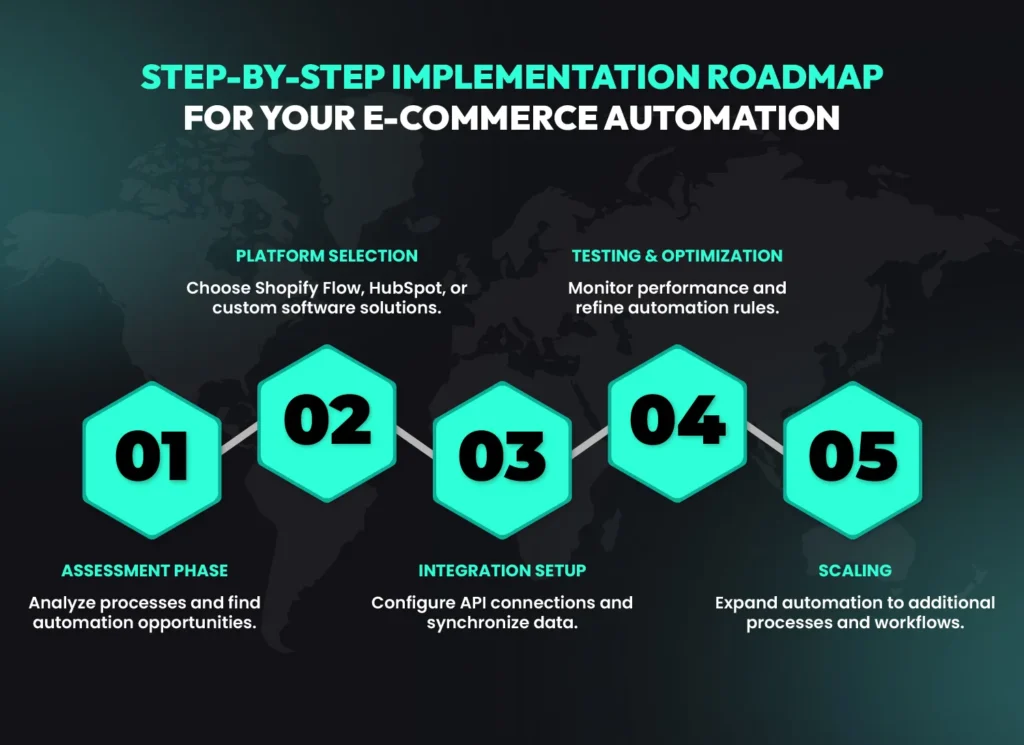
Implementation Roadmap
A five-step roadmap for implementing AI-driven e-commerce automation, from assessment and platform selection to integration, testing and scaling.
Assessment Phase: Analyze current processes and identify automation opportunities
Platform Selection: Choose between Shopify Flow, HubSpot, or custom software solutions
Integration Setup: Configure API connections and data synchronization
Testing & Optimization: Monitor performance and refine automation rules
Scaling: Expand automation to additional business processes
Essential AI Technologies for E-Commerce Automation
Modern e-commerce automation relies on Natural Language Processing for customer communication, Computer vision for product recognition, AI Chatbots for support, and Large Language Models for content generation and personalized interactions. Understanding these technologies helps businesses choose the right solutions for their needs.
Natural Language Processing (NLP) Applications
Natural Language Processing transforms how e-commerce businesses communicate with customers, analyze feedback, and create content automatically.
Customer Service:AI Chatbots handling complex customer inquiries with human-like responses
Content Creation: Automated product descriptions and marketing copy generation
Sentiment Analysis: Understanding customer feedback and social media mentions
Voice Commerce: Voice command processing for hands-free shopping experiences
Computer Vision for E-Commerce
Computer vision technology enables visual recognition and processing, creating new opportunities for product discovery and quality control.
Application
Use Case
Business Impact
Visual Search
Customers finding products using images
40% increase in product discovery
Quality Control
Automated product inspection
60% reduction in defective items
Augmented Reality
Virtual try-on experiences
25% boost in conversion rates
Inventory Tracking
Automated stock counting
90% accuracy improvement
AI Agents and Autonomous Systems
Agentic AI systems create autonomous agents capable of making decisions and taking actions without human intervention, revolutionizing e-commerce operations.
Intelligent Shopping Assistants: Personal advisors providing tailored recommendations
Automated Decision Making: Dynamic pricing and inventory optimization
Workflow Orchestration: End-to-end process automation across departments
What Are Large Language Models?
Large Language Models are AI systems trained on vast amounts of text data, enabling sophisticated content generation, customer communication, and data analysis through natural language interactions.
Building Personalized Customer Experiences Through AI Automation
AI-powered personalization creates tailored customer experiences through dynamic product recommendations, personalized customer journeys, intelligent content delivery, and predictive customer engagement strategies that increase satisfaction and loyalty. This approach can boost customer lifetime value by up to 50%.
Struggling with Customer Retention? Let Our AI Experts Fix It
Let’s Talk
We design AI-powered e-commerce automation strategies that increase loyalty, reduce churn and turn first-time buyers into long-term customers.
Intelligent recommendation systems analyze customer behavior, purchase history, and preferences to suggest relevant products at optimal moments. AI content recommendation systems use multiple algorithms to deliver personalized experiences.
Collaborative Filtering: Recommendations based on similar customer behavior patterns
Content-Based Filtering: Suggestions matching customer preferences and purchase history
Dynamic Recommendations: Real-time adjustments based on browsing behavior
Cross-Selling Intelligence: Smart product bundles and upgrade suggestions
Automated Customer Journey Optimization
Customer journey automation creates seamless experiences from first contact to post-purchase support, using behavioral triggers and predictive analytics to guide customers through optimized pathways.
Journey Stage
Automation Feature
Expected Improvement
Awareness
Personalized content delivery
45% engagement increase
Consideration
Dynamic product showcases
30% longer session duration
Purchase
Intelligent checkout optimization
20% cart abandonment reduction
Retention
Automated loyalty programs
35% repeat purchase rate
Real-Time Personalization
Real-time personalization adapts website content, product displays, and messaging based on current visitor behavior, location, and preferences, creating unique experiences for each user.
Website Customization: Dynamic content based on visitor behavior and history
Personalized Search Results: AI-powered search ranking based on user preferences
Adaptive User Interface: Interface adjustments based on interaction patterns
Contextual Messaging: Location, time, and behavior-driven communications
AI-Powered Marketing Automation for E-Commerce Success
AI-powered marketing automation transforms e-commerce success through intelligent email marketing sequences, personalized marketing campaigns, automated content creation, and data-driven conversion optimization that increases ROI by 40-60%. Modern businesses leverage AI in digital marketing to create sophisticated, multi-channel campaigns.
Email Marketing Automation
AI-powered email marketing optimization goes beyond basic scheduling to create intelligent campaigns that adapt to individual customer preferences and behaviors.
Segmentation Intelligence: AI-driven customer segmentation for targeted campaigns
Send Time Optimization: Predictive timing for maximum email engagement
Content Personalization: Dynamic email content based on customer preferences
Performance Analytics: Automated A/B testing and campaign optimization
Personalized Marketing Campaigns
AI enables sophisticated campaign personalization that adapts messaging, timing, and content based on individual customer profiles and predicted behaviors.
Campaign Type
AI Enhancement
Typical Results
Welcome Series
Behavioral trigger optimization
50% higher engagement
Abandoned Cart
Intelligent timing and incentives
25% recovery rate improvement
Retargeting
Dynamic product recommendations
40% increase in click-through rates
Loyalty Programs
Predictive reward timing
60% more program participation
Conversion Rate Optimization
AI-driven dynamic pricing and conversion optimization create intelligent systems that automatically adjust pricing, content, and user experiences to maximize sales.
Dynamic Pricing: AI-driven price optimization for maximum profitability
Landing Page Testing: Automated multivariate testing and optimization
Checkout Optimization: Streamlined purchase processes with intelligent suggestions
Retargeting Automation: Smart ad targeting based on customer behavior patterns
What Is Dynamic Pricing?
Dynamic pricing uses AI algorithms to automatically adjust product prices based on demand, competition, inventory levels, and customer behavior, optimizing revenue in real-time.
Inventory Management and Operations Automation
AI-powered operations automation optimizes inventory management through demand forecasting, implements dynamic pricing strategies, automates fraud detection, and streamlines invoice processing to reduce costs and improve efficiency by 30-50%. These systems create intelligent supply chain management that adapts to market conditions.
Intelligent Inventory Management
AI in supply chain management revolutionizes inventory control by predicting demand patterns and automating reordering processes based on multiple data sources.
Demand Forecasting: Predictive analytics for accurate stock planning
Automated Reordering: Smart replenishment based on sales patterns and seasonality
Multi-Channel Inventory: Synchronized stock levels across all sales channels
Warehouse Optimization: AI-driven storage and fulfillment strategies
Dynamic Pricing Automation
Advanced pricing algorithms continuously monitor market conditions, competitor pricing, and customer behavior to optimize prices for maximum profitability and competitiveness.
Pricing Strategy
AI Implementation
Business Impact
Competitive Pricing
Real-time competitor monitoring
15% margin improvement
Demand-Based Pricing
Dynamic pricing based on inventory
20% revenue increase
Customer Segmentation
Personalized pricing strategies
25% conversion improvement
Profit Optimization
AI algorithms balancing volume/margin
30% profitability boost
Fraud Detection and Security
AI-powered fraud detection systems analyze transaction patterns in real-time, identifying suspicious activities and preventing fraudulent transactions before they impact the business.
Transaction Monitoring: Real-time analysis of suspicious payment patterns
Risk Scoring: AI models assessing customer and transaction risk levels
Account Protection: Automated detection of compromised accounts
Chargeback Prevention: Proactive identification of fraudulent transactions
Analytics and Performance Optimization Through AI
AI-driven analytics transforms e-commerce performance through predictive analytics, real-time data processing, automated KPI monitoring, and Big Data Analytics that provide actionable insights for strategic decision-making and continuous optimization. Modern businesses use these insights to achieve 23% better performance across key metrics.
Predictive Analytics for E-Commerce
Predictive analytics uses historical data and machine learning algorithms to forecast future trends, customer behavior, and business opportunities, enabling proactive decision-making.
Sales Forecasting: Advanced models predicting future revenue and growth trends
Customer Behavior Prediction: Anticipating customer needs and purchase intentions
Market Trend Analysis: Early detection of emerging opportunities and threats
Seasonal Planning: Automated preparation for peak seasons and fluctuations
Real-Time Data Processing
Real-time analytics provide immediate insights into business performance, enabling quick responses to changing market conditions and customer behaviors.
Data Type
Processing Method
Response Time
Business Value
Customer Behavior
Stream processing
< 1 second
Instant personalization
Inventory Levels
Real-time updates
< 5 seconds
Prevent stockouts
Transaction Data
Fraud detection
< 2 seconds
Risk mitigation
Performance Metrics
Dashboard updates
< 10 seconds
Immediate insights
Big Data Analytics Implementation
Big Data analytics processes vast amounts of information from multiple sources to uncover patterns, trends, and insights that drive strategic business decisions.
Customer Data Integration: Unified view of customer interactions across touchpoints
Behavioral Analytics: Deep insights into customer journey and decision-making
Market Intelligence: Comprehensive analysis of competitive landscape
Operational Analytics: Performance optimization across business functions
What Are Key Performance Indicators (KPIs)?
KPIs are measurable values that demonstrate how effectively a business achieves key objectives, helping track progress toward strategic goals and identify areas for improvement.
Maximizing Customer Lifetime Value Through AI Automation
AI automation maximizes customer lifetime value by optimizing customer retention strategies, increasing average order value through intelligent recommendations, implementing sophisticated customer segmentation, and automating loyalty programs for sustained business growth. These strategies can increase CLV by 25% within 12 months.
Customer Lifetime Value Optimization
AI customer segmentation enables precise targeting and personalized experiences that extend customer relationships and increase long-term value.
Value Prediction Models: AI algorithms forecasting individual customer potential
Retention Strategy Automation: Proactive interventions for at-risk customers
Loyalty Program Intelligence: Personalized rewards and recognition systems
Cross-Selling Optimization: Strategic recommendations to increase customer value
Customer Retention Automation
Automated retention systems identify at-risk customers early and deploy targeted interventions to prevent churn and re-engage inactive users.
Retention Strategy
AI Implementation
Success Rate
Churn Prediction
Machine learning risk models
85% accuracy
Win-Back Campaigns
Personalized re-engagement
30% reactivation
Satisfaction Monitoring
Sentiment analysis
70% issue prevention
Loyalty Building
Behavioral reward triggers
45% engagement increase
Average Order Value Enhancement
AI systems analyze customer behavior and preferences to create intelligent upselling and cross-selling opportunities that naturally increase transaction values.
Bundle Recommendations: AI-generated product bundles for higher transaction values
Upselling Automation: Intelligent upgrade suggestions based on customer profile
Timing Optimization: Perfect moment identification for promotional offers
Price Sensitivity Analysis: Personalized pricing strategies for value optimization
Top AI Automation Tools and Platforms for E-Commerce
Leading e-commerce AI automation platforms include Hypotenuse AI for content generation, Kore AI for conversational experiences, Impact Analytics for business intelligence, and Shopify Magic for integrated e-commerce automation, each offering unique capabilities for different business needs. Choosing the right combination depends on specific requirements and integration capabilities.
Not Sure Which AI Tools Fit Your E-Commerce Business? Let Our Experts Guide You
Let’s Talk
We help e-commerce brands cut through the noise of AI platforms, selecting only the tools that align with your goals, deliver real ROI and scale with your business.
AI-powered content generation tools automate the creation of product descriptions, marketing materials, and social media content, saving time while maintaining quality and consistency.
Hypotenuse AI: Advanced content creation for product descriptions and marketing materials
Copy.ai Integration: Automated copywriting for email campaigns and social media
Visual Content Generation: AI-powered image and video creation for product marketing
SEO Content Optimization: Automated content optimization for search visibility
Conversational AI and Customer Service
AI chatbots for business automation provide 24/7 customer support, handle complex queries, and create seamless conversational experiences across multiple channels.
Platform
Key Features
Best For
Integration Level
Kore AI
Advanced NLP, multi-channel support
Enterprise businesses
High customization
Shopify Magic
Native e-commerce integration
Shopify stores
Seamless built-in
Custom Solutions
Tailored functionality
Unique requirements
Complete control
Third-party APIs
Flexible integration options
Multi-platform businesses
Moderate complexity
Business Intelligence and Analytics
Advanced analytics platforms provide comprehensive insights into customer behavior, business performance, and market trends, enabling data-driven decision-making.
Impact Analytics: Advanced analytics platform for e-commerce optimization
Predictive Modeling: AI-driven forecasting and trend analysis tools
Customer Analytics: Deep insights into customer behavior and preferences
ROI Measurement: Automated calculation of business performance metrics
Platform Selection Guidelines
Successful platform selection requires evaluating business needs, technical capabilities, integration requirements, and growth plans. Professional AI consulting can help assess options and create implementation strategies.
Business Size Considerations: Matching platform capabilities with organizational needs
Integration Requirements: Ensuring compatibility with existing systems
Scalability Planning: Choosing platforms that grow with business expansion
Cost-Benefit Analysis: Evaluating ROI potential and implementation costs
Implementation Timeline and Best Practices
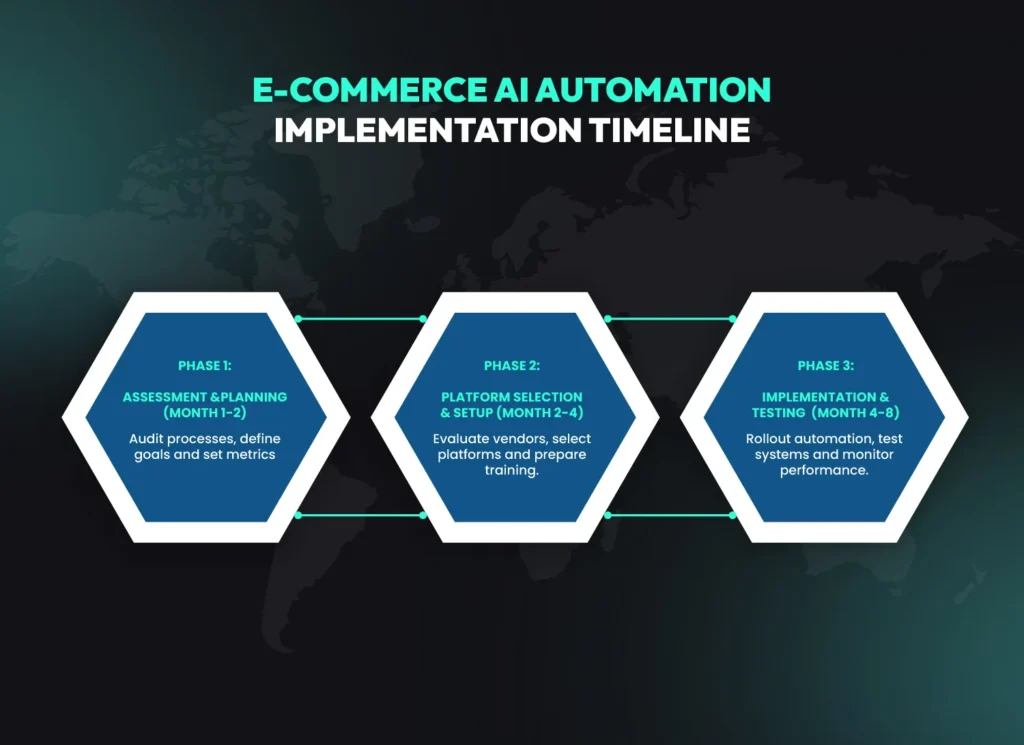
Successful e-commerce AI automation implementation follows a structured 6-12 month timeline, starting with process assessment, followed by tool selection, phased rollout, staff training, and continuous optimization to ensure maximum ROI and minimal business disruption. Proper planning prevents common pitfalls and ensures smooth transitions.
A visual timeline of e-commerce AI automation from assessment and planning to platform setup, training, rollout and performance testing.
Phase 1: Assessment and Planning (Month 1-2)
The foundation of successful automation begins with comprehensive assessment of current processes and clear definition of goals and success metrics.
Current Process Audit: Comprehensive review of existing business operations
Automation Opportunity Identification: Prioritizing processes for AI implementation
Resource Allocation: Budget planning and team assignment for implementation
Success Metrics Definition: Establishing clear KPIs and measurement criteria
Phased implementation reduces risk and allows for continuous optimization based on real-world performance and user feedback.
Phased Rollout Strategy: Gradual implementation across business functions
Integration Testing: Ensuring seamless connection between systems
Performance Monitoring: Continuous tracking of automation effectiveness
Feedback Collection: Gathering insights from staff and customers
Common Pitfalls and How to Avoid Them
Learning from common implementation challenges helps businesses avoid costly mistakes and achieve faster success with AI automation initiatives.
Over-Automation: Maintaining human oversight for critical business decisions
Insufficient Training: Ensuring staff competency in new automated systems
Integration Challenges: Comprehensive testing before full implementation
Customer Experience Disruption: Gradual transition with clear communication
Future Trends and Emerging Technologies
E-commerce AI automation in 2025 will feature autonomous agents, advanced voice commerce, multi-modal AI interactions, and quantum computing applications, requiring businesses to prepare for more sophisticated, predictive, and personalized automation technologies. Staying ahead of these trends ensures competitive advantage.
Autonomous Agents and Self-Managing Systems
The future of e-commerce automation lies in fully autonomous systems capable of managing complex business processes without human intervention, learning and adapting continuously.
Fully Autonomous Customer Service: AI agents handling complex issues independently
Self-Optimizing Marketing: Campaigns that automatically adjust strategy
Autonomous Inventory Management: Complete automation of purchasing and distribution
Predictive Business Operations: Systems that anticipate and prevent challenges
Advanced Conversational AI
Next-generation conversational AI will offer more natural, context-aware interactions with emotional intelligence and long-term memory capabilities.
Technology
Current State
2025 Projection
Impact
Voice Commerce
Basic commands
Natural conversations
50% adoption increase
Emotional AI
Sentiment detection
Emotional response
40% satisfaction improvement
Multi-modal AI
Single input processing
Combined voice/text/visual
300% interaction efficiency
Context Memory
Session-based
Long-term relationship
60% personalization enhancement
Preparing for Future Technologies
Businesses must build flexible infrastructure and develop forward-thinking strategies to capitalize on emerging AI technologies as they become available.
Infrastructure Scalability: Building systems capable of integrating new technologies
Skill Development: Training teams for next-generation AI capabilities
Technology Partnerships: Establishing relationships with innovative solution providers
Competitive Intelligence: Staying informed about automation trends and opportunities
At a Glance: Key Takeaways
Strategic Implementation: Follow structured phases from assessment to scaling for maximum success
Technology Selection: Choose platforms based on business size, integration needs, and scalability requirements
Customer Focus: Prioritize personalization and customer experience in all automation initiatives
Performance Measurement: Use AI-driven analytics to continuously optimize automation performance
Future Preparation: Build flexible infrastructure to accommodate emerging AI technologies
ROI Optimization: Expect 25-40% cost reductions and 30-50% performance improvements within 12 months
Implementation Area
Timeline
Expected ROI
Key Success Factor
Customer Service Automation
2-3 months
40% cost reduction
Proper NLP integration
Marketing Automation
3-4 months
50% efficiency gain
Quality data and segmentation
Inventory Management
4-6 months
30% cost savings
Accurate demand forecasting
Personalization Systems
6-8 months
25% conversion increase
Comprehensive customer data
Frequently Asked Questions
What is e-commerce automation?
E-commerce automation uses AI and machine learning to streamline online business operations without human intervention. It includes automated customer service, inventory management, marketing campaigns, and order processing, helping businesses reduce costs while improving customer experience and operational efficiency.
How to automate lead nurturing workflows for e-commerce businesses?
Implement email marketing automation with behavioral triggers, use AI chatbots for initial engagement, create personalized content sequences based on customer segments, and integrate CRM systems with predictive analytics to identify high-value prospects and optimize conversion timing.
How to automate e-commerce business operations effectively?
Start with process mapping, select appropriate automation tools like Shopify Flow or HubSpot, implement API integrations for seamless data flow, establish automated workflows for inventory, customer service, and marketing, then continuously monitor and optimize performance based on business metrics.
What are the best AI tools for e-commerce automation?
Leading AI automation tools include Hypotenuse AI for content generation, Kore AI for customer service, Impact Analytics for business intelligence, Shopify Magic for integrated e-commerce features, and various specialized solutions for inventory management, pricing optimization, and fraud detection.
How much does e-commerce AI automation cost to implement?
Implementation costs vary from $5,000-50,000 for small businesses using no-code platforms to $100,000+ for enterprise custom solutions. Consider platform subscriptions, integration costs, training expenses, and ongoing maintenance. ROI typically appears within 6-12 months through operational savings and increased sales.
Which e-commerce platforms support AI automation best?
Shopify leads with built-in AI features like Shopify Magic and Flow, while custom e-commerce platforms offer maximum flexibility for advanced AI integration. WooCommerce and BigCommerce provide good third-party AI integration capabilities for growing businesses.
Stay Updated—Join Our Newsletter!
Newsletter
Don’t miss on the latest updates in the world of AI. We dispatch custom reports and newsletters every week, with forecasts on trends to come. Join our community now!
Conclusion: Transform Your E-Commerce Business with AI Automation
Building comprehensive e-commerce AI automation in 2025 represents a transformative opportunity that can revolutionize your business operations, customer experience, and profitability. From intelligent chatbots and personalized recommendations to predictive analytics and automated inventory management, the technologies outlined in this guide provide a clear roadmap for success.
The key to successful implementation lies in strategic planning, choosing the right technology stack, and following a structured approach that prioritizes customer value and business objectives. Whether you’re a small business starting with basic automation or an enterprise implementing sophisticated AI systems, the principles and strategies covered here will guide your journey toward AI-powered success.
Ready to transform your e-commerce business with cutting-edge AI automation? Kodexo Labs specializes in custom AI solutions, software development, and web applications designed to maximize your automation ROI. Our experienced team can help you navigate the complexities of AI implementation and create tailored solutions that drive sustainable growth. Contact us today to start your AI automation journey.
The future of e-commerce belongs to businesses that successfully blend human creativity with artificial intelligence capabilities. By implementing the strategies and technologies outlined in this complete guide, you’re positioning your business for success in an increasingly automated and intelligent marketplace that rewards innovation and customer-centricity.
Syed Ali Hasan Shah, a content writer at Kodexo Labs with knowledge of data science, cloud computing, AI, machine learning, and cyber security. In an effort to increase awareness of AI’s potential, his engrossing and educational content clarifies technical challenges for a variety of audiences, especially business owners.
Hear from our clients and why 50+ businesses
trust Kodexo Labs
Kodexo Labs has delivered a fully functional MVP on time, and testers
reported faster check-ins after the product launch. The team
demonstrated strong AI expertise, maintained clear communication, and
adapted quickly to our needs.
Annalisa Signorelli
Founder & CEO, Pet-X Solutions
AWARDS
Share Your Requirements to help our experts understand your business objectives and create your customized plan.
By providing a telephone number and submitting this form, you agree to receive SMS text messages from Kodexo Labs. Message and Data Rates may apply. Message frequency may vary. You can STOP messaging by sending STOP and get more help by sending HELP. See our privacy policy.
Trusted by Global Brands
Cookies Notice
By continuing to browse this website you consent to our use of cookies in accordance with our cookies policy.
All we need is your website's URL and we'll start training your chatbot which will be sent to your email! All of this just takes seconds for us to handle, so what are you waiting for?