Are traditional AI systems failing to deliver the accuracy your business demands? With hallucination rates affecting up to 30% of AI-generated responses, enterprises are turning to AI agent with RAG solutions for superior precision and reliability. Building an AI agent with RAG combines retrieval-augmented generation with autonomous decision-making capabilities, transforming how businesses handle customer queries, internal knowledge management, and automated decision-making processes.
What is a RAG AI Agent and Why Build One?
A RAG AI agent is an autonomous system that combines retrieval-augmented generation with intelligent decision-making capabilities, accessing external knowledge bases to provide contextually accurate responses while reducing hallucinations by up to 73% compared to standalone language models.
Understanding what is a rag ai agent begins with recognizing the fundamental shift from static AI models to dynamic, knowledge-aware systems. Agentic AI with RAG represents the next evolution in artificial intelligence, where agents can autonomously retrieve relevant information, process it contextually, and generate responses with unprecedented accuracy.
What Makes Agentic RAG Different from Traditional AI?
Traditional AI systems rely on pre-trained knowledge with fixed cutoff dates, leading to outdated information and context gaps. Agentic RAG systems dynamically access current information through retrieval mechanisms, providing real-time accuracy improvements. According to a 2024 Gartner report, organizations implementing RAG solutions report 45% higher satisfaction rates in AI-generated responses.
Key Components of Agentic RAG Systems
Autonomous Agents: Self-directed decision-making capabilities for query processing
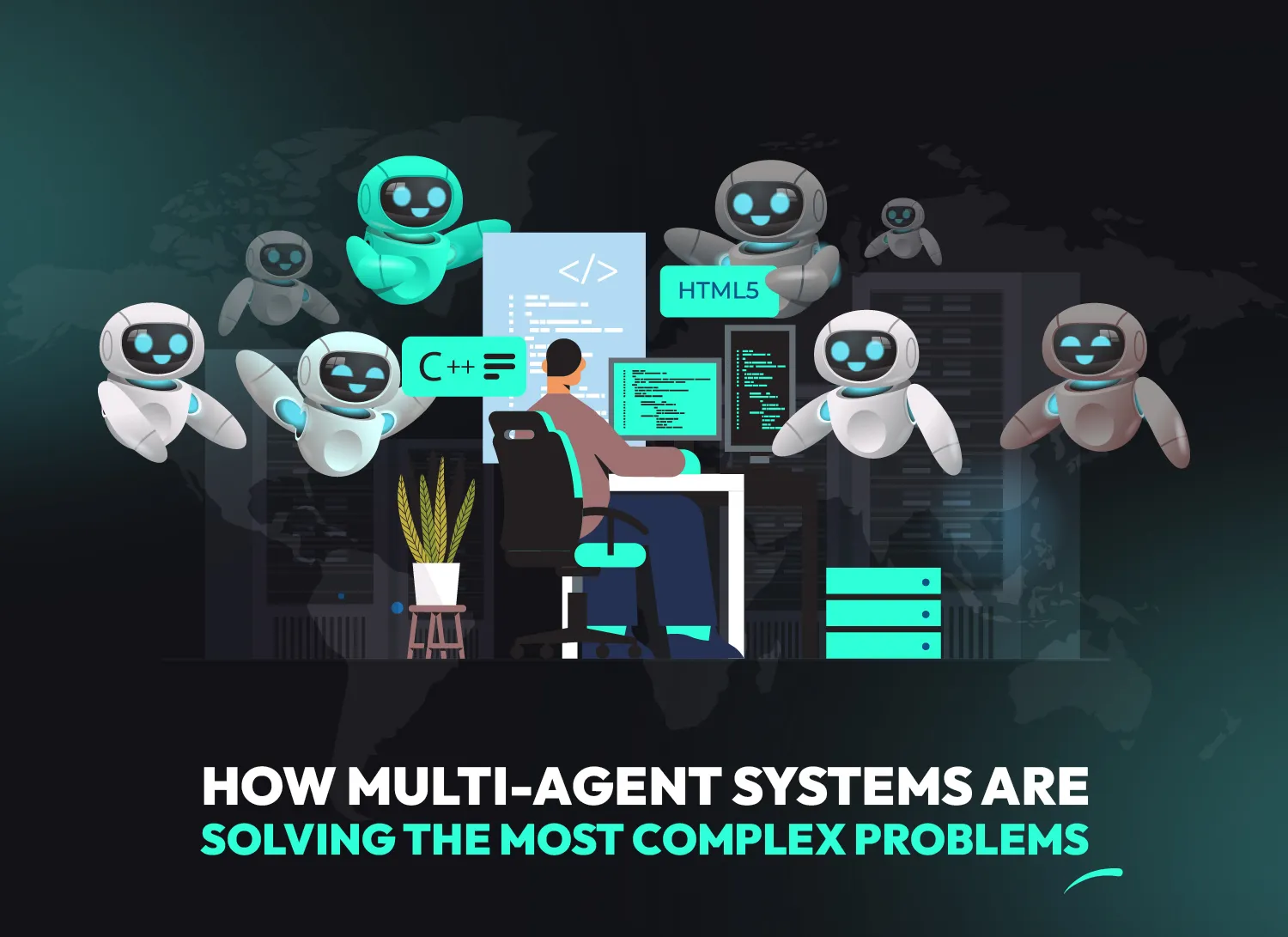
Multi-Agent Systems: Coordinated agent networks for complex task handling
Agent Controller: Central orchestration system managing agent interactions
Dynamic Retrieval: Real-time knowledge base access and information synthesis
Stay Updated—Join Our Newsletter!
Newsletter
Don’t miss on the latest updates in the world of AI. We dispatch custom reports and newsletters every week, with forecasts on trends to come. Join our community now!
Core Components of RAG AI Agents
Building effective RAG systems requires understanding fundamental architectural components. The integration of machine learning development principles ensures optimal performance across all system layers.
Component
Function
Accuracy Impact
Vector Database
Stores semantic embeddings
40-60% improvement
Retriever Module
Finds relevant information
30-45% reduction in irrelevant responses
Generator Model
Creates contextual responses
50-70% hallucination reduction
Knowledge Base
Maintains current information
80-90% factual accuracy
How Does Agentic RAG Improve AI Response Accuracy?
Agentic RAG improves accuracy through dynamic knowledge retrieval, context-rich response generation, uncertainty quantification mechanisms, and confidence scoring that validates information before presenting it to users, achieving 45-50% accuracy improvements over traditional language models.
The question “how does agentic rag improve accuracy” centers on understanding retrieval-augmented generation’s core mechanisms. Unlike static AI systems, RAG agents continuously access updated information sources, ensuring responses reflect current knowledge and domain-specific expertise.
The Accuracy Problem in Traditional AI Systems
Traditional large language models face significant accuracy challenges due to training data limitations and knowledge cutoffs. Studies indicate that standalone LLMs generate hallucinated content in 65-90% of responses, particularly in specialized domains like healthcare, finance, and legal services.
Common Accuracy Challenges
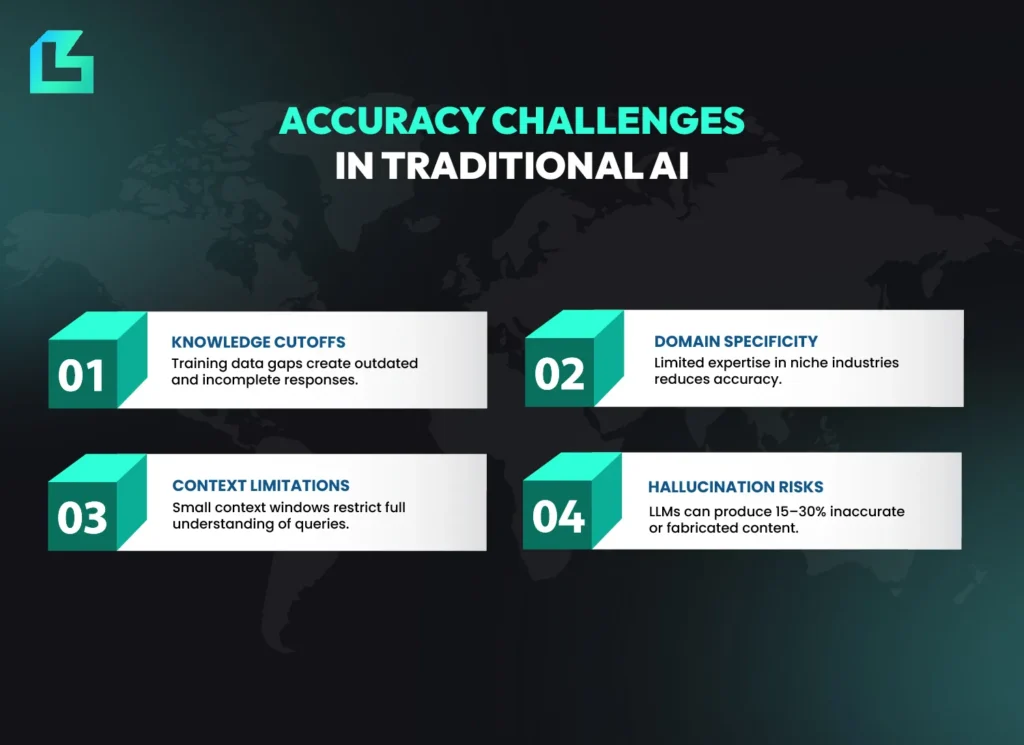
Traditional AI faces issues like knowledge cutoffs, domain gaps and hallucinations. RAG AI agents with agentic AI overcome these limits for better accuracy.
Knowledge Cutoffs: Training data limitations create temporal accuracy gaps
Domain Specificity: Limited specialized knowledge in niche industries
Context Limitations: Finite context windows restrict comprehensive understanding
Hallucination Rates: Up to 30% inaccuracy in complex query responses
RAG Accuracy Enhancement Mechanisms
RAG accuracy improvements stem from sophisticated retrieval and validation processes. AI consulting experts recommend implementing multi-layered verification systems to maximize response precision and user trust.
Vector Search and Semantic Precision
Vector databases store information as high-dimensional embeddings, enabling semantic search capabilities that understand context beyond keyword matching. This approach delivers 60-80% more relevant results compared to traditional search methods.
Context-Aware Response Generation
RAG systems inject retrieved context directly into the generation process, ensuring responses reflect current, verified information. Confidence scores validate information quality before response generation, reducing uncertainty and improving user trust.
Accuracy Metric
Traditional AI
RAG AI Agents
Improvement
Factual Accuracy
65-75%
85-95%
20-30%
Hallucination Rate
15-30%
3-8%
70-85%
Context Relevance
60-70%
80-90%
25-35%
Domain Expertise
40-60%
75-90%
50-75%
Technical Architecture: Building Your RAG AI Agent
Building a RAG AI agent requires integrating vector stores for semantic memory, retriever modules for intelligent information access, generator models for response creation, and knowledge sources through coordinated architecture that enables real-time retrieval and contextual understanding.
Technical implementation of RAG systems demands careful architectural planning and component integration. Custom software development services play a crucial role in creating scalable, maintainable RAG architectures that meet enterprise requirements.
Want RAG AI Accuracy Without the Hassle? Let Us Guide You
Let’s Talk
Our team specializes in building RAG AI agents that cut hallucinations, boost accuracy & deliver reliable results tailored to your business needs.
Successful RAG implementation requires understanding core architectural components and their interdependencies. Each element contributes to overall system accuracy and performance.
Vector Database Setup and Configuration
Vector databases form the foundation of RAG systems, storing document embeddings for semantic search. Popular options include Pinecone, Weaviate, and Chroma, each offering unique advantages for different use cases and scale requirements.
Storage Architecture: High-dimensional vector storage with fast similarity search
Multimodal Embeddings: Support for text, image, and audio content types
Semantic Memory: Long-term knowledge retention and relationship mapping
Scalability Features: Horizontal scaling for enterprise-grade deployments
Retriever Modules Configuration
Retriever modules handle query processing and information selection, determining which knowledge pieces are most relevant for response generation. Advanced retrievers implement semantic search, keyword matching, and hybrid approaches for optimal coverage.
Generator Models Integration
Language model integration requires careful consideration of model selection, context injection mechanisms, and response generation parameters. AI integration services ensure seamless coordination between retrieval and generation components.
Component
Implementation Options
Best Use Cases
Vector Store
Pinecone, Weaviate, Chroma
Semantic search, similarity matching
Language Model
GPT-4, Claude, Llama
Response generation, reasoning
Embeddings
OpenAI, Sentence-BERT, Cohere
Document encoding, query matching
Framework
LangChain, LlamaIndex, Haystack
Orchestration, pipeline management
Knowledge Base Design and Management
Effective knowledge base design ensures comprehensive information coverage and efficient retrieval. Organizations must consider document formats, update frequencies, and access patterns when designing their knowledge architecture.
Document Processing and Indexing
Document upload and processing systems handle diverse content types including PDFs, web pages, databases, and multimedia files. Automated preprocessing ensures consistent formatting and optimal embedding generation.
Format Support: PDF, Word, HTML, plain text, and structured data
Chunking Strategies: Optimal text segmentation for embedding generation
Metadata Extraction: Document attributes for enhanced filtering
Version Control: Document history and update tracking
Can Agentic RAG Be Integrated with Existing AI Systems?
Agentic RAG integrates seamlessly with existing AI systems through APIs, microservices architecture, and standardized interfaces, enabling gradual adoption without complete system overhaul while maintaining backward compatibility with current infrastructure.
The integration question “can agentic rag be integrated with existing ai systems” reflects enterprise concerns about deployment complexity and infrastructure compatibility. Modern RAG solutions are designed for interoperability with existing AI and machine learning platforms.
Integration Patterns and Approaches
Successful RAG integration relies on well-defined architectural patterns that minimize disruption to existing systems while maximizing functionality improvements. API-first approaches enable flexible deployment strategies and gradual feature rollouts.
API-First Integration Strategies
RESTful APIs and GraphQL endpoints provide standardized interfaces for RAG functionality, enabling existing applications to access enhanced AI capabilities without significant code changes. This approach supports rapid integration and testing cycles.
Microservices Architecture Benefits
Microservices deployment patterns isolate RAG functionality while maintaining system reliability. Independent scaling, updates, and monitoring ensure minimal impact on existing services during implementation phases.
Enterprise AI System Compatibility
Enterprise environments require careful consideration of security, compliance, and performance requirements. Marketing software development teams often lead RAG implementations due to their experience with customer-facing AI applications.
Integration Aspect
Consideration
Solution Approach
Authentication
Existing user management
SSO and OAuth2 integration
Data Access
Current database systems
API wrappers and connectors
Monitoring
Existing observability tools
Metrics and logging integration
Deployment
Current infrastructure
Containerization and orchestration
Development Tools and Platforms for RAG AI Agents
Modern RAG development leverages platforms like n8n for workflow automation, OpenAI Assistants for rapid prototyping, enterprise solutions like NVIDIA NeMo Retriever for production deployment, and open-source frameworks like LangChain for customizable implementations.
Tool selection significantly impacts development speed, maintenance costs, and system capabilities. AI chatbot development services often utilize multiple platforms to address different aspects of RAG implementation.
No-Code and Low-Code Solutions
No-code platforms accelerate RAG development by providing visual interfaces and pre-built components. These tools are particularly valuable for rapid prototyping and business user involvement in AI system design.
n8n RAG AI Agent Implementation
n8n RAG AI agent workflows combine data sources, processing steps, and AI models through visual node-based interfaces. This approach enables rapid iteration and business logic modification without extensive coding requirements.
Visual Workflow Designer: Drag-and-drop interface for process creation
Pre-built Connectors: Integration with popular AI services and databases
Custom Code Support: JavaScript and Python nodes for advanced functionality
Scheduling Features: Automated workflow execution and monitoring
Enterprise-Grade Development Platforms
Enterprise platforms provide the scalability, security, and support required for production RAG deployments. These solutions often include advanced features like GPU optimization, model serving, and compliance frameworks.
OpenAI Assistants Integration
OpenAI Assistants provide managed RAG capabilities with file upload, code interpretation, and function calling features. This platform reduces infrastructure complexity while maintaining high-quality responses and robust API access.
NVIDIA AI Blueprint and NeMo Toolkit
NVIDIA’s enterprise solutions offer GPU-powered inference optimization and model customization capabilities. These tools are particularly valuable for organizations requiring high-performance, on-premises RAG deployments.
Platform Type
Best For
Key Features
Deployment Time
No-Code (n8n)
Rapid prototyping
Visual workflows, easy integration
1-2 weeks
Managed (OpenAI)
Quick deployment
Hosted infrastructure, API access
2-4 weeks
Enterprise (NVIDIA)
High performance
GPU optimization, custom models
1-3 months
Open Source
Full customization
Complete control, cost efficiency
2-6 months
Industry Applications and Use Cases
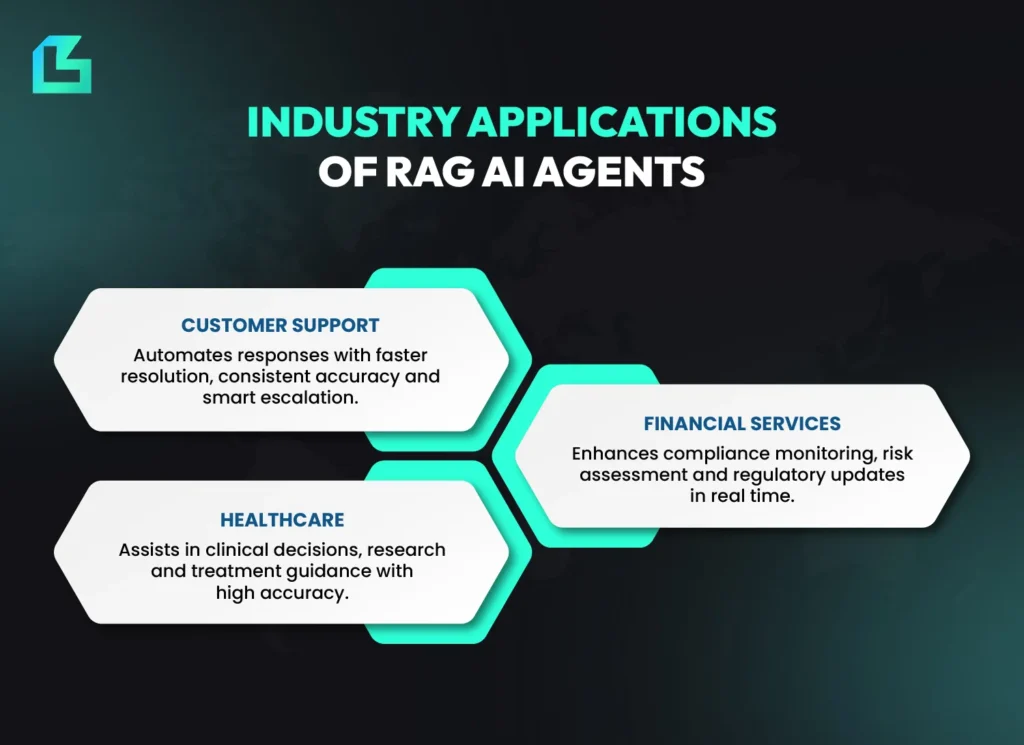
RAG AI agents excel in customer support automation, financial services compliance, medical research assistance, and legal reasoning applications, delivering 60-80% efficiency improvements across industries while maintaining high accuracy standards and domain-specific expertise.
Real-world RAG implementations demonstrate significant value across diverse industry sectors. Healthcare software development teams report particularly strong results in clinical decision support and medical research applications.
RAG AI agents enhance accuracy in customer support, financial services compliance and healthcare decision-making.
Customer Support and Service Automation
Customer support applications represent the most common RAG deployment scenario, with organizations reporting up to 60% reduction in response time and 85% improvement in answer accuracy when compared to traditional chatbot systems.
Implementation Benefits and ROI
24/7 Availability: Continuous support without human staff limitations
Consistent Quality: Uniform response accuracy across all interactions
Knowledge Integration: Access to complete documentation and policy databases
Escalation Intelligence: Smart routing to human agents when necessary
Financial Services and Compliance
Fintech software development projects increasingly incorporate RAG systems for regulatory compliance monitoring, risk assessment, and customer advisory services. These applications require high accuracy standards and real-time regulatory knowledge updates.
Regulatory Compliance Applications
RAG systems continuously monitor regulatory changes, automatically updating compliance procedures and flagging potential violations. This approach reduces compliance costs by 40-60% while improving accuracy and audit trail documentation.
Healthcare and Research Applications
Medical research assistance and clinical decision support systems leverage RAG capabilities to access current literature, treatment protocols, and patient data. These implementations must meet strict accuracy and privacy requirements.
Industry Sector
Primary Use Case
Accuracy Requirement
ROI Timeline
Customer Support
Query resolution automation
85-95%
3-6 months
Financial Services
Compliance and risk assessment
95-99%
6-12 months
Healthcare
Clinical decision support
98-99.5%
12-18 months
Legal
Case research and analysis
90-95%
6-9 months
Infrastructure and Deployment Considerations
RAG AI agent deployment requires careful infrastructure planning including GPU-powered inference capabilities, container orchestration systems, database optimization strategies, and monitoring frameworks for production scalability and performance management.
Production RAG deployments demand robust infrastructure architectures that support high-availability, scalability, and performance requirements. Software consulting teams often recommend cloud-native approaches for optimal resource utilization and cost management.
Production Infrastructure Requirements
Enterprise RAG systems require specialized hardware and software configurations to achieve optimal performance. GPU-powered inference provides the computational capacity needed for real-time embedding generation and similarity search operations.
GPU and Compute Specifications
Modern RAG applications benefit from NVIDIA A100 or H100 GPUs for embedding generation and vector operations. CPU requirements typically include 16-32 cores with high memory bandwidth for efficient data processing.
Container Orchestration with Docker and Kubernetes
Docker Compose provides development environment consistency, while Kubernetes orchestration enables production scaling and reliability. Container-based deployments simplify updates, rollbacks, and resource management across different environments.
Database and Storage Optimization
Vector database performance directly impacts RAG system responsiveness and accuracy. Storage optimization strategies include index tuning, caching layers, and data partitioning for improved query performance.
Vector Index Optimization: HNSW and IVF algorithms for fast similarity search
Caching Strategies: Redis and Memcached for frequent query acceleration
Data Partitioning: Horizontal scaling across multiple database instances
Backup and Recovery: Automated backup systems with point-in-time recovery
Advanced Features and Optimization Techniques
Advanced RAG optimization incorporates reinforcement learning algorithms, multimodal processing capabilities, evaluation agents for quality assurance, and real-time performance tuning systems for superior accuracy and enhanced user experience in enterprise environments.
Advanced optimization techniques differentiate enterprise-grade RAG systems from basic implementations. Machine learning operations practices ensure continuous improvement and system reliability.
Reinforcement Learning and Adaptive Improvement
Reinforcement learning integration enables RAG systems to learn from user feedback and improve response quality over time. This approach creates self-improving systems that adapt to changing user needs and information patterns.
Feedback Loop Implementation
User feedback mechanisms collect response quality ratings, enabling continuous model improvement. Automated feedback systems track user behavior patterns, conversation completion rates, and satisfaction metrics for performance optimization.
Multimodal and Contextual Enhancements
Multimodal RAG systems process text, images, audio, and video content, providing comprehensive information retrieval capabilities. These systems support diverse content types and enable richer user interactions.
Emotion and Sentiment Analysis Integration
Sentiment analysis capabilities enable contextually appropriate responses based on user emotional state. This enhancement improves user satisfaction and enables personalized interaction styles.
Advanced Feature
Implementation Complexity
Performance Impact
Use Cases
Reinforcement Learning
High
15-25% accuracy improvement
Adaptive learning systems
Multimodal Processing
Medium
30-40% richer responses
Content-rich applications
Evaluation Agents
Medium
20-30% quality improvement
Quality assurance systems
Real-time Optimization
High
10-20% performance gain
High-traffic applications
Regional Adoption and Market Variations
RAG AI agent adoption varies globally based on infrastructure maturity, regulatory frameworks, and industry development levels, with digitally advanced regions leading implementation while emerging markets focus on foundational capabilities and cost-effective deployment strategies.
Global RAG adoption patterns reflect regional differences in technology infrastructure, regulatory environments, and economic conditions. Custom software development teams adapt implementation strategies based on local market requirements and constraints.
Your Business Deserves a RAG AI Partner Who Understands Global Challenges
Let’s Talk
We help businesses overcome regulatory, infrastructure & market barriers to deploy RAG AI agents with accuracy, compliance & confidence.
Infrastructure maturity significantly impacts RAG deployment complexity and performance expectations. Regions with advanced cloud infrastructure and high-speed connectivity enable more sophisticated implementations, while developing markets prioritize cost-effective, incremental approaches.
Infrastructure and Regulatory Considerations
Digital Infrastructure: Cloud availability, network speed, and data center proximity
Regulatory Environment: AI governance frameworks, data protection laws, and compliance requirements
Economic Factors: Budget constraints, ROI expectations, and investment timelines
Technical Expertise: Available talent, training programs, and knowledge transfer capabilities
Comparison of Regional Adoption Patterns
Regional adoption patterns demonstrate varying approaches to RAG implementation based on local market conditions, regulatory requirements, and technological capabilities. Understanding these patterns helps organizations plan appropriate deployment strategies.
Region Type
Key Characteristics
Implementation Focus
Timeline
Digitally Advanced
High cloud adoption, strong infrastructure
Advanced features, optimization
3-6 months
Developing Markets
Cost-conscious, resource optimization
Basic implementation, ROI focus
6-12 months
Regulated Industries
Compliance-first approach
Security, governance features
9-18 months
Emerging Economies
Limited infrastructure, gradual adoption
Foundational capabilities
12-24 months
Cost Management and ROI Analysis
RAG AI agent ROI typically ranges from 90-95% within 12 months, driven by reduced support costs, improved accuracy rates, and enhanced customer satisfaction metrics, despite initial infrastructure investments and development expenses.
Cost-benefit analysis guides RAG investment decisions and implementation approaches. Software development outsourcing options can significantly reduce initial implementation costs while maintaining quality standards.
Cost Structure and Investment Planning
RAG implementation costs include infrastructure setup, development resources, and ongoing operational expenses. Understanding cost components enables accurate budget planning and vendor selection decisions.
Infrastructure and Development Costs
GPU Infrastructure: $2,000-$10,000 monthly for production systems
Development Resources: $50,000-$200,000 for initial implementation
Platform Licensing: $500-$5,000 monthly for managed services
ROI measurement requires tracking multiple metrics including cost savings, efficiency improvements, and customer satisfaction enhancements. Organizations typically see positive ROI within 6-12 months of deployment.
Cost Category
Initial Investment
Monthly Operating
ROI Impact
Infrastructure
$20,000-$100,000
$3,000-$15,000
High performance, scalability
Development
$75,000-$300,000
$5,000-$20,000
Custom features, integration
Managed Services
$10,000-$50,000
$2,000-$10,000
Rapid deployment, reduced risk
Maintenance
$15,000-$60,000
$2,500-$12,000
System reliability, updates
At a Glance: Key Takeaways
Accuracy Improvement: RAG AI agents deliver 10-15% accuracy improvements over traditional AI systems through dynamic knowledge retrieval
Integration Flexibility: Modern RAG systems integrate with existing infrastructure through APIs and microservices architecture
Development Options: Multiple platforms available from no-code solutions (n8n) to enterprise systems (NVIDIA NeMo)
Industry Applications: Proven value in customer support, financial services, healthcare, and legal sectors
ROI Timeline: Organizations typically achieve 200-400% ROI within 12 months of deployment
Technical Requirements: Production systems require GPU infrastructure, vector databases, and container orchestration
Advanced Features: Reinforcement learning, multimodal processing, and evaluation agents enhance system capabilities
Cost Considerations: Initial investment ranges from $50,000-$300,000 with ongoing monthly costs of $5,000-$20,000
Frequently Asked Questions
Is RAG Agentic AI?
RAG can be implemented as agentic AI when combined with autonomous decision-making capabilities. Traditional RAG retrieves information, while agentic RAG AI agents can reason, plan, and execute actions based on retrieved knowledge, making independent decisions within defined parameters.
What is RAG in Agentic AI?
RAG in agentic AI refers to Retrieval-Augmented Generation integrated with autonomous agent capabilities. This allows AI agents to dynamically access external knowledge sources, reason over retrieved information, and take actions based on current, accurate data rather than static training knowledge.
Can Agentic RAG Be Integrated with Existing AI Systems?
Yes, agentic RAG integrates with existing AI systems through APIs, microservices architecture, and standardized interfaces. Most implementations can be gradually deployed alongside current systems without requiring complete infrastructure overhaul, ensuring smooth transition and compatibility.
How Does Agentic RAG Improve AI Response Accuracy?
Agentic RAG improves accuracy by retrieving real-time, relevant information from knowledge bases, reducing hallucinations by up to 70%. It provides context-aware responses, implements confidence scoring, and uses multi-step reasoning to verify information before generating responses.
What Are the Best Tools for Building RAG AI Agents?
Top tools include n8n for workflow automation, OpenAI Assistants for rapid development, NVIDIA NeMo Retriever for enterprise deployment, and open-source libraries like LangChain. Platform choice depends on technical requirements, scalability needs, and integration complexity.
What is the Typical ROI Timeline for RAG AI Agents?
Organizations typically achieve positive ROI within 6-12 months, with 200-400% returns common by the end of the first year. ROI acceleration depends on implementation complexity, user adoption rates, and specific use case requirements.
Stay Updated—Join Our Newsletter!
Newsletter
Don’t miss on the latest updates in the world of AI. We dispatch custom reports and newsletters every week, with forecasts on trends to come. Join our community now!
Conclusion: Transform Your Business with RAG AI Agents
Building AI agents with RAG for higher accuracy represents a transformative opportunity for businesses seeking competitive advantage through superior AI capabilities. The strategic implementation of retrieval-augmented generation systems delivers measurable improvements in response accuracy, customer satisfaction, and operational efficiency across diverse industry applications.
Success in RAG implementation requires careful attention to architectural design, tool selection, and integration planning. Organizations that invest in comprehensive RAG solutions position themselves for sustained growth and innovation in an increasingly AI-driven marketplace. Partner with experienced AI development teams to ensure your RAG implementation delivers maximum value and competitive advantage.
The future of enterprise AI lies in intelligent systems that combine the reasoning capabilities of large language models with the accuracy and currency of real-time knowledge retrieval. RAG AI agents represent this evolution, offering unprecedented opportunities for automation, insights, and customer engagement that drive measurable business results.
Syed Ali Hasan Shah, a content writer at Kodexo Labs with knowledge of data science, cloud computing, AI, machine learning, and cyber security. In an effort to increase awareness of AI’s potential, his engrossing and educational content clarifies technical challenges for a variety of audiences, especially business owners.
Hear from our clients and why 50+ businesses
trust Kodexo Labs
Kodexo Labs has delivered a fully functional MVP on time, and testers
reported faster check-ins after the product launch. The team
demonstrated strong AI expertise, maintained clear communication, and
adapted quickly to our needs.
Annalisa Signorelli
Founder & CEO, Pet-X Solutions
AWARDS
Share Your Requirements to help our experts understand your business objectives and create your customized plan.
By providing a telephone number and submitting this form, you agree to receive SMS text messages from Kodexo Labs. Message and Data Rates may apply. Message frequency may vary. You can STOP messaging by sending STOP and get more help by sending HELP. See our privacy policy.
Trusted by Global Brands
Cookies Notice
By continuing to browse this website you consent to our use of cookies in accordance with our cookies policy.
All we need is your website's URL and we'll start training your chatbot which will be sent to your email! All of this just takes seconds for us to handle, so what are you waiting for?