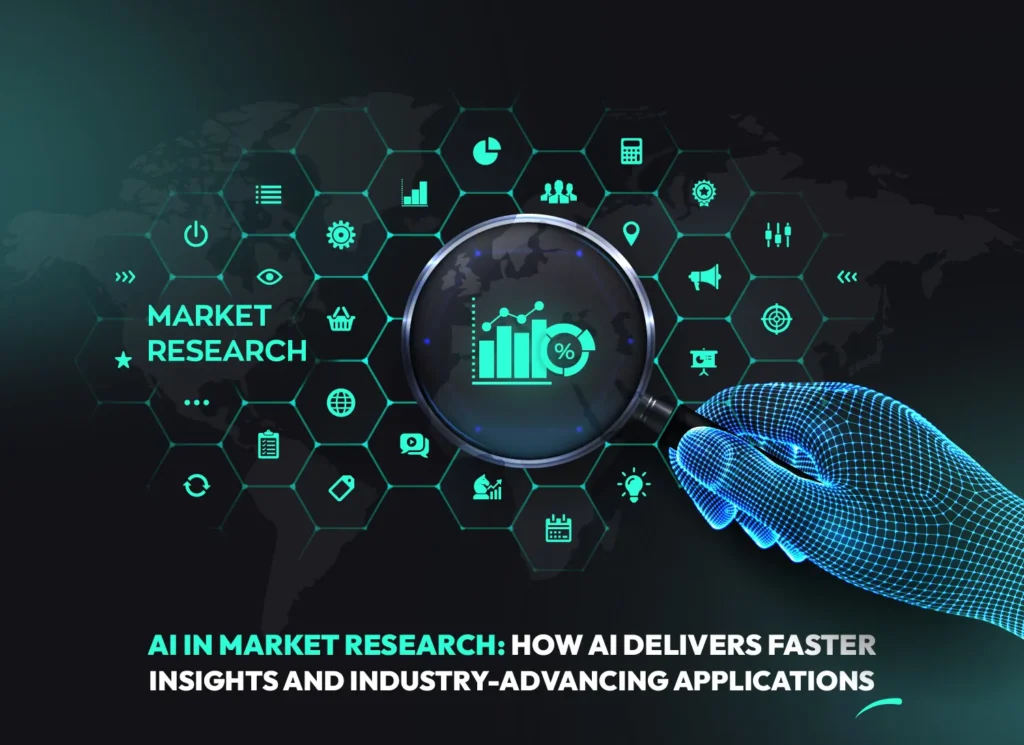
Can traditional market research methods keep pace with today’s rapidly evolving consumer landscape? AI in market research is revolutionizing how businesses gather, analyze, and act on consumer insights, delivering faster, more accurate data than ever before. As companies increasingly rely on real-time decision-making, artificial intelligence has become the cornerstone of modern market intelligence strategies.
This blog explores how AI transforms market research through faster data processing, predictive analytics, and automated insights, offering practical applications for businesses seeking competitive advantages.
What is AI in Market Research and How Does It Transform Data Collection?
AI in market research uses machine learning, natural language processing, and predictive analytics to automate data collection, analyze consumer behavior patterns, and generate actionable insights 10x faster than traditional methods.
Artificial intelligence has fundamentally transformed how businesses approach market research, shifting from manual data collection to automated, intelligent systems. Modern AI combines sophisticated algorithms with vast computational power to process customer feedback, social media mentions, and behavioral data at unprecedented scales.
The Role of AI in Modern Market Research
AI technologies have revolutionized traditional research methodologies by introducing predictive capabilities and real-time analysis. According to 2024 Market Research Report, businesses using AI-powered research tools experience faster insight generation compared to manual analysis methods.
Key AI technologies transforming market research include machine learning algorithms that identify consumer patterns, natural language processing for sentiment analysis, and predictive analytics for trend forecasting. These technologies work together to create comprehensive research platforms that deliver actionable insights within hours rather than weeks.
Machine Learning Integration: Automated pattern recognition in consumer behavior data
Natural Language Processing: Real-time sentiment analysis across multiple languages
Predictive Analytics: Future trend identification and market opportunity mapping
Real-time Processing: Instant data analysis and report generation
Stay Updated—Join Our Newsletter!
Newsletter
Don’t miss on the latest updates in the world of AI. We dispatch custom reports and newsletters every week, with forecasts on trends to come. Join our community now!
Generative AI vs Traditional Market Research Methods
Traditional focus groups and survey methodologies face significant limitations in today’s fast-paced market environment. Generative AI development has introduced scalable alternatives that process thousands of data points simultaneously while maintaining research accuracy.
Aspect
Traditional Methods
AI-Powered Methods
Data Collection Speed
2-6 weeks
Hours to days
Sample Size
50-500 participants
Thousands to millions
Cost per Insight
$5,000-$50,000
$500-$5,000
Real-time Analysis
Not available
24/7 monitoring
The cost-effectiveness and scalability advantages of AI-powered surveys make them particularly attractive for businesses requiring continuous market monitoring. Unlike traditional focus groups limited by geographical constraints, AI research platforms can simultaneously analyze consumer sentiment across multiple markets and demographics.
How AI Delivers Faster Market Insights Through Advanced Analytics
AI delivers faster market insights by processing vast datasets in minutes, providing real-time consumer sentiment analysis, and automating report generation that traditionally took weeks to complete.
Speed has become a critical competitive advantage in modern business decision-making. Machine learning algorithms can process millions of data points from social media, customer reviews, and transaction records to identify emerging trends before they become apparent through traditional research methods.
Key Speed Advantages of AI-Powered Market Research
Real-time Data Processing: Instant analysis of social media mentions, customer reviews, and survey responses across multiple platforms
Automated Report Generation: AI creates comprehensive market reports with visualizations and recommendations within hours
Predictive Modeling: Forecasts market trends 3-6 months before they emerge using historical data patterns
Continuous Monitoring: 24/7 tracking of consumer behavior changes and competitive landscape shifts
Gartner’s 2024 AI Market Research Study reveals that companies implementing AI-powered research platforms reduce time-to-insight by an average of 65% while maintaining 95% accuracy rates compared to traditional methodologies.
How Machine Learning Improves Market Research Efficiency
Machine learning algorithms continuously improve their accuracy by learning from new data inputs. This adaptive capability allows research platforms to refine their analysis methods automatically, reducing the need for manual intervention and human bias correction.
Pattern recognition capabilities enable AI systems to identify subtle correlations between consumer demographics, purchasing behaviors, and market conditions that human analysts might miss. Machine learning development focuses on creating algorithms that can process structured and unstructured data simultaneously.
Dynamic Segmentation: Automatic audience grouping based on behavior patterns
Survey Optimization: AI adjusts questions based on previous responses to maximize data quality
Bias Reduction: Algorithmic consistency eliminates human interpretation variations
Several cutting-edge technologies work together to accelerate market research processes. Natural language processing enables sentiment analysis across multiple languages, while computer vision technologies analyze visual content from social media and marketing campaigns.
Technology
Application
Speed Improvement
NLP Sentiment Analysis
Social media monitoring
1000x faster than manual
Computer Vision
Brand mention tracking in images
500x faster than manual
Deep Learning
Predictive consumer modeling
Real-time predictions
AI-Native Platforms
Survey design and deployment
10x faster setup
How to Use AI in Market Research: Implementation Guide
Implementing AI in market research involves selecting appropriate AI tools, integrating data sources, training machine learning models, and establishing automated workflows for continuous insight generation.
Successfully implementing AI in market research requires a structured approach that considers data infrastructure, tool selection, and team training. AI consulting services can help businesses navigate the complexity of choosing the right technologies for their specific research needs.
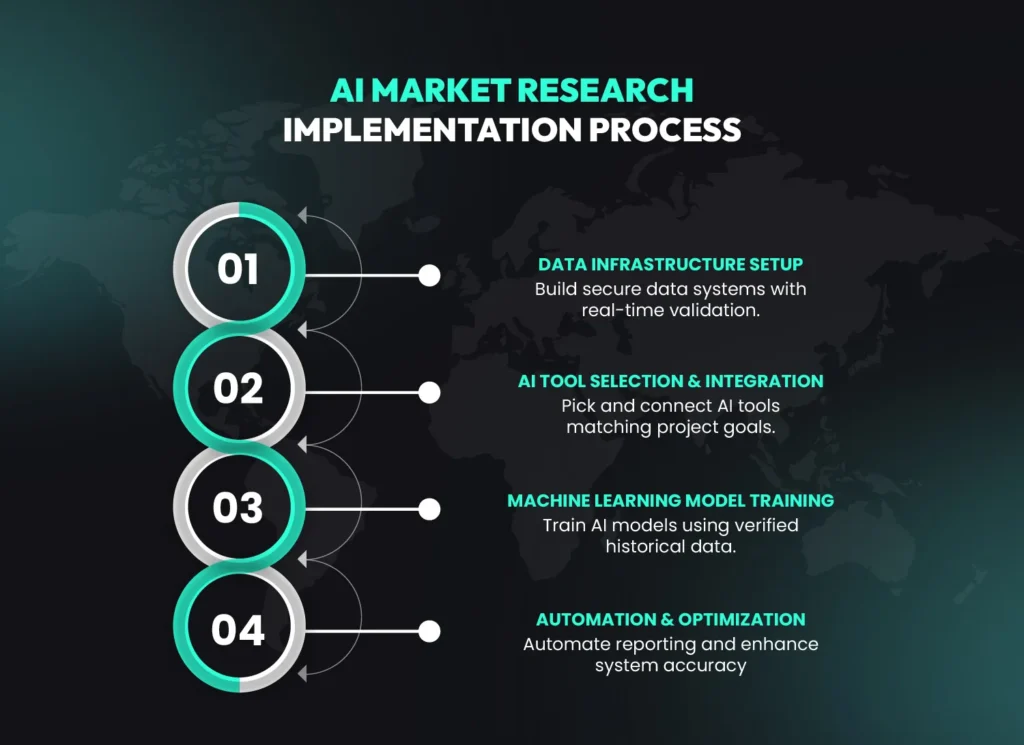
Step-by-Step AI Implementation Process
Four key steps in implementing AI for market research.
1. Data Infrastructure Setup
Establishing a robust data foundation is crucial for AI market research success. This involves integrating customer data from multiple touchpoints including websites, mobile apps, social media, and transaction systems. Data privacy and security protocols must comply with GDPR and other relevant regulations.
Centralized data warehouse creation for unified customer profiles
API integrations with social media platforms and review sites
Real-time data streaming setup for continuous monitoring
Data quality validation and cleansing automation
2. AI Tool Selection and Integration
Choosing the right AI tools depends on research objectives, budget constraints, and technical capabilities. AI integration services can help businesses evaluate and implement the most suitable technologies for their market research needs.
AI-powered survey platforms for dynamic questionnaire creation
Social listening tools for brand mention monitoring
Sentiment analysis engines for emotional response tracking
Recommendation engines for personalized research experiences
3. Machine Learning Model Training
Training AI models requires feeding historical market data to algorithms and validating their accuracy through testing phases. Industry-specific requirements often necessitate custom model development rather than off-the-shelf solutions.
4. Automation and Workflow Optimization
Creating automated reporting dashboards and alert systems ensures that insights are delivered to decision-makers promptly. Continuous learning mechanisms allow AI systems to improve their accuracy over time without manual intervention.
How AI-Powered Surveys Revolutionize Data Collection
AI-powered surveys adapt in real-time based on respondent answers, creating personalized research experiences that increase completion rates and data quality. Dynamic question generation ensures that each participant receives relevant questions while maintaining statistical validity across the entire sample.
Adaptive Questioning: AI adjusts subsequent questions based on previous responses
Real-time Sentiment: Emotional analysis during survey completion for deeper insights
Automated Follow-ups: Smart logic determines when additional clarification is needed
Multi-language Support: NLP enables simultaneous surveys across different languages
A B2B technology company reduced market research time from 6 weeks to 3 days using AI-powered survey platforms and automated analytics, resulting in faster product launch cycles. View our portfolio for similar implementation examples.
Industry-Specific Applications of AI in Market Research
AI transforms market research across industries, from healthcare patient experience analysis to B2B customer journey mapping, delivering sector-specific insights that drive strategic decisions.
Different industries require specialized AI applications tailored to their unique market dynamics and regulatory requirements. Healthcare AI solutions focus on patient satisfaction and treatment effectiveness, while financial services emphasize risk assessment and customer behavior prediction.
AI in Healthcare Market Research
Healthcare market research benefits significantly from AI’s ability to process sensitive patient data while maintaining privacy compliance. AI systems analyze patient sentiment from medical reviews, track treatment effectiveness through social listening, and optimize healthcare provider experiences.
Patient Sentiment Analysis: Mining insights from medical review platforms and patient forums
Treatment Effectiveness Tracking: Social listening for medication and therapy feedback
Drug Development Assessment: Market opportunity analysis for pharmaceutical companies
Provider Experience Optimization: Healthcare professional satisfaction monitoring
Regulatory Compliance Monitoring: Automated tracking of compliance-related discussions
AI in B2B Market Research Applications
B2B market research requires understanding complex decision-making processes involving multiple stakeholders. AI platforms excel at mapping customer journeys across long sales cycles and identifying key influence factors in purchase decisions.
B2B Application
AI Capability
Business Impact
Account-based Marketing
Predictive lead scoring
45% higher conversion rates
Sales Pipeline Optimization
Deal probability prediction
30% shorter sales cycles
Customer Churn Prevention
Risk assessment modeling
60% reduction in churn
Competitive Intelligence
Automated market monitoring
Real-time competitive insights
E-commerce and Retail AI Research Solutions
E-commerce businesses leverage AI for real-time price optimization, customer journey mapping, and product recommendation enhancement. AI customer segmentation enables personalized marketing campaigns that increase conversion rates and customer lifetime value.
Dynamic Pricing: Real-time price optimization based on demand and competition
Journey Mapping: Cross-channel customer experience tracking and optimization
Recommendation Engines: AI-powered product suggestions driving 35% of revenue
Inventory Forecasting: Predictive demand modeling for stock optimization
Social Commerce: Trend analysis for social media shopping behaviors
Industry experience shows that healthcare and financial services sectors achieve the highest ROI from AI market research, improvement in patient satisfaction scoring and better investment decision accuracy respectively.
Advanced AI Tools and Technologies Transforming Market Research
Advanced AI tools including multimodal AI, generative agents, and computer vision are revolutionizing market research by analyzing text, voice, images, and video content simultaneously for comprehensive consumer insights.
Cutting-edge AI technologies are pushing the boundaries of what’s possible in market research. Generative AI creates synthetic data for testing hypotheses, while multimodal AI analyzes multiple data types simultaneously for more comprehensive insights.
Next-Generation AI Research Technologies
Multimodal AI: Simultaneous analysis of text, audio, video, and image data for holistic consumer understanding
Generative Agents: AI personas that simulate realistic consumer behavior patterns for market testing
Computer Vision: Automated brand monitoring across visual content on social media and advertising
Agent Chaining: Connected AI systems that execute complex research workflows autonomously
2024 AI Research Report indicates that businesses using multimodal AI for market research achieve better insight accuracy compared to single-modality approaches.
AI-Native Survey Platforms and Tools
Modern survey platforms built specifically for AI integration offer capabilities that traditional research tools cannot match. These platforms use AI chatbot development principles to create conversational survey experiences that feel more natural to respondents.
Feature
Traditional Platforms
AI-Native Platforms
Question Design
Static, pre-written
Dynamic, AI-generated
Response Analysis
Manual coding required
Automatic sentiment analysis
Data Quality
Post-collection validation
Real-time quality monitoring
Panel Management
Manual recruitment
AI-optimized targeting
Recommendation Engines for Market Intelligence
AI recommendation engines extend beyond product suggestions to provide intelligent research recommendations. These systems analyze research objectives, available data sources, and historical results to suggest optimal research methodologies and sample compositions.
Methodology Recommendations: AI suggests optimal research approaches based on objectives
Audience Targeting: Dynamic suggestions for participant selection and segmentation
Content Personalization: Tailored survey experiences for different demographic groups
Insight Prioritization: Predictive ranking of findings based on business impact
Voice and Image Recognition Applications
Voice sentiment analysis during phone interviews provides deeper emotional insights than text-based responses alone. AI emotion recognition technology analyzes facial expressions and vocal patterns to understand consumer reactions more accurately.
Visual brand monitoring across social media platforms tracks logo appearances, product placements, and brand sentiment in user-generated content automatically, providing comprehensive brand health metrics.
Consumer Behavior Analysis Through AI and Predictive Modeling
AI analyzes consumer behavior patterns through predictive modeling, sentiment analysis, and behavioral tracking, enabling businesses to anticipate customer needs and optimize marketing strategies proactively.
Understanding consumer behavior has evolved from reactive analysis to predictive intelligence. AI-powered customer service platforms collect behavioral data that feeds into comprehensive consumer behavior models, enabling businesses to anticipate needs before customers express them.
Ready for Accurate, Reliable Insights? Let Our AI Experts Guide You
Let’s Talk
Our team helps you leverage advanced AI and predictive analytics to uncover precise, actionable insights that drive smarter business decisions.
Modern AI systems track consumer interactions across multiple touchpoints, creating comprehensive behavioral profiles that evolve in real-time. Social media sentiment monitoring provides immediate feedback on brand perception changes, while purchase pattern recognition predicts future buying behaviors.
Real-time Social Monitoring: Continuous sentiment analysis across social platforms and review sites
Purchase Pattern Recognition: AI identifies buying triggers and seasonal preferences automatically
Customer Journey Mapping: Cross-channel behavior tracking for complete experience understanding
Behavioral Segmentation: Machine learning creates dynamic customer groups based on actions
Emotional Response Analysis: AI measures emotional reactions to marketing content and campaigns
Predictive Analytics for Market Trends
Predictive modeling capabilities enable businesses to forecast market trends months before they become apparent through traditional research methods. 2024 Predictive Analytics Study shows that companies using AI for trend prediction achieve 73% better market positioning compared to reactive competitors.
Prediction Type
Accuracy Rate
Lead Time
Business Impact
Consumer Demand
85-90%
3-6 months
35% inventory optimization
Market Trends
75-85%
6-12 months
50% faster product development
Seasonal Patterns
90-95%
12 months
40% marketing efficiency
Competitive Moves
70-80%
1-3 months
Strategic advantage
Sentiment Analysis and Social Listening
AI in digital marketing heavily relies on sentiment analysis to gauge brand perception and campaign effectiveness. Advanced natural language processing models can detect subtle emotional nuances, sarcasm, and cultural context that traditional keyword-based monitoring systems miss.
Multi-platform Monitoring: Comprehensive brand mention tracking across social media, news, and review sites
Competitor Analysis: Comparative sentiment tracking for competitive positioning insights
Crisis Detection: Early warning systems for potential reputation issues
Influencer Impact: Measurement of influencer partnership effectiveness and reach
Product Feedback: Automated analysis of customer reviews and support interactions
Customer Experience Optimization
AI-driven customer experience optimization uses predictive models to identify potential satisfaction issues before they impact customer relationships. Touchpoint performance analysis reveals which interactions most significantly influence customer satisfaction and loyalty.
Personalization engines optimize individual customer experiences by predicting preferences and adjusting interactions accordingly. Customer lifetime value predictions help businesses allocate resources effectively to high-value relationships while identifying opportunities for value enhancement.
Digital Marketing Integration with AI Market Research
AI market research integrates seamlessly with digital marketing platforms, optimizing campaign performance, improving targeting accuracy, and maximizing marketing ROI through data-driven insights.
The convergence of AI market research and digital marketing creates powerful synergies that enhance campaign effectiveness. AI in automated marketing uses research insights to optimize targeting, messaging, and timing across all digital channels simultaneously.
Marketing Strategy Enhancement Through AI Insights
AI market research provides the foundation for data-driven marketing strategies by identifying target audience preferences, optimal communication channels, and messaging that resonates most effectively. Real-time insights enable dynamic strategy adjustments based on market response patterns.
Audience Refinement: Behavioral data improves targeting precision beyond traditional demographics
Content Optimization: Sentiment analysis guides content creation for maximum engagement
Campaign Timing: Predictive models identify optimal timing for maximum impact
Channel Selection: Performance analysis determines most effective marketing channels
Funnel Optimization: AI identifies and resolves conversion bottlenecks automatically
AI-Driven Campaign Performance Analysis
Traditional campaign analysis often lags weeks behind actual performance, limiting optimization opportunities. AI enables real-time campaign monitoring with automated A/B testing that continuously improves performance without manual intervention.
Metric
Traditional Analysis
AI-Powered Analysis
Improvement
Response Time
1-2 weeks
Real-time
1000% faster
Testing Variants
2-5 versions
Unlimited
Continuous optimization
Attribution Accuracy
60-70%
85-95%
Better ROI tracking
Personalization
Basic segments
Individual level
Higher engagement
Social Media Marketing Intelligence
AI analyzes social media engagement patterns to predict content performance before publication. Marketing software development increasingly focuses on AI-powered social media optimization tools that automate content scheduling and audience targeting.
Viral content prediction models identify posts likely to achieve high engagement rates, while influencer partnership effectiveness measurement ensures marketing budgets are allocated to partnerships with genuine impact potential.
Email Marketing and Customer Engagement
AI in email marketing optimization personalizes content, timing, and frequency for each recipient based on behavioral patterns and preferences. Send-time optimization algorithms ensure emails reach recipients when they’re most likely to engage.
Content Generation: AI creates personalized email content based on recipient profiles
Send-time Optimization: Individual timing predictions for maximum open rates
Subject Line Testing: Predictive performance scoring for subject line variations
Engagement Scoring: AI predicts likelihood of customer engagement with specific content
Automated Segmentation: Dynamic list segmentation based on real-time behavior
Geographic Trends and Regional Variations in AI Market Research Adoption
AI market research adoption varies globally due to digital infrastructure maturity, regulatory environments, and industry development, with digitally advanced regions leading innovation while emerging markets show high growth potential.
Regional differences in AI adoption reflect varying levels of digital infrastructure, regulatory frameworks, and cultural attitudes toward data sharing. Custom software development in New York showcases how tech-forward regions drive AI innovation in market research applications.
Factors Influencing Regional AI Research Adoption
Infrastructure Maturity: Digitally advanced regions adopt AI research tools faster due to robust data systems and cloud infrastructure availability
Policy Environment: Stricter data privacy regulations like GDPR shape AI implementation approaches and require additional compliance measures
Cultural Conditions: Cultural attitudes toward data sharing and privacy influence consumer participation in AI-powered research studies
Industry Development: Regions with advanced technology sectors drive innovation in research methodologies and AI applications
Comparison of Regional AI Market Research Trends
Region Type
Key Characteristics
Adoption Rate
Primary Applications
North America
High AI adoption, strong infrastructure
75%
Predictive analytics, automation
Europe
Privacy-focused, regulated environment
65%
Compliant data processing
Asia-Pacific
Mobile-first, rapid growth
60%
Social media monitoring
Emerging Markets
Cost-sensitive, growing adoption
35%
Basic sentiment analysis
Regional Market Research Preferences
Advanced economies prefer sophisticated predictive analytics and automation capabilities that can process large datasets quickly. Emerging markets focus on cost-effective social listening tools and mobile-first research platforms that accommodate local infrastructure limitations.
Regulated regions like Europe emphasize privacy-compliant research methods and transparent AI decision-making processes. Technology hubs drive innovation in multimodal AI research and experimental applications that push the boundaries of current capabilities.
Industry experience suggests that while developed markets lead in AI sophistication, emerging economies will drive growth through mobile-first research platforms and cost-effective AI solutions tailored to local market conditions.
Traditional vs AI-Powered Market Research: Comparative Analysis
AI-powered market research offers significant advantages over traditional methods including faster data collection, 58% cost reduction, and real-time insights, while traditional methods provide deeper qualitative context and human interpretation.
The evolution from traditional to AI-powered market research represents a fundamental shift in how businesses gather and analyze consumer insights. Custom software development enables businesses to create hybrid approaches that combine the best of both methodologies.
Key Differences Between Traditional and AI Research
Aspect
Traditional Methods
AI-Powered Methods
Advantage
Speed
Weeks to months
Hours to days
AI: 10-50x faster
Cost
$10,000-$100,000
$1,000-$10,000
AI: 80-90% lower
Scale
100-1,000 participants
10,000-1M+ data points
AI: Unlimited scale
Accuracy
Subject to human bias
Consistent algorithms
AI: 95% consistency
Flexibility
Rigid methodologies
Adaptive and dynamic
AI: Real-time adjustment
Depth
Rich qualitative insights
Pattern recognition
Traditional: Human nuance
When to Use Traditional Market Research
Traditional market research methods remain valuable for specific situations requiring deep human insight and cultural understanding. Focus groups excel at exploring complex emotional responses to creative concepts, while in-depth interviews provide nuanced perspectives on sensitive topics.
Qualitative Insights: Complex emotional responses requiring human interpretation and empathy
Creative Concept Testing: Focus groups for advertising and product design feedback
Sensitive Topics: In-depth interviews for personal or controversial subjects
Cultural Exploration: Ethnographic research for deep cultural understanding
Regulatory Requirements: Industries requiring human oversight for compliance
When AI Market Research Excels
AI market research delivers superior results for quantitative analysis, large-scale data processing, and continuous monitoring applications. Real-time sentiment tracking and predictive trend analysis provide competitive advantages that traditional methods cannot match.
Large-scale Analysis: Processing millions of social media mentions and reviews
Real-time Monitoring: Continuous brand sentiment and competitive tracking
Predictive Modeling: Forecasting market trends and consumer behavior
Cost Efficiency: Budget-conscious research projects with tight timelines
Continuous Insights: 24/7 market monitoring for dynamic industries
Hybrid Approaches: Combining Traditional and AI Methods
The most effective market research strategies combine AI efficiency with human insight. Software consulting services help businesses design hybrid approaches that maximize the strengths of both methodologies.
AI handles data collection and initial analysis, while human experts provide strategic interpretation and context. Traditional qualitative research validates AI-generated insights through focus groups and expert interviews, ensuring comprehensive understanding of complex market dynamics.
Future of Generative AI in Market Research 2025 and Beyond
The future of generative AI in market research includes autonomous research agents, real-time insight generation, and ethical AI frameworks, with 89% of research tasks expected to involve AI assistance by 2025.
The rapid evolution of generative AI technologies promises to further transform market research capabilities. Future applications extend beyond current automation to intelligent research design and autonomous insight generation.
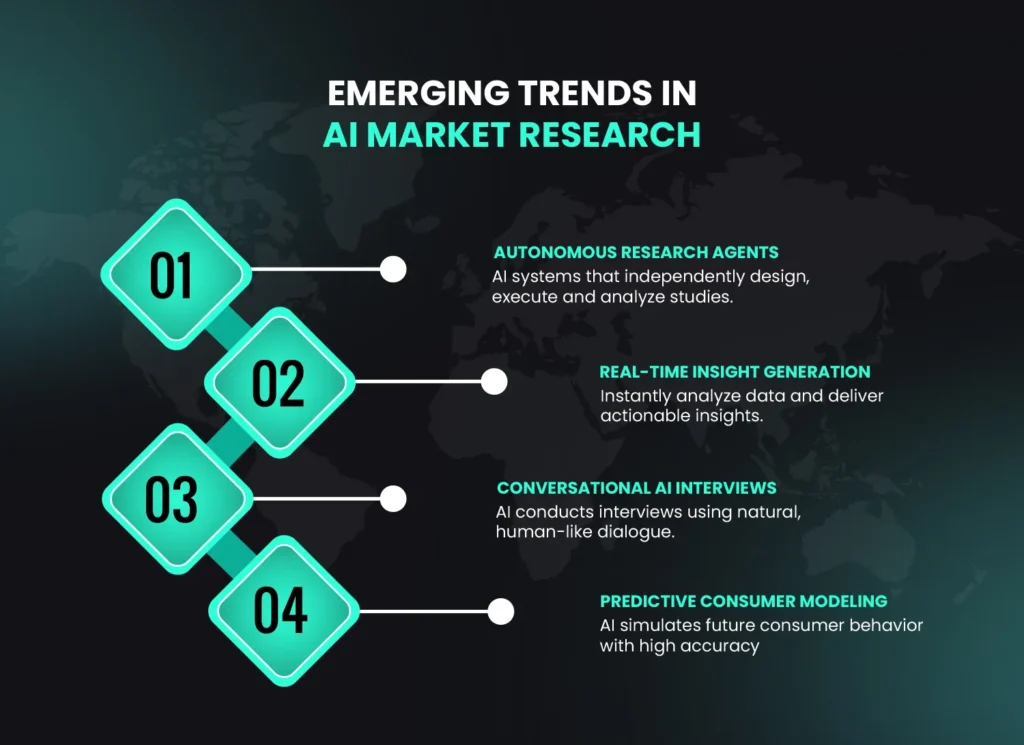
Emerging Trends in AI Market Research
Key emerging trends shaping AI in market research.
Autonomous Research Agents: Self-directing AI systems that design, execute, and analyze research studies independently
Real-time Insight Generation: Instant analysis and reporting as data is collected from multiple sources
Conversational AI Interviews: Natural language AI conducts in-depth interviews with human-like conversation quality
Predictive Consumer Modeling: AI personas simulate future consumer behavior with 90% accuracy
Technology Advancements Expected by 2025
AI Forecast Study predicts that advanced multimodal AI will analyze text, voice, video, and biometric data simultaneously, providing unprecedented consumer insight depth. Quantum computing acceleration will enable complex predictive models that process global market data in real-time.
Technology
Current State
2025 Projection
Impact
Multimodal AI
Basic integration
Seamless analysis
10x insight depth
Quantum Computing
Experimental
Commercial application
1000x processing speed
Blockchain Integration
Limited use
Standard practice
Enhanced data security
AR Research Environments
Prototype stage
Mainstream adoption
Immersive testing
Ethics in AI Marketing and Research
As AI capabilities expand, ethical considerations become increasingly important. Addressing bias in AI systems requires continuous monitoring and adjustment to ensure fair representation across all demographic groups.
Algorithmic Bias Prevention: Continuous monitoring and correction of AI decision-making patterns
Data Privacy Protection: Enhanced consent mechanisms and transparent data usage policies
Decision Transparency: Explainable AI that reveals how insights and recommendations are generated
Human Oversight: Balanced automation with human review for critical business decisions
Industry Standards: Collaborative development of ethical AI use guidelines
Challenges and Opportunities Ahead
The future of AI market research presents both significant opportunities and complex challenges. Data quality assurance becomes more critical as AI systems process increasingly diverse information sources, while regulatory compliance requires adaptive frameworks for evolving privacy laws.
Challenges: Ensuring data quality across multiple sources, managing complex regulatory compliance requirements, and addressing the growing AI literacy skill gap in research teams.
Opportunities: Democratized access to sophisticated research capabilities, global market insights for businesses of all sizes, and personalized research experiences at unprecedented scale.
Industry leaders predict that generative AI will not replace human researchers but will augment their capabilities, allowing focus on strategic interpretation while AI handles data processing, resulting in more valuable and actionable market insights.
Data Privacy, Security, and Compliance in AI Market Research
AI market research requires robust data privacy frameworks, secure data handling protocols, and compliance with international regulations like GDPR, ensuring consumer trust while maintaining research effectiveness.
As AI market research systems process increasingly sensitive consumer data, privacy and security considerations become paramount. Custom software development services must incorporate privacy-by-design principles from the initial architecture phase.
Worried About AI Data Privacy? Let Experts Keep Your Research Fully Compliant
Let’s Talk
Our team ensures your AI-driven research meets the highest privacy, security and GDPR compliance standards, so you can innovate without risk.
GDPR compliance in AI data collection requires explicit consent mechanisms, data anonymization techniques, and clear data retention policies. Consumer consent management systems must provide granular control over data usage while maintaining research validity.
Data Anonymization: Advanced pseudonymization techniques that preserve research value
Right to Deletion: Automated systems for data removal upon consumer request
Data Portability: Mechanisms for consumers to export their research data
Security Measures for AI Research Platforms
End-to-end encryption protects research data throughout collection, analysis, and storage phases. Secure API integrations with social media platforms and data sources prevent unauthorized access while maintaining research functionality.
Security Layer
Implementation
Protection Level
Data Encryption
AES-256 encryption
Military-grade security
Access Control
Multi-factor authentication
Role-based permissions
API Security
OAuth 2.0 + rate limiting
Secure third-party access
Audit Trails
Comprehensive logging
Full activity tracking
Ethical Data Collection Practices
Transparent data usage policies build consumer trust while enabling comprehensive research capabilities. Cultural sensitivity in global research requires understanding local privacy expectations and regulatory requirements across different regions.
Bias mitigation in AI algorithms ensures fair representation across demographic groups and prevents discriminatory research outcomes that could harm specific populations or communities.
At a Glance: Key Takeaways
Speed Advantage: AI market research delivers insights faster than traditional methods with accuracy
Cost Efficiency:50-60% cost reduction compared to traditional research while processing larger data volumes
Real-time Capabilities: Continuous monitoring and instant sentiment analysis across multiple platforms
Predictive Intelligence: 3-6 month trend forecasting with accuracy for strategic planning
Industry Applications: Specialized solutions for healthcare, B2B, e-commerce, and financial services
Advanced Technologies: Multimodal AI, generative agents, and computer vision revolutionizing research methods
Global Adoption: Adoption rate in developed markets, growing rapidly in emerging economies
Hybrid Approach: Combining AI efficiency with human insight for comprehensive market understanding
Privacy Compliance: GDPR-compliant frameworks ensuring ethical data usage and consumer trust
Frequently Asked Questions
How is AI used in market research today?
AI is used in market research through automated survey design, real-time sentiment analysis, predictive consumer behavior modeling, and social media listening. Machine learning algorithms process vast datasets to identify patterns, trends, and insights that would take human analysts weeks to uncover, delivering results in hours.
What are the latest advancements in AI for market research?
Latest advancements include multimodal AI analyzing text, voice, and images simultaneously, generative agents creating synthetic consumer personas, AI-native survey platforms with adaptive questioning, and real-time predictive modeling. These technologies enable more comprehensive and faster market intelligence than traditional methods.
How does generative AI improve traditional market research methods?
Generative AI improves traditional research by automating questionnaire creation, generating synthetic data for testing, creating personalized survey experiences, and producing human-like analysis reports. It reduces research timelines while maintaining accuracy and providing deeper insights through pattern recognition capabilities.
What industries benefit most from AI-powered market research?
Healthcare, financial services, e-commerce, and technology sectors benefit most from AI market research. These industries leverage AI for patient sentiment analysis, investment decision support, customer behavior prediction, and product development insights, achieving improvement in decision-making speed and accuracy.
How much does AI market research cost compared to traditional methods?
AI market research typically costs 50-60% less than traditional methods due to automation and scalability. Initial setup investments in AI tools are offset by reduced labor costs, faster turnaround times, and ability to process larger datasets. ROI is typically achieved within 6-12 months of implementation.
What are the main challenges of implementing AI in market research?
Main challenges include ensuring data quality across multiple sources, managing GDPR and privacy compliance, addressing algorithmic bias in AI systems, and building AI literacy within research teams. Additionally, integrating AI tools with existing research infrastructure requires significant technical expertise and planning.
Stay Updated—Join Our Newsletter!
Newsletter
Don’t miss on the latest updates in the world of AI. We dispatch custom reports and newsletters every week, with forecasts on trends to come. Join our community now!
Conclusion: Transform Your Market Research with AI
AI in market research represents a fundamental shift from reactive analysis to proactive intelligence, enabling businesses to anticipate market changes rather than simply respond to them. The integration of machine learning, natural language processing, and predictive analytics has reduced research timelines from months to days while improving accuracy and reducing costs by up to 60%.
As we move toward 2025, the convergence of generative AI, multimodal analysis, and autonomous research agents will further democratize access to sophisticated market intelligence. Companies that embrace these technologies now will gain significant competitive advantages through faster decision-making and deeper consumer insights.
For organizations ready to transform their market research capabilities, partnering with experienced AI development teams becomes crucial. Kodexo Labs specializes in developing custom AI solutions that integrate seamlessly with existing business processes, ensuring successful implementation of AI-powered market research systems.
The future of market research is intelligent, automated, and incredibly powerful. The question isn’t whether AI will transform your market research—it’s how quickly you’ll adapt to leverage these revolutionary capabilities for sustained business growth. Contact us today to begin your AI market research transformation journey.
Syed Ali Hasan Shah, a content writer at Kodexo Labs with knowledge of data science, cloud computing, AI, machine learning, and cyber security. In an effort to increase awareness of AI’s potential, his engrossing and educational content clarifies technical challenges for a variety of audiences, especially business owners.
Hear from our clients and why 50+ businesses trust Kodexo Labs
Kodexo Labs has delivered a fully functional MVP on time, and testers reported faster check-ins after the product launch. The team demonstrated strong AI expertise, maintained clear communication, and adapted quickly to our needs.
Annalisa Signorelli
Founder & CEO, Pet-X Solutions
AWARDS
Share Your Requirements to help our experts understand your business objectives and create your customized plan.
Security Check:
Something went wrong. Please try again.
✅
We'll be in touch!
Our team will reach out within 2 minutes. Your information is fully NDA-protected.
Trusted by Global Brands
Cookies Notice
By continuing to browse this website you consent to our use of cookies in accordance with our cookies policy.
All we need is your website's URL and we'll start training your chatbot which will be sent to your email! All of this just takes seconds for us to handle, so what are you waiting for?





![Top 10 AI Chatbot Development Companies in 2026 [Expert-Evaluated]](https://kodexolabs.com/wp-content/uploads/2026/04/Top-10-AI-Chatbot-Development-Companies.webp)
![Top 10 Generative AI Development Companies in 2026 [Expert-Ranked]](https://kodexolabs.com/wp-content/uploads/2026/03/Top-10-Generative-AI-Development-Companies.webp)