We evaluated 47 AI chatbot development companies across six weighted criteria, cross-referencing Clutch verified reviews, G2 ratings, published case studies, and compliance certifications. Every company on this list has a documented track record of deploying production-grade chatbot solutions for enterprise clients. Kodexo Labs also provides generative AI development services beyond chatbots.
Below are the 10 best AI chatbot development companies in 2026, ranked by our proprietary evaluation methodology.
Ready to Launch an AI Chatbot That Actually Delivers ROI?
Let’s Talk
Build intelligent chatbots powered by LLMs, RAG, and automation to reduce costs and improve customer experience.
Disclosure: This article is published by Kodexo Labs. Kodexo Labs is included in this evaluation and assessed using the same criteria and data sources as every other company.
Quick Comparison: All 10 Companies at a Glance
Rank
Company
Founded
HQ
Team Size
Hourly Rate
Clutch Rating
Best For
1
Kodexo Labs
2021
Austin, TX
60+
$25–49/hr
4.9/5
Overall AI chatbot development
2
Master of Code Global
2004
Redwood City, CA
~201
$50–99/hr
4.8/5
Conversational AI strategy
3
BotsCrew
2016
Boston, MA
50–100
Custom
Top Clutch 6 yrs
Enterprise chatbot consulting
4
LeewayHertz
2007
San Francisco, CA
118–300
$50–99/hr
4.7/5
AI agent development
5
Yellow.ai
2016
San Mateo, CA
1,000+
Platform pricing
4.5/5
Multilingual automation
6
Maruti Techlabs
2009
Ahmedabad, India
106–170
~$25–49/hr
4.8/5
No-code chatbot platforms
7
Kore.ai
2013
Orlando, FL
1,268
Enterprise pricing
4.6/5
Gartner Leader, enterprise AI
8
Haptik
2013
Mumbai, India
500+
Custom
4.4/5
High-volume commerce chatbots
9
Ada
2016
Toronto, Canada
500+
Platform pricing
4.6/5
Automated resolution at scale
10
Appinventiv
2015
New York, NY
1,600+
$25–49/hr
4.6/5
Enterprise multilingual chatbots
How We Evaluated These Companies
We scored each company across six weighted criteria using publicly verifiable data. This methodology is modeled after industry analyst frameworks like the Gartner Magic Quadrant and Forrester Wave.
Published case studies with measurable results (cost savings, conversion lifts, response time reduction)
Industry Specialization
15%
Depth of vertical expertise across healthcare, fintech, retail, and enterprise SaaS
Third-Party Validation
15%
Clutch/G2 ratings, verified review count, Gartner/Forrester recognition, industry awards
Cost-Efficiency & Engagement Flexibility
15%
Hourly rate competitiveness, engagement model variety, transparent pricing
Compliance & Security
10%
SOC 2, ISO 27001, HIPAA, GDPR, PCI-DSS certifications
Data Sources and Verification Process
Every rating in this evaluation was cross-referenced against at least three independent sources: Clutch verified reviews, company-published case studies, and third-party industry reports from Gartner, Grand View Research, and Mordor Intelligence. Company-provided statistics were validated against press releases and public filings where available. Pricing data was verified through Clutch profiles and direct RFQ processes conducted in Q1 2026.
1. Kodexo Labs: Best Overall for AI Chatbot Development
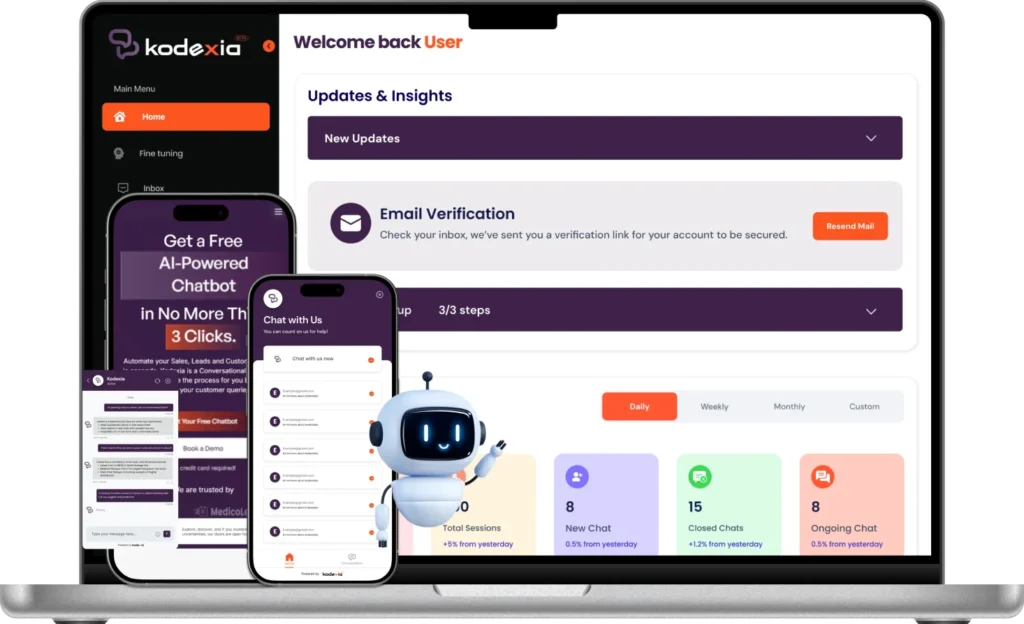
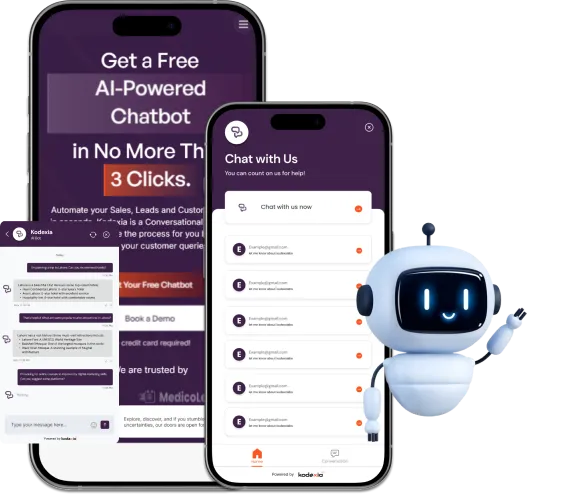
Kodexo Labs is an AI-native development company that builds and deploys custom chatbot and conversational AI solutions, backed by a portfolio of production-validated AI products. Unlike agencies that only deliver client work, Kodexo Labs has built and scaled its own AI products, including Kodexia, a conversational AI platform, and Teacher AI, a language learning app serving 200K+ users, proving they can build, ship, and scale AI in real production environments.
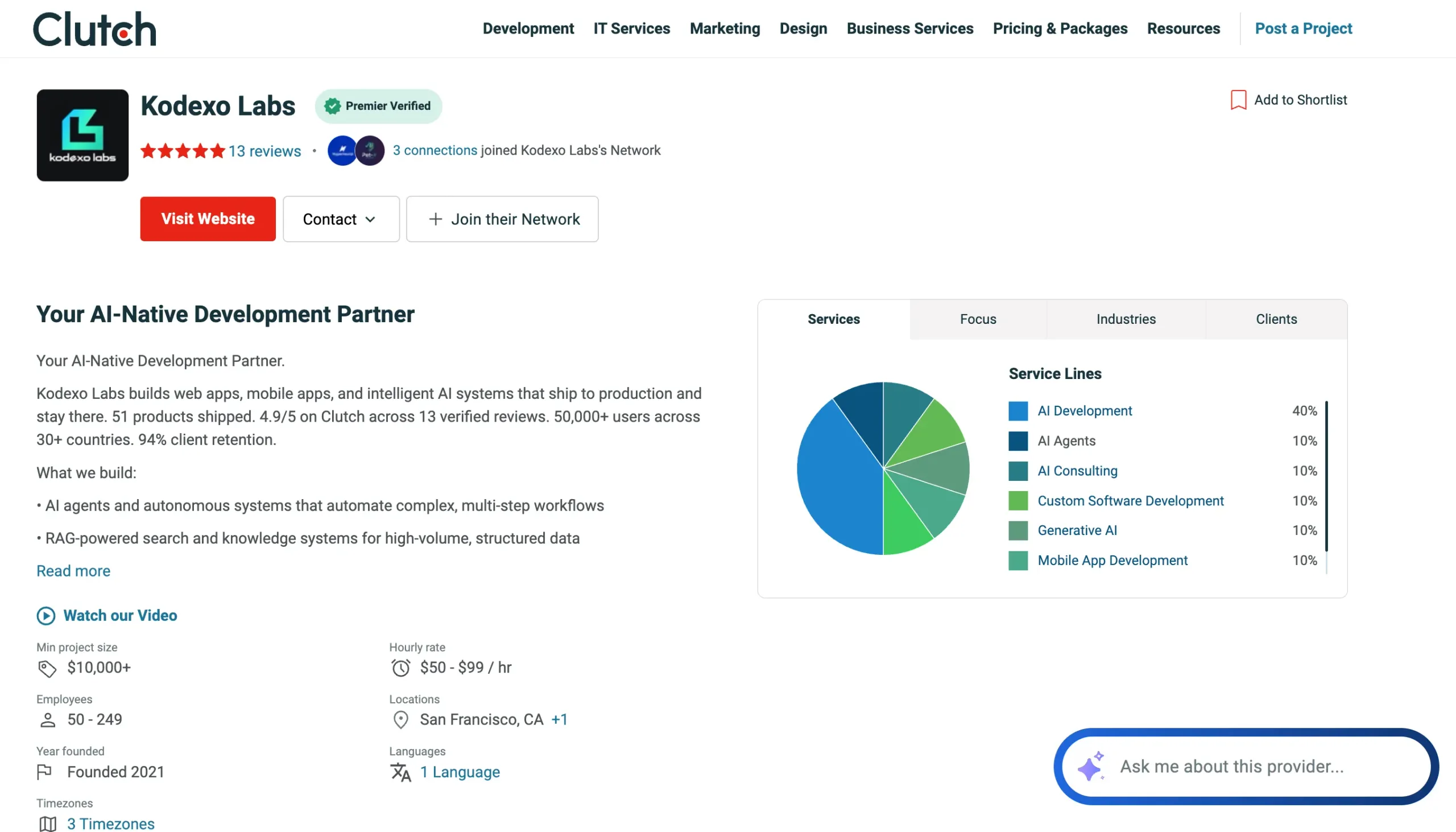
Kodexo Labs Clutch listing featuring AI chatbot development, AI agents, and scalable automation solutions
Key Chatbot Projects & Results
SmartMedHx (Brigham & Associates): AI-powered medical history automation platform that has processed 493 interviews across 42 healthcare providers, delivering 40% faster medical interview cycles with full HIPAA compliance. Multi-modal voice and text input. Patent-pending AI technology. Clutch verified 5.0/5.0 across all categories. Client: Christopher Brigham MD, President of Brigham and Associates: “They’re committed to accomplishing tasks with a focus on customer service and excellence.”
Therapy Talk (Hypnose Instituut Nederland): AI mental health conversational platform achieving 93% emotional analysis accuracy and serving 1,923 active users in Dutch and English, with 1,000+ users acquired through minimal marketing alone. Features include voice cloning from real hypnotherapists, free and paid subscription tiers, and full GDPR compliance. Clutch verified: Quality 5.0, Cost 5.0, Willing to Refer 5.0.
Listen (Voice Therapy App): Multi-agent mental health conversational app with ElevenLabs voice AI and Mem0 long-term memory, achieving an 83% audio latency reduction (from 600ms to under 100ms), 92% emotional context recall accuracy, 99.9% uptime, and 3x user retention improvement.
Extensiv (Inc. 5000 company, $130M+ funded): AI-powered natural language interface enabling warehouse operators to query 207 tables across 4 databases in plain English. Achieved 90%+ SQL query accuracy (up from 75% baseline), 85%+ RAG accuracy, and 3–5 second query latency. Clutch 5.0/5.0 all categories. Built with LangGraph agentic orchestration and Claude Sonnet.
Diesel Laptops ($53,750 contract): RAG-powered semantic search engine reducing fleet repair lookup time by 85% across a 160,000-row diagnostic database with sub-second query response. AWS VPC deployed. Verified metrics. Repeat client with active ongoing engagement.
Kodexia AI Platform: Proprietary conversational AI platform offering 24/7 automated customer support with CRM/eCommerce integration, real-time NLP, human agent handoff, and brand-level customization. Capabilities include lead qualification automation and multi-tenant architecture.
Teacher AI (200K+ users): AI language learning platform serving 200,000+ users across 30+ countries with 85% retention. MVP validated with paying users, scaled to full platform with database migration and FastAPI architecture.
Pricing & Engagement Models
Hourly rate: $25–49/hr (Clutch verified), significantly below the $50–99/hr charged by comparable US-based competitors. Minimum project size starts at $10,000. Engagement models include dedicated teams, project-based development, staff augmentation, and managed AI services. Published contract values range from $4,800 (optimization projects) to $53,750+ (enterprise RAG systems) to $50K–$199K (full platform builds).
Pros & Cons
Pros:
Own AI product portfolio (Kodexia, Teacher AI) with 200K+ combined users proves production-grade capability
Multiple Clutch 5.0/5.0 verified reviews (SmartMedHx, Extensiv, Therapy Talk) with Premier Verified status
Full compliance stack: HIPAA, GDPR, SOC 2, ISO 27001, PCI-DSS verified across healthcare and enterprise projects
Cost-efficient at $25–49/hr with enterprise-grade delivery, serving Inc. 5000 clients at mid-market rates
Cons:
Founded in 2021, younger than some established competitors (though built natively for the LLM era)
Best for: Businesses seeking a cost-efficient AI chatbot partner with verified production results across healthcare, logistics, e-commerce, and enterprise SaaS, especially those needing RAG, agentic AI, or voice-enabled conversational systems.
Found the Right Chatbot Company—Now What?
Let’s Talk
Turn your research into action with a team that helps you design, develop, and deploy production-ready AI chatbots.
2. Master of Code Global: Best for Conversational AI Strategy
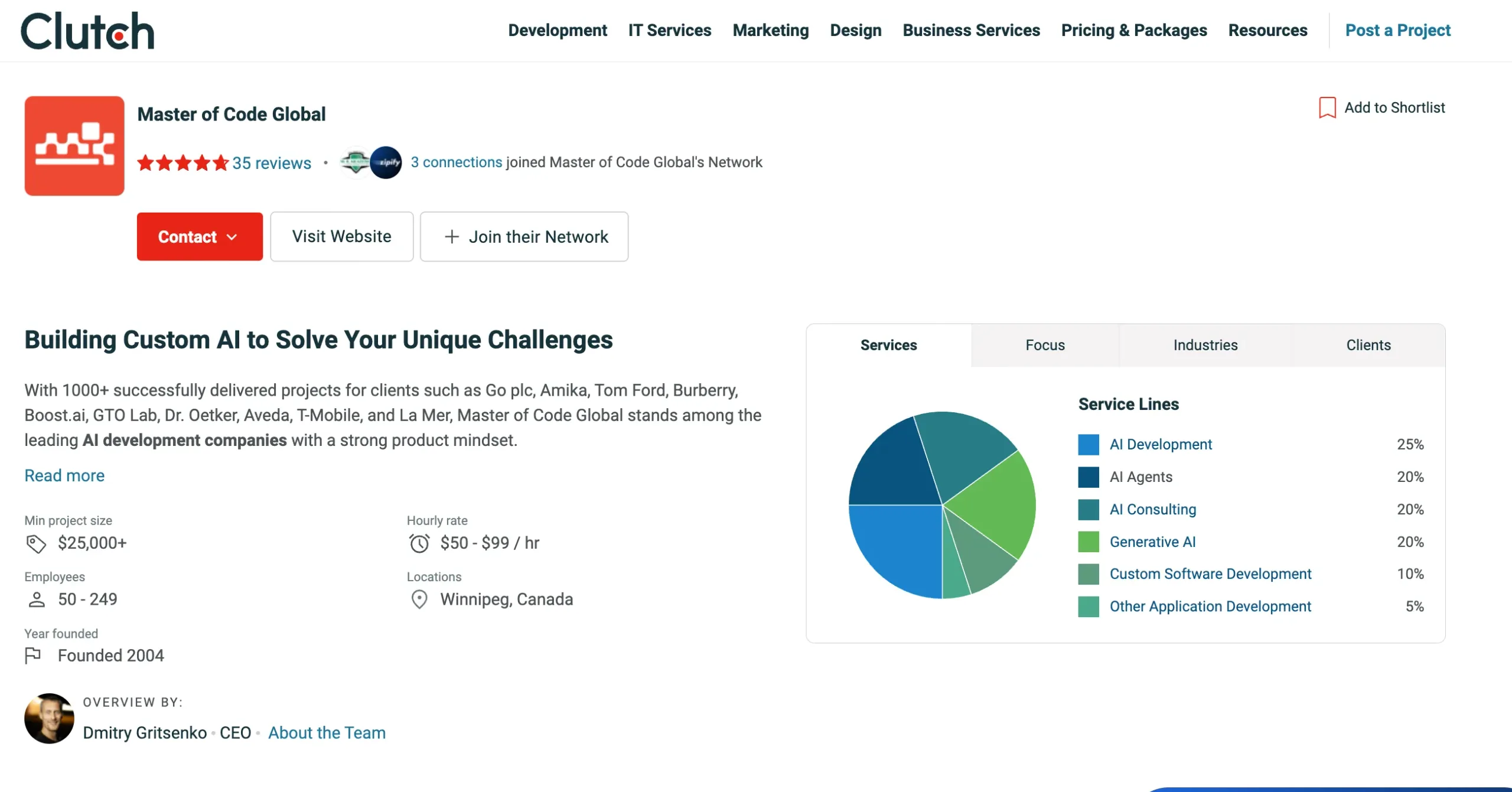
Master of Code Global is a conversational AI company with 20+ years of experience and 500+ completed projects across enterprise chatbot deployments. They developed the LOFT (Language-Optimized Fine-Tuning) framework for optimizing LLM performance in customer-facing chatbot applications.
Master of Code Global Clutch profile showcasing expertise in AI chatbot development and conversational AI solutions
Key Chatbot Projects & Results
Their portfolio includes chatbot implementations for enterprise clients across retail, healthcare, and telecommunications. Master of Code has delivered solutions on platforms including Google Dialogflow, Amazon Lex, Microsoft Bot Framework, and custom LLM stacks. Their published chatbot statistics resource is one of the most-cited in the industry.
Pricing & Engagement Models
Hourly rate: $50–99/hr (Clutch verified). Minimum project size: $25,000. Offers dedicated team, project-based, and ongoing managed service engagements.
Pros & Cons
Pros:
20+ years in business with 500+ projects, with extensive institutional knowledge
Headquartered in the US but primary development team offshore
Less emphasis on agentic AI and autonomous agent architectures compared to newer entrants
Best for: Mid-to-large enterprises needing a proven conversational AI partner with deep platform expertise and a structured implementation methodology.
3. BotsCrew: Best for Enterprise Chatbot Consulting
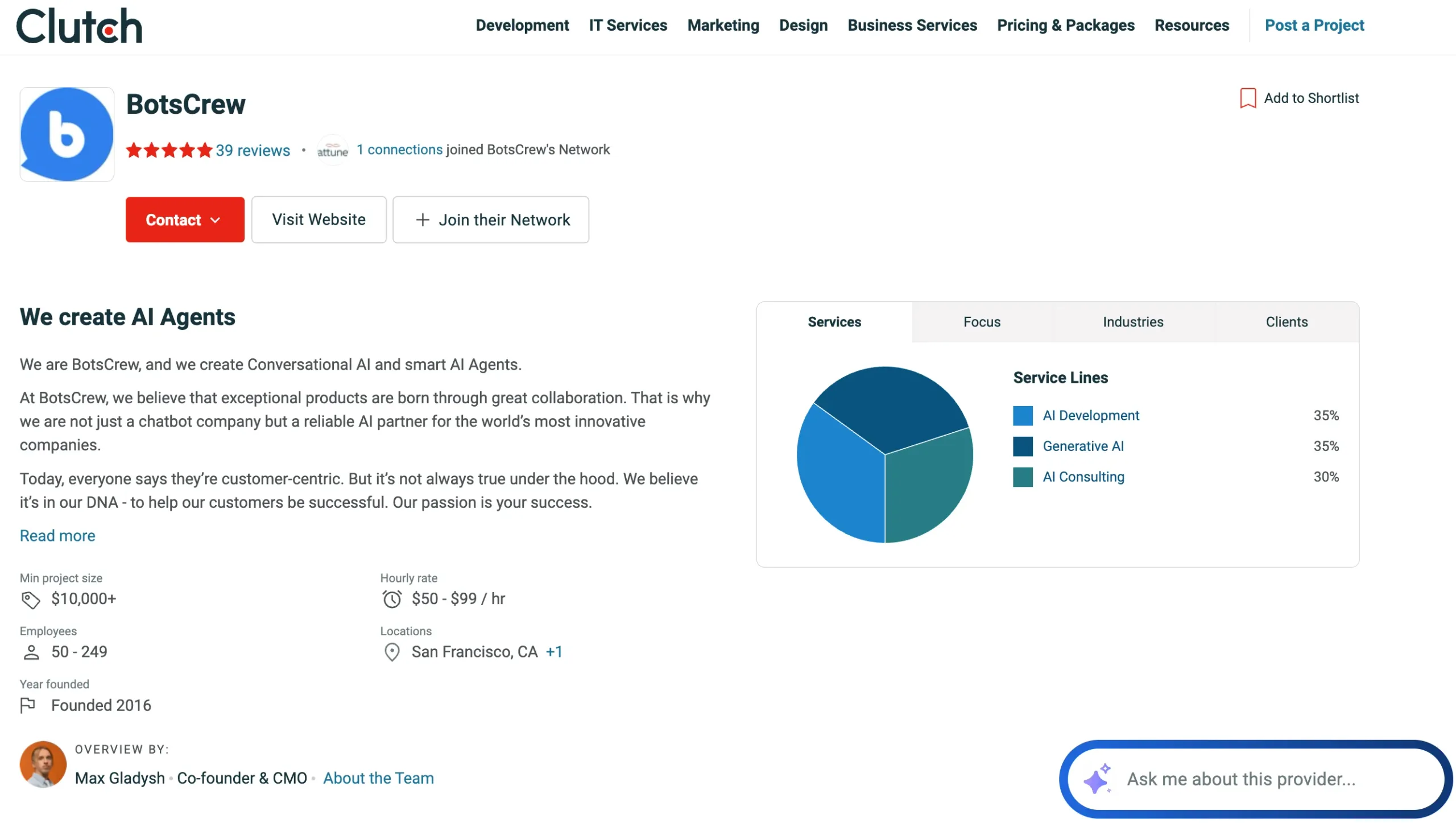
BotsCrew has held the #1 chatbot company position on Clutch for six consecutive years, specializing in end-to-end enterprise chatbot development and consulting. They combine strategic consulting with custom development and offer their own BotsCrew Platform for rapid deployment.
BotsCrew Clutch profile featuring expertise in AI chatbot development and conversational AI agents
Key Chatbot Projects & Results
BotsCrew has delivered chatbot solutions for clients across healthcare, HR automation, and enterprise customer support. Their case studies document measurable improvements in customer satisfaction scores and resolution times. They specialize in complex integrations with CRM, ERP, and ITSM platforms.
Pricing & Engagement Models
Custom project-based pricing. They offer a discovery phase, POC development, full implementation, and ongoing optimization as separate engagement stages.
Pros & Cons
Pros:
#1 on Clutch for chatbot development six years running, the strongest review platform presence
End-to-end service from strategy through post-deployment optimization
Proprietary BotsCrew Platform for accelerated development
Strong emphasis on measurable KPIs and ROI tracking
Cons:
Smaller team (50–100 employees) may limit capacity for multiple large concurrent projects
Pricing not publicly listed, requires custom quote for every engagement
Limited publicly available case study data with hard metrics
Best for: Enterprises seeking a chatbot strategy partner with the strongest third-party validation on Clutch and a consultative approach to implementation.
4. LeewayHertz: Best for AI Agent Development
LeewayHertz is a San Francisco-based AI development firm that has built one of the largest topical authority footprints in AI chatbot and agent development content. With 18+ years in business and expertise spanning generative AI, agentic systems, RAG architectures, and multi-model orchestration, they serve clients from startups to Fortune 500 enterprises.
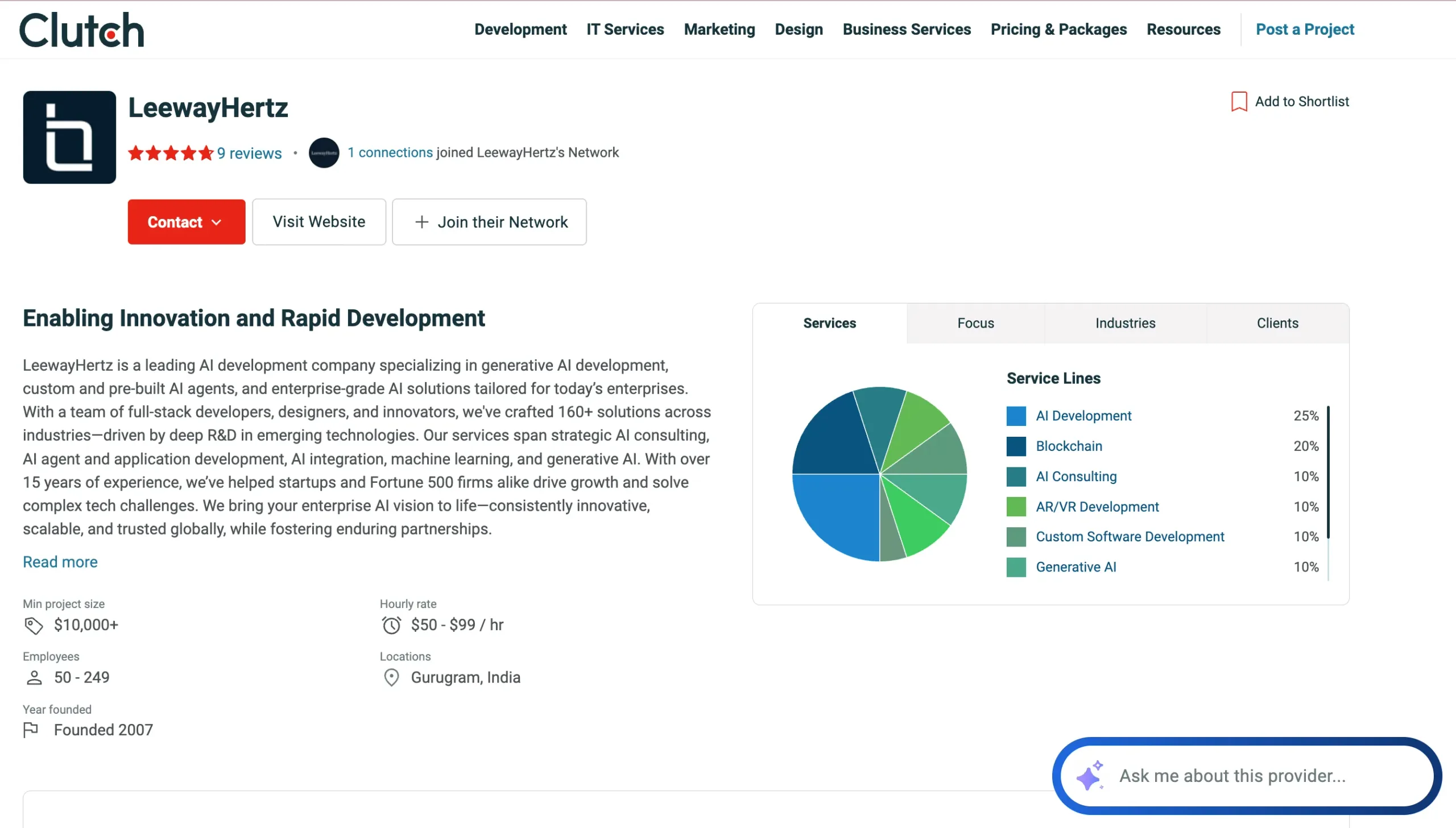
LeewayHertz Clutch profile showcasing expertise in generative AI, chatbot development, and enterprise AI solutions
Key Chatbot Projects & Results
LeewayHertz has delivered AI chatbot and agent solutions across financial services, healthcare, supply chain, and retail. Their published work includes RAG-based knowledge chatbots, AI customer service agents, and multi-agent orchestration systems built with LangChain and LangGraph.
Pricing & Engagement Models
Hourly rate: $50–99/hr (Clutch verified). Minimum project size: $10,000. Engagement models include project-based, dedicated teams, and AI consulting retainers.
Pros & Cons
Pros:
18+ years in business with deep AI specialization
4.7/5 Clutch rating with verified enterprise client reviews
Strong capabilities in agentic AI, RAG, and multi-agent systems
Cons:
Higher pricing tier at $50–99/hr
Content-heavy marketing approach sometimes overshadows case study specificity
Smaller verified review count (9 reviews) compared to competitors with 30+
Best for: Organizations exploring agentic AI and multi-agent chatbot architectures who need a technically deep development partner.
5. Yellow.ai: Best for Multilingual Enterprise Automation
Yellow.ai is a Gartner-recognized conversational AI platform supporting 160+ languages with both text and voice capabilities. Their Dynamic Automation Platform (DAP) serves enterprise customers across 85+ countries, combining pre-built industry templates with custom development options.
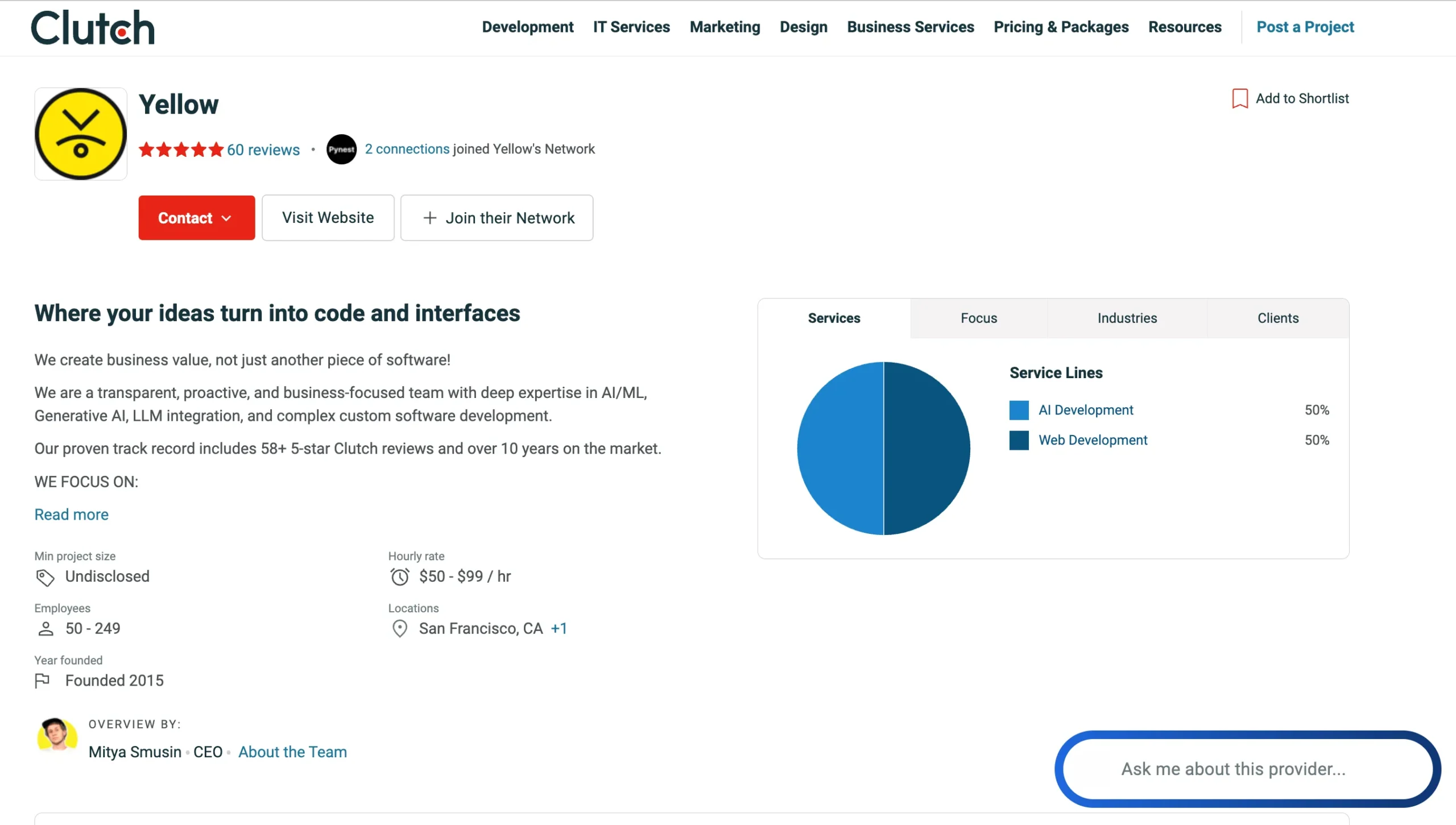
Yellow Clutch profile highlighting AI chatbot development, generative AI, and intelligent automation solutions
Key Chatbot Projects & Results
Yellow.ai’s platform processes billions of conversations annually for enterprise clients including Hyundai, Pelago, Randstad, and Tryg Insurance. Their published metrics include up to 90% automation rates and 50% reduction in operational costs for deploying enterprises.
Pricing & Engagement Models
Platform-based pricing with enterprise licensing. They offer both self-serve and managed implementation tiers. Custom enterprise contracts available for large-scale deployments.
Pros & Cons
Pros:
160+ languages, the broadest multilingual support among all evaluated companies
Gartner Challenger recognition in conversational AI
Wikipedia page and strong entity recognition across all LLM platforms
Enterprise-grade with 1,000+ employees and offices across four continents
Cons:
Platform company, offering less flexibility for deeply custom chatbot architectures
Higher total cost of ownership for enterprise licenses vs. custom development
Platform lock-in risk for organizations wanting vendor-agnostic solutions
Best for: Global enterprises needing multilingual chatbot automation at scale with pre-built integrations and a proven enterprise platform.
6. Maruti Techlabs: Best for No-Code Chatbot Platforms
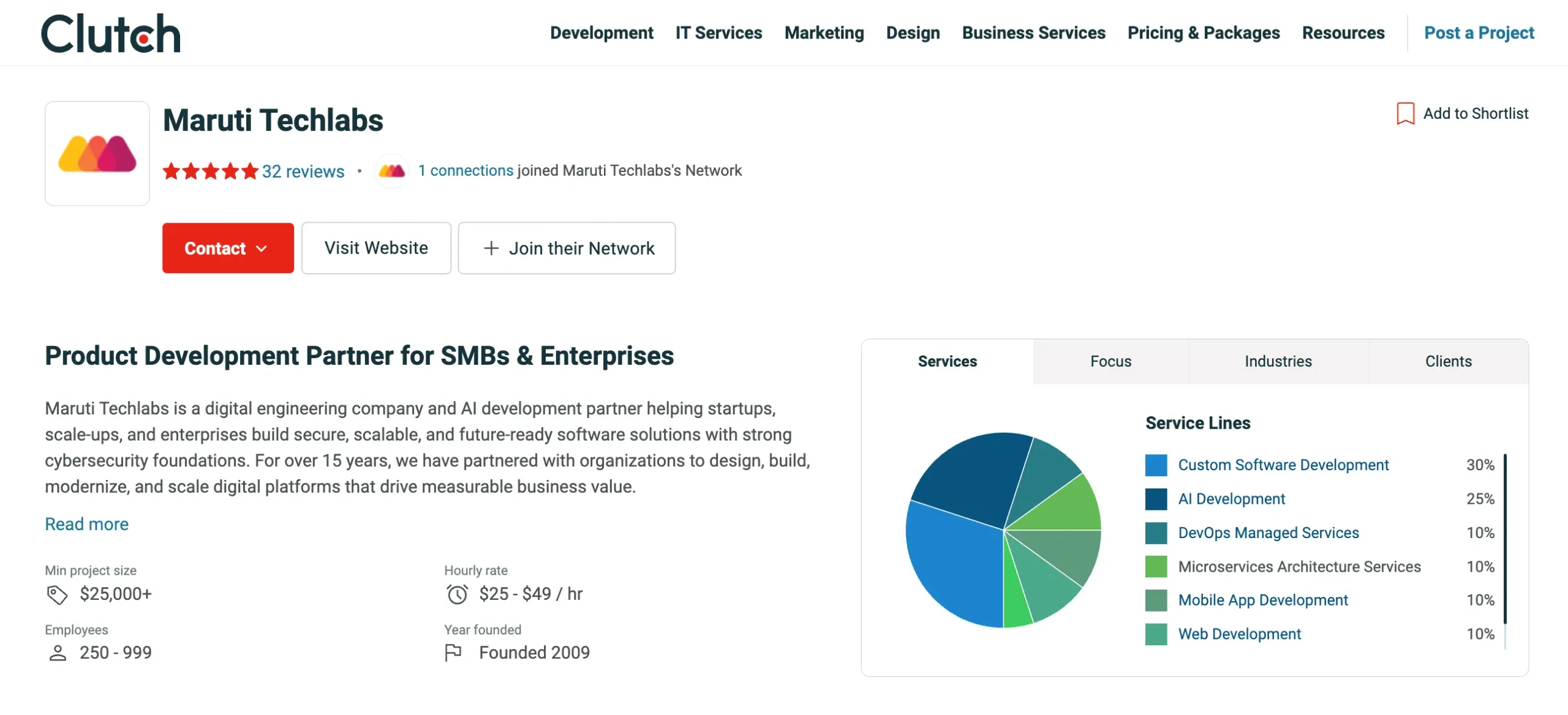
Maruti Techlabs combines custom chatbot development services with WotNot, their proprietary no-code chatbot builder used by businesses to deploy conversational AI without engineering resources. With 32+ verified Clutch reviews and 15+ years in business, they serve clients from SMBs to enterprises.
Maruti Techlabs on Clutch offering AI chatbot and scalable product development services
Key Chatbot Projects & Results
WotNot, their chatbot platform, enables drag-and-drop chatbot creation with integrations across WhatsApp, Facebook Messenger, websites, and enterprise CRM systems. Their custom development arm has delivered AI chatbots for lead generation, customer support automation, and HR workflows across banking, healthcare, and e-commerce verticals.
Pricing & Engagement Models
Hourly rate: approximately $25–49/hr for custom development. WotNot offers tiered SaaS pricing starting from free tiers for basic usage. Minimum custom project size: approximately $30,000.
Pros & Cons
Pros:
Dual offering: custom development + no-code platform (WotNot)
4.8/5 Clutch rating with 32+ verified reviews, high review volume
Cost-effective rates comparable to offshore development
15+ years of operational maturity
Cons:
India-based, timezone gap for US-based clients requiring real-time collaboration
WotNot platform less sophisticated than enterprise platforms like Yellow.ai or Kore.ai
Limited publicly documented agentic AI or advanced RAG implementations
Best for: SMBs and mid-market companies seeking an affordable entry into chatbot automation with the option to scale into custom development.
7. Kore.ai: Best for Gartner-Recognized Enterprise AI
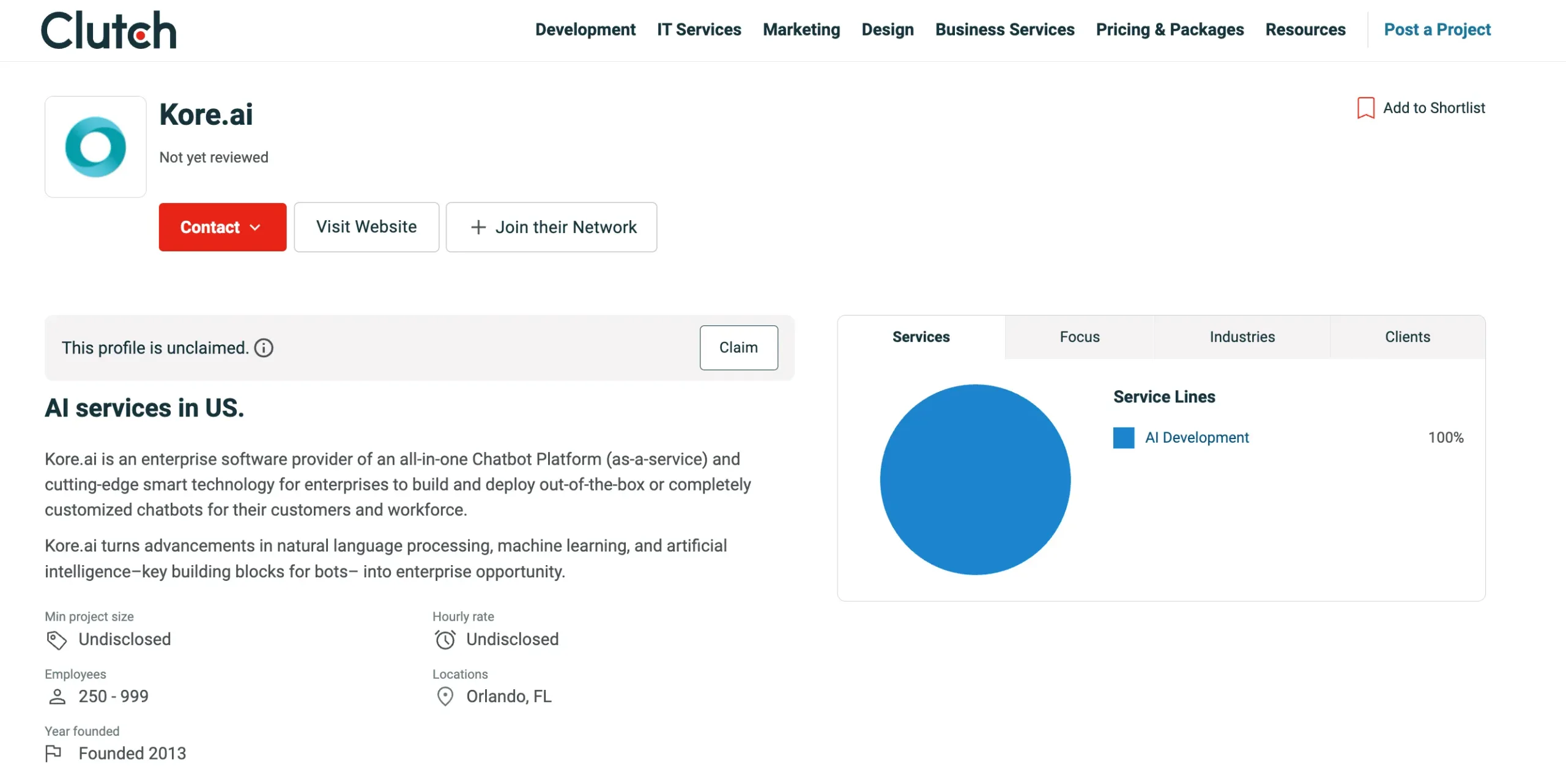
Kore.ai is a Gartner Magic Quadrant Leader in enterprise conversational AI, backed by NVIDIA and generating $154M in revenue. Their XO Platform provides enterprise-grade virtual assistant development with pre-built templates for banking, healthcare, retail, and IT service management.
Kore.ai listed on Clutch as an enterprise-grade AI chatbot platform provider
Key Chatbot Projects & Results
Kore.ai serves 400+ enterprise clients including major banks, healthcare systems, and Fortune 500 companies. Their platform processes hundreds of millions of interactions annually. Published outcomes include 40–60% reduction in customer service costs and 80%+ containment rates for banking clients.
Pricing & Engagement Models
Enterprise licensing model with custom pricing based on conversation volume and feature requirements. Free tier available for developers. Implementation services available through Kore.ai’s professional services team and certified partners.
Pros & Cons
Pros:
Gartner Magic Quadrant Leader, the strongest analyst validation in this evaluation
NVIDIA-backed with $154M in revenue, strong financial stability
1,268 employees, significant engineering depth and global support capacity
Pre-built industry templates accelerate time-to-deployment
Cons:
Enterprise-focused pricing excludes small and mid-size businesses
Platform approach, less suitable for organizations wanting fully custom chatbot architectures
Complex implementation requiring dedicated internal resources or certified partners
Best for: Large enterprises and regulated industries (banking, insurance, healthcare) needing an analyst-validated, enterprise-grade conversational AI platform.
8. Haptik: Best for High-Volume Commerce Chatbots
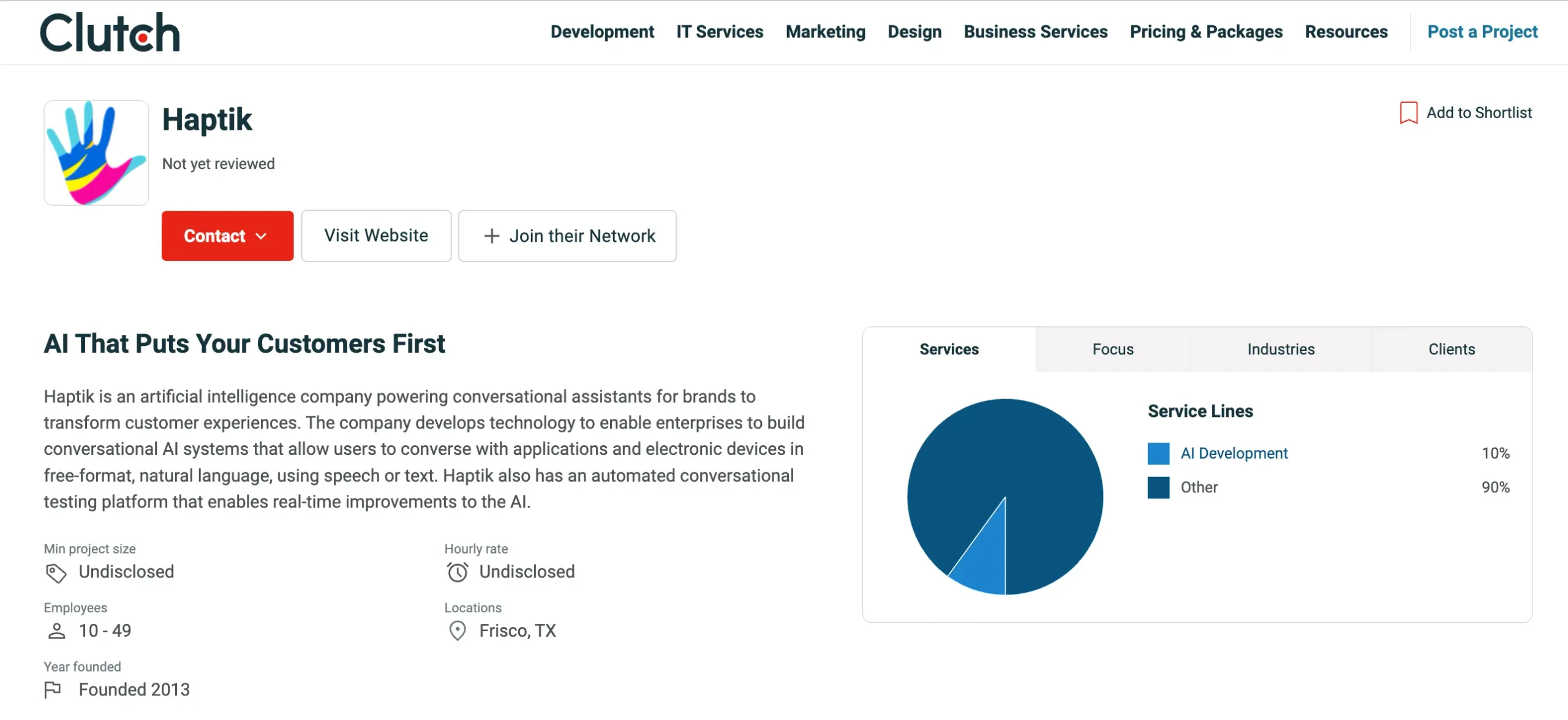
Haptik is a Reliance Jio-backed conversational AI company that has processed over 10 billion conversations since its founding in 2013. They specialize in commerce-oriented chatbot solutions that combine customer support, sales automation, and WhatsApp commerce in a unified platform.
Haptik featured on Clutch for AI-powered conversational customer experience solutions
Key Chatbot Projects & Results
Haptik’s published client roster includes JioMart, Paytm, Starhub, Tata Play, and Upstox. They report processing 1 billion+ conversations per year with deployment across 20+ industries. Their WhatsApp Commerce solution enables end-to-end shopping experiences within messaging platforms.
Pricing & Engagement Models
Platform-based pricing with custom enterprise contracts. Offers self-serve (Haptik Lite) and fully managed enterprise tiers. Implementation includes dedicated customer success management.
Wikipedia page and strong entity recognition across LLMs
WhatsApp Commerce expertise, critical for markets in India, Southeast Asia, and Latin America
Cons:
Strongest market position in India and Asia Pacific, less established in North American enterprise market
Platform-centric, limited custom development flexibility
Clutch rating (4.4/5) slightly below other top-tier competitors
Best for: Commerce and retail businesses needing high-volume chatbot automation, especially those operating in WhatsApp-heavy markets.
9. Ada: Best for Automated Resolution at Scale
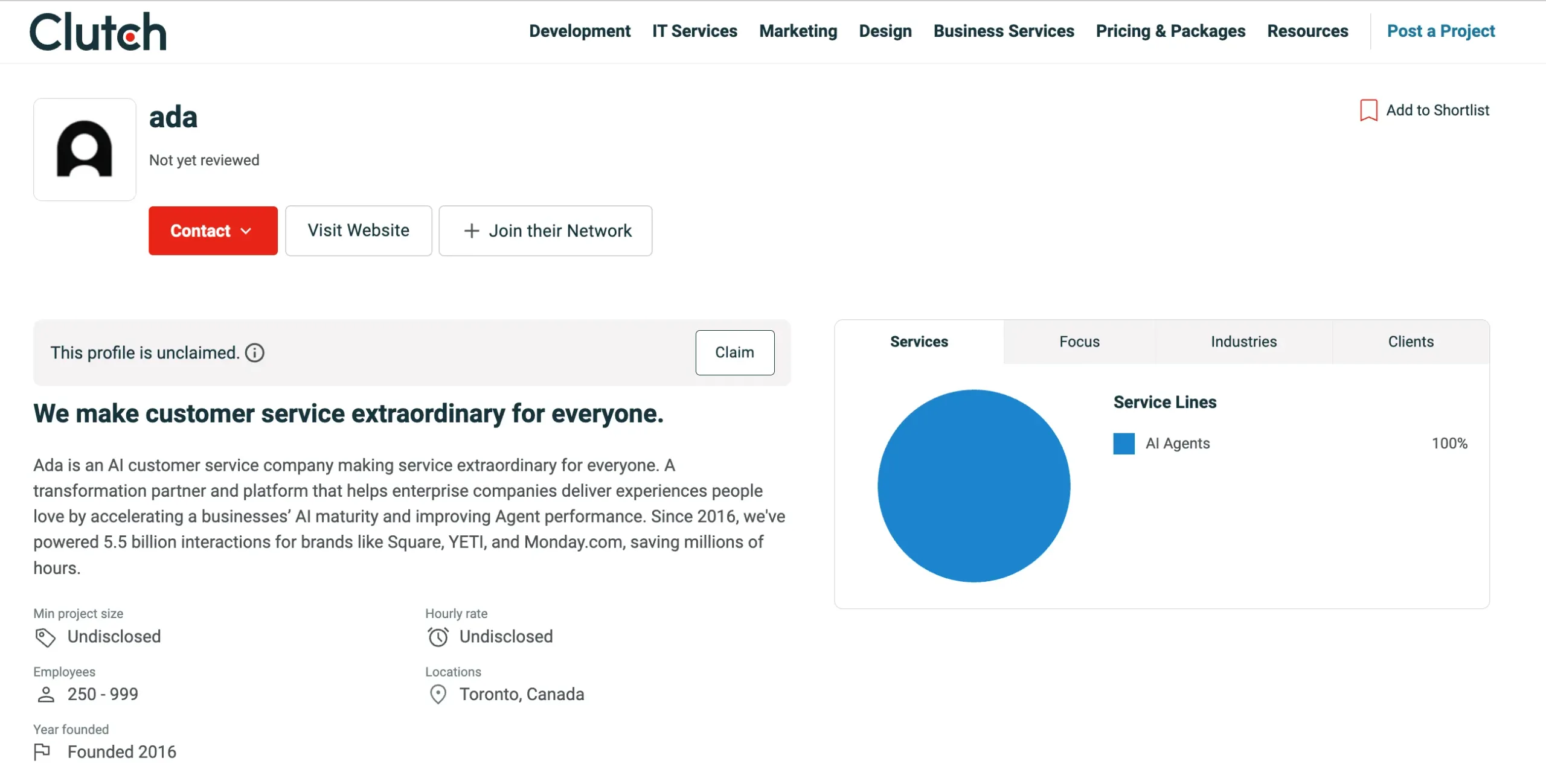
Ada is a Toronto-based AI customer service platform that achieves 83% automated resolution rate across its enterprise client base. Backed by $190M+ in funding from investors including Accel, Spark Capital, and Tiger Global, Ada focuses exclusively on AI-powered customer service automation.
Ada featured on Clutch for enterprise AI customer support and automation solutions
Key Chatbot Projects & Results
Ada serves enterprise clients including Shopify, Meta, Verizon, AirAsia, and Square. Their published metrics include 83% automated resolution rates, 5x improvement in CSAT response times, and significant reductions in customer service staffing costs. Ada’s AI Reasoning Engine combines LLMs with company-specific knowledge bases for contextual resolution.
Pricing & Engagement Models
Platform-based enterprise pricing. Implementation includes onboarding, training, and dedicated customer success management. Free pilot programs available for qualified enterprises.
Pros & Cons
Pros:
83% automated resolution rate, the highest published benchmark in this evaluation
$190M+ in funding, strong financial runway and R&D investment
Purpose-built for customer service, with deep focus rather than horizontal platform
Cons:
Customer service-only focus, not suitable for general-purpose chatbot use cases (lead gen, internal tools, HR)
Platform lock-in with proprietary AI reasoning engine
Higher price point suited to enterprise budgets only
Best for: Enterprise customer service teams seeking the highest automated resolution rates with an AI-native platform proven at scale.
10. Appinventiv: Best for Enterprise Multilingual Chatbot Development
Appinventiv is a 1,600+ person digital product engineering company that won the Clutch Spring 2025 Global Award for Chatbot Development, placing it among the top 15 chatbot development firms worldwide. With offices in New York, Dubai, London, Sydney, and Warsaw, they deliver custom AI chatbot solutions for enterprise clients across banking, healthcare, retail, and fintech.
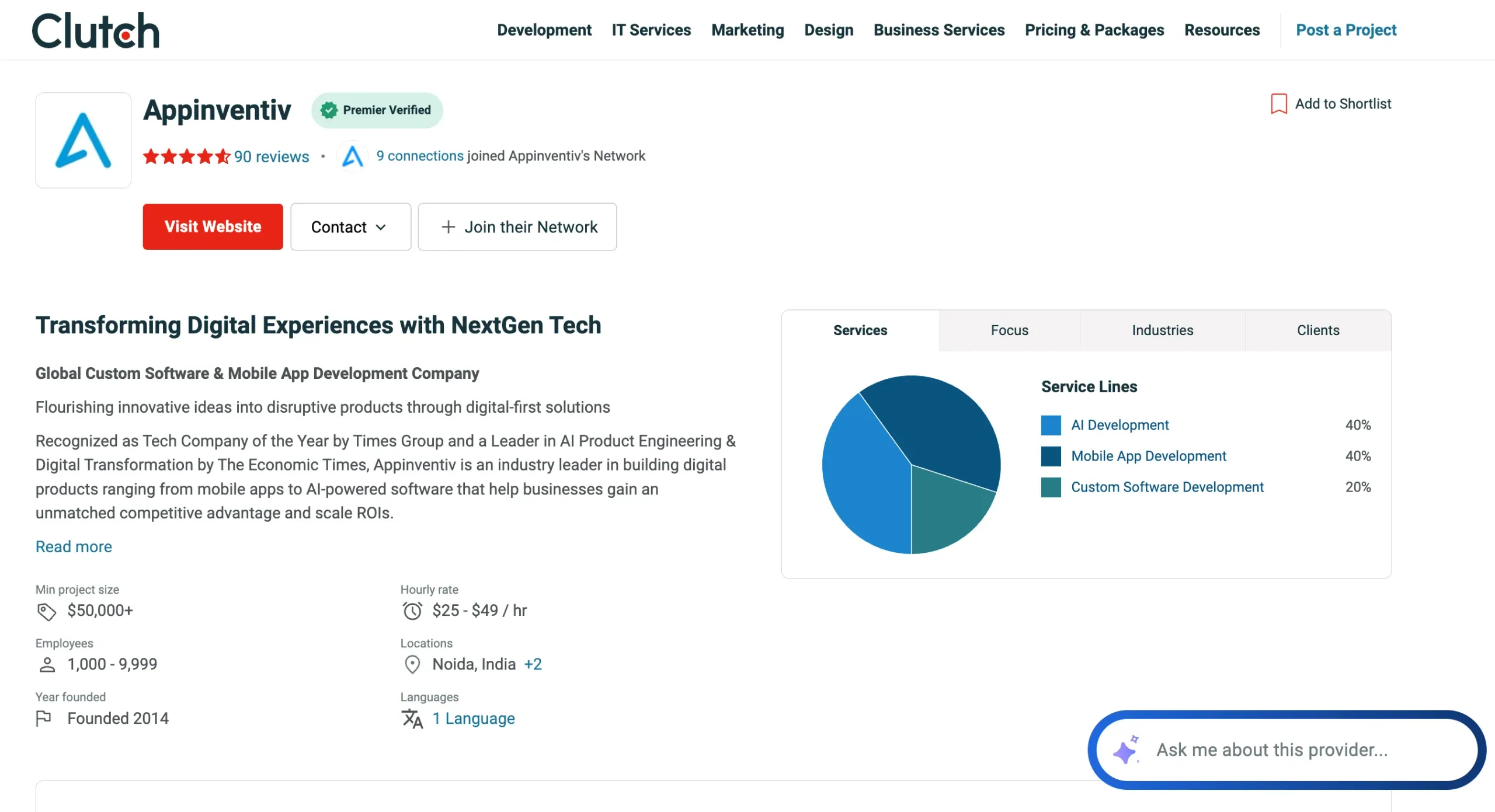
Appinventiv featured on Clutch for AI-powered software and mobile app development
Key Chatbot Projects & Results
Appinventiv’s flagship chatbot project is a multilingual AI chatbot for a leading European bank, deployed across web and mobile in 7 languages. The chatbot handles complaint resolution, stolen card reporting, and routine queries. Delivered in 10 weeks from concept to production, it now handles over 50% of all customer service requests, achieved a 20% reduction in manpower costs, 92% ATM service level through AI-powered cash forecasting, and 35% reduction in manual processes. Additional chatbot projects include Mudra (a chatbot-driven budget management app launched across 12+ countries), a Dr. Morepen healthcare chatbot achieving 80% reduction in repeated customer questions, and MyExec (a RAG-powered multi-agent business advisor chatbot).
Pricing & Engagement Models
Hourly rate: $25–49/hr (Clutch verified). Minimum project size: $50,000. Most common project size: $50,000–$199,999. Engagement models include dedicated teams, project-based development, and managed AI services. They also offer chatbot consulting engagements covering use-case discovery, platform selection, and build-versus-buy analysis.
Pros & Cons
Pros:
Clutch Spring 2025 Global Award winner specifically for Chatbot Development (top 15 worldwide)
4.6/5 Clutch rating with 90 verified reviews and Premier Verified status, the highest review volume among chatbot-focused agencies
Consecutive Deloitte Technology Fast 50 India winner (2023 and 2024), ranked #1 in Digital & Cloud Tech in 2024
1,600+ employees across 6 global offices with competitive $25–49/hr rates
Cons:
Primarily a mobile/software development firm, chatbot development is a growing practice rather than the company’s sole focus
Flagship European bank chatbot case study uses an unnamed client
Higher minimum project size ($50,000) compared to agencies starting at $10,000–$25,000
No Gartner or Forrester analyst recognition
Best for: Enterprises needing multilingual, production-grade chatbot deployments across banking, fintech, healthcare, or retail operations, especially those requiring rapid delivery timelines and integration with complex legacy systems.
AI Chatbot Market in 2026: Key Statistics
The AI chatbot industry is undergoing a structural transformation driven by generative AI, agentic architectures, and enterprise-wide automation mandates.
The global chatbot market was valued at $7.76 billion in 2024 and is projected to reach $27.29 billion by 2030 at a 23.3% compound annual growth rate according to Grand View Research. Mordor Intelligence provides a parallel estimate of $11.45 billion in 2026, growing to $32.45 billion by 2031. Both firms converge around 23% annual growth.
The generative AI chatbot segment is growing even faster. Fortune Business Insights values the broader conversational AI market at $17.97 billion in 2026, projecting $82.46 billion by 2034 at a 21% CAGR. LLM-powered chatbots specifically are outpacing the broader market at a 31.11% compound growth rate.
Enterprise adoption has reached critical mass. Over 1 billion people now use AI chatbots monthly according to DataReportal’s Digital 2026 report. Banking leads adoption at 92%, with e-commerce at 80% expected penetration by end of 2025. Gartner predicts that 40% of enterprise applications will feature task-specific AI agents by the end of 2026, up from less than 5% in 2025.
North America holds 31% of global chatbot market share and leads in both adoption and investment. Customer support accounts for approximately 42% of the total chatbot market by application.
How Much Does AI Chatbot Development Cost in 2026?
Custom AI chatbot development costs range from $2,000 for basic rule-based bots to over $1 million for enterprise-grade agentic systems. The right budget depends on complexity, integration requirements, and whether you build custom or use a platform.
Complexity Tier
Custom Build Cost
Timeline
Monthly SaaS Alternative
Basic / rule-based
$2,000 – $30,000
2–4 weeks
$0 – $100/month
AI-powered / intermediate
$75,000 – $200,000
2–4 months
$200 – $500/month
Enterprise / multi-channel
$200,000 – $500,000
4–8 months
$1,200 – $5,000/month
Agentic AI / custom LLM
$300,000 – $1,000,000+
6–12 months
Custom enterprise contracts
Average chatbot interaction cost is approximately $0.50 compared to $6.00 for a human agent, a 12x cost reduction that drives the ROI case for enterprise adoption. Developer rates vary by seniority and geography: junior developers at $25–50/hr, mid-level at $50–90/hr, and senior AI engineers at $90–150/hr.
Hidden costs to budget for include data preparation and cleaning (typically 20–30% of total project cost), ongoing model fine-tuning and retraining (10–15% annually), integration with existing CRM/ERP systems, and compliance certification requirements for regulated industries.
How to Choose the Right AI Chatbot Development Company
The best chatbot partner for your organization depends on your technical requirements, budget, industry, and whether you need a custom solution or platform deployment. Use this seven-step framework to evaluate potential partners:
Step 1: Define your chatbot’s primary function. Is it customer support, lead generation, internal helpdesk, or an agentic workflow automation? Different companies specialize in different use cases.
Step 2: Assess technical requirements. Do you need RAG architecture for knowledge-grounded responses? Agentic capabilities with LangGraph or CrewAI? Multi-channel deployment across web, WhatsApp, and voice? Match requirements to company capabilities.
Step 3: Verify production experience. Ask for case studies with measurable outcomes, not just testimonials. Companies that have built their own AI products (like Kodexo Labs with Kodexia) have demonstrated production capability beyond consulting.
Step 4: Check compliance certifications. For healthcare (HIPAA), finance (PCI-DSS, SOC 2), or European markets (GDPR), compliance is non-negotiable. Verify certifications are current, not just claimed.
Step 5: Evaluate pricing transparency. Request detailed project quotes with milestone-based payment structures. Companies offering $25–49/hr rates with enterprise-grade delivery represent the best cost-efficiency.
Step 6: Review third-party validation. Cross-reference Clutch ratings, verified review counts, and industry awards. A 4.7+ rating with 10+ verified reviews indicates consistent quality.
Step 7: Test with a proof-of-concept. Before committing to a full engagement, invest in a 4–6 week POC to validate the team’s technical capabilities, communication quality, and delivery cadence.
Key Technology Trends Shaping AI Chatbot Development in 2026
What is agentic AI and why does it matter for chatbots?
Agentic AI enables chatbots to autonomously plan, execute, and complete multi-step tasks without human intervention, transforming chatbots from “answering” tools into “acting” systems. The AI agent market is growing at 46.3% CAGR from $7.84 billion (2025) to $52.62 billion by 2030. Frameworks like LangGraph and CrewAI enable multi-agent orchestration where specialized chatbot agents collaborate to resolve complex customer issues.
What role does RAG play in modern chatbot development?
RAG (Retrieval-Augmented Generation) has become the baseline architecture for enterprise chatbots in 2026, grounding LLM responses in verified company data to reduce hallucinations. Agentic RAG architectures that plan retrieval journeys and cross-check sources before generating answers represent the cutting edge. Enterprise chatbots using RAG cut support costs by up to 30% while delivering significantly more accurate responses.
How are multimodal capabilities changing chatbot development?
Multimodal chatbots that process text, voice, images, and video simultaneously are becoming the enterprise standard. Gartner projects that 40% of generative AI solutions will be multimodal by 2027. This enables use cases like visual product search in e-commerce, medical image analysis in healthcare chatbots, and voice-enabled customer service agents with real-time sentiment detection.
Frequently Asked Questions
What is an AI chatbot development company?
An AI chatbot development company designs, builds, and deploys conversational AI solutions using technologies like natural language processing, large language models, and machine learning. These companies deliver custom chatbot systems for customer support, lead generation, internal automation, and commerce applications, either as bespoke solutions or through configurable platforms.
How much does AI chatbot development cost in 2026?
Custom AI chatbot development ranges from $2,000 for basic rule-based bots to over $1 million for enterprise-grade agentic AI systems. Mid-range AI-powered chatbots typically cost $75,000 to $200,000. SaaS platform alternatives range from free tiers to $5,000+ monthly for enterprise licenses. Total cost depends on complexity, integrations, compliance requirements, and ongoing maintenance.
How do I choose the right AI chatbot development company?
Evaluate potential partners across six dimensions: technical expertise in LLMs and RAG, published case studies with measurable ROI, industry-specific experience, Clutch or G2 verified reviews, compliance certifications relevant to your industry, and pricing transparency. Request a proof-of-concept engagement before committing to a full project.
What technologies do top AI chatbot companies use in 2026?
Leading chatbot companies use large language models (GPT-4, Claude, Gemini), RAG architectures with vector databases (Pinecone, Weaviate, Milvus), agentic AI frameworks (LangChain, LangGraph, CrewAI), and deployment infrastructure on AWS, Azure, or GCP. Modern chatbots also leverage real-time NLP, sentiment analysis, and multi-channel integration APIs for WhatsApp, Slack, and web deployment.
How long does it take to develop a custom AI chatbot?
Basic rule-based chatbots take 2–4 weeks. AI-powered chatbots with LLM integration require 2–4 months. Enterprise-grade agentic systems with complex integrations, compliance certification, and multi-channel deployment typically take 6–12 months from discovery through production launch. Starting with a 4–6 week proof-of-concept accelerates the process.
What industries benefit most from AI chatbot development?
Banking and financial services lead adoption at 92%, using chatbots for account management, fraud detection, and customer onboarding. Healthcare uses chatbots for patient intake, appointment scheduling, and clinical documentation. E-commerce deploys chatbots for product recommendations, cart recovery, and order tracking. Enterprise SaaS uses internal chatbots for IT helpdesk, HR automation, and knowledge management.
What is the difference between a chatbot platform and custom development?
Chatbot platforms (Yellow.ai, Kore.ai, Ada) offer pre-built frameworks with drag-and-drop builders and built-in integrations (faster to deploy but less flexible). Custom development (Kodexo Labs, BotsCrew, LeewayHertz) delivers bespoke chatbot architectures tailored to specific business logic, integration requirements, and compliance needs, more flexible but requiring larger upfront investment.
Can AI chatbots integrate with existing business systems?
Yes. Modern AI chatbots integrate with CRM systems (Salesforce, HubSpot), ERP platforms (SAP, Oracle), helpdesk tools (Zendesk, ServiceNow), e-commerce platforms (Shopify, Magento), and communication channels (WhatsApp, Slack, Microsoft Teams) through APIs and middleware. The complexity and cost of integration depends on the number of systems, data formats, and security requirements involved.
Stay Updated—Join Our Newsletter!
Let’s Talk
Don’t miss on the latest updates in the world of AI. We dispatch custom reports and newsletters every week, with forecasts on trends to come. Join our community now!
For the best overall combination of technical depth, cost-efficiency, and production-proven AI products,Kodexo Labsleads this evaluation. Their unique position as both an AI product company (Kodexia, Teacher AI with 200K+ users) and a development services firm, with multiple Clutch 5.0/5.0 verified reviews and clients including Inc. 5000-listed Extensiv, provides a credibility layer that pure consulting companies cannot match. For enterprises needing an analyst-validated platform, Kore.ai and Yellow.ai offer Gartner-recognized solutions. For organizations requiring full infrastructure control, Rasa’s open-source framework remains the gold standard.
The companies on this list represent the top tier of AI chatbot development in 2026. Your ideal partner depends on your specific requirements, but with the data in this evaluation, you have the foundation to make an informed decision.
This evaluation was conducted by Kodexo Labs’ research team using publicly available data from Clutch, G2, Gartner, Grand View Research, Mordor Intelligence, and company-published resources. All statistics were verified as of March 2026. This page is updated quarterly to reflect changes in company performance, market data, and industry developments.
Syed Ali Hasan Shah, a content writer at Kodexo Labs with knowledge of data science, cloud computing, AI, machine learning, and cyber security. In an effort to increase awareness of AI’s potential, his engrossing and educational content clarifies technical challenges for a variety of audiences, especially business owners.
Hear from our clients and why 50+ businesses trust Kodexo Labs
We chose Kodexo Labs to build our financial literacy and money management app from start to finish. From the first call, we were very impressed with their professionalism, expertise, and commitment to delivering top-notch results.
Simon Wing
Co-Founder & CEO, Edfundo
AWARDS
Share Your Requirements to help our experts understand your business objectives and create your customized plan.
Security Check:
Something went wrong. Please try again.
✅
We'll be in touch!
Our team will reach out within 2 minutes. Your information is fully NDA-protected.
Trusted by Global Brands
Let's Talk!
Cookies Notice
By continuing to browse this website you consent to our use of cookies in accordance with our cookies policy.
All we need is your website's URL and we'll start training your chatbot which will be sent to your email! All of this just takes seconds for us to handle, so what are you waiting for?

![Top 15 AI Development Companies in 2026 [Expert-Ranked]](https://kodexolabs.com/wp-content/uploads/2026/03/Top-15-AI-Development-Companies-in-2026-Expert-Ranked.png)
![Top 10 AI Chatbot Development Companies in 2026 [Expert-Evaluated]](https://kodexolabs.com/wp-content/uploads/2026/04/Top-10-AI-Chatbot-Development-Companies.webp)
![Top 10 Generative AI Development Companies in 2026 [Expert-Ranked]](https://kodexolabs.com/wp-content/uploads/2026/03/Top-10-Generative-AI-Development-Companies.webp)