And yet: only 6% of those same organizations qualify as what McKinsey calls “AI high performers,” meaning they can attribute at least 5% of EBIT directly to AI. The other 94% have adopted AI without producing proportionate returns.
The explanation for that gap is not technical. The models work. The platforms are mature. The problem sits squarely in the space between a working proof of concept and a production system that people actually use and that generates measurable value. That space is where integration companies either earn their fees or they do not.
RAND Corporation’s 2024 research, based on structured interviews with 65 experienced AI practitioners, found that more than 80% of AI projects fail, twice the failure rate of non-AI IT projects. The causes are structural, not technical: teams mismanage the business problem, organizations lack quality training data, infrastructure is inadequate for production deployment, and projects apply AI to problems that are fundamentally unsolvable with current techniques. A 2025 MIT report covered by Fortune put the generative AI pilot failure rate even higher, at 95% of enterprise GenAI pilots failing to deliver measurable P&L impact.
Choosing the right integration partner is the single most consequential technology decision most organizations will make this year. It determines not just whether your AI project launches, but whether it produces anything worth launching.
This guide profiles the ten AI integration companies that are actually delivering in 2026, ranked by verified delivery track record, validated client outcomes, technical depth, and value proposition across a range of buyer profiles. Every metric cited for every company has a traceable, authoritative source including Clutch reviews, published case studies, confirmed contract values, and third-party platform ratings. Nothing has been included that cannot be independently verified.
Need Help Choosing the Right AI Integration Partner?
Let’s Talk
Get a clear, unbiased recommendation based on your use case, budget, and technical requirements.
The organizations capturing that value are not necessarily the ones with the largest AI budgets. They are the ones that picked partners who know how to move from concept to production without losing the business case along the way.
The Five Failure Modes You Are Paying a Partner to Avoid
RAND’s research identified five root causes that explain the overwhelming majority of AI project failures. A serious integration partner has systems, not just intentions, for addressing each one.
Miscommunicating the business problem. The AI team builds what was asked for, not what was needed. A competent partner invests heavily in problem definition before writing a single line of code.
Lacking quality training data. Sophisticated models cannot compensate for incomplete, biased, or poorly labeled data. Partners with data engineering depth prevent this before it becomes a project-killing mid-sprint discovery.
Focusing on technology rather than outcomes. The choice of model or framework becomes the goal rather than the means. Experienced partners maintain relentless focus on the business metric being optimized.
Inadequate infrastructure. A model that performs well in development falls apart in production because the underlying infrastructure cannot support real-time inference at scale, proper monitoring, or reliable uptime. This is entirely an architecture and MLOps problem.
Applying AI to unsolvable problems. Some problems are not good AI candidates yet. A trustworthy partner tells you this before the engagement starts.
Six Criteria for Evaluating Any Integration Partner
Verified outcomes over claimed capabilities. Ask for Clutch, G2, or Upwork profiles. Read the actual reviews. Request named client references in your industry who will take a 20-minute call.
Compliance depth matched to your industry. HIPAA for healthcare. GDPR for any EU user data. SOC 2 for enterprise SaaS. PCI DSS for financial transactions. HITRUST for health information exchange. Ask whether certifications were achieved through third-party audits, not self-attestation.
MLOps maturity. Deployment is the beginning, not the end. Ask how they handle model drift detection, automated retraining, production monitoring, performance degradation alerts, and rollback procedures. These capabilities determine whether your AI system improves or degrades over time.
Cloud-native architecture expertise. Verify certified partner status including AWS Premier, Azure Certified, and GCP Partner, not just general familiarity. Architecture decisions made in the first two weeks of a project determine scalability for three to five years.
PoC-to-production conversion rate. Ask directly: what percentage of your proof-of-concept projects reach production deployment? What percentage of clients become repeat engagements? High numbers indicate operational competence; low numbers indicate a firm that is good at demos.
Engagement model alignment. Fixed-price works for well-scoped, clearly defined deliverables. Time-and-materials works for evolving requirements. Ensure the commercial model matches the nature of your project, not just the structure that minimizes your initial financial exposure.
The 5 AI Integration Trends Defining 2026
The best partners are not just executing against today’s requirements. They are building systems for where enterprise AI is heading. These five shifts are reshaping the competitive landscape right now.
1. Agentic AI: From Responses to Autonomous Execution
The defining architectural shift of 2026 is the move from single-turn AI responses to multi-step autonomous agents that plan, call tools, coordinate with other agents, and self-correct across complex workflows without requiring human intervention at each step.
2. RAG Architecture: Making Enterprise Knowledge Queryable
Retrieval-Augmented Generation has become the standard approach for grounding enterprise AI in proprietary knowledge. Rather than relying on what a language model learned during training, which is both static and imprecise for internal business data, RAG systems retrieve relevant context from internal databases, documents, and knowledge bases at inference time.
86% of enterprises are now augmenting their LLMs with RAG frameworks, according to a K2view survey of 300 enterprise decision-makers. A peer-reviewed study published in JMIR Cancer found that well-designed RAG reduced hallucination rates from approximately 40% for standard generative chatbots to near zero for GPT-4 in high-stakes clinical contexts. The RAG market is growing at 39.66% CAGR, reaching $10.2 billion by 2030 per Mordor Intelligence. For technical teams evaluating implementation approaches, the practical guide to building AI agents with RAG covers the architectural decisions that determine retrieval accuracy.
Voice AI has crossed the quality threshold for genuine enterprise deployment. Audio latency has collapsed from a 600ms industry average to under 100ms with modern stacks combining ElevenLabs, Deepgram, and streaming LLM inference, enabling interactions that feel conversational rather than transactional. Production capabilities now include multi-agent voice architectures with distinct emotional state management, long-term cross-session memory using systems like Mem0, voice cloning for brand persona consistency, and multilingual support across 30+ languages. Healthcare documentation, customer service automation, field operations, and mental health platforms are the fastest-growing deployment verticals. Organizations building toward this in healthcare should understand the agentic AI applications and benefits in healthcare before designing their system architecture.
4. AI Governance: Compliance Becomes a Hard Constraint
The regulatory environment shifted from voluntary guidance to enforceable law in 2025. The EU AI Act’s high-risk system obligations become enforceable on August 2, 2026, covering healthcare AI, biometric systems, critical infrastructure, and employment AI, with fines reaching €35 million or 7% of global annual turnover. Any AI integration touching EU users, personal health data, or biometric information must be architected for compliance from day one, not retrofitted post-deployment. This makes compliance depth one of the most critical differentiators when evaluating integration partners for any regulated industry.
5. Multimodal AI: Text, Vision, and Audio in a Single System
The practical gap between what organizations need AI to process and what AI can actually handle has closed substantially. GPT-4o, Gemini 2.5, and Claude’s multimodal capabilities allow single systems to process text, images, audio, video, and structured data simultaneously, enabling use cases that were not feasible two years ago. The Stanford AI Index 2025 found the performance gap between open-source and proprietary multimodal models has narrowed from 8% to under 2%, making multimodal integration viable for organizations that previously assumed they needed expensive proprietary systems exclusively. Understanding how multi-agent systems solve complex problems at the architectural level is essential for any organization designing multimodal pipelines, since the orchestration layer is where most implementations succeed or fail.
Top 10 AI Integration Companies to Watch in 2026
#1: Kodexo Labs
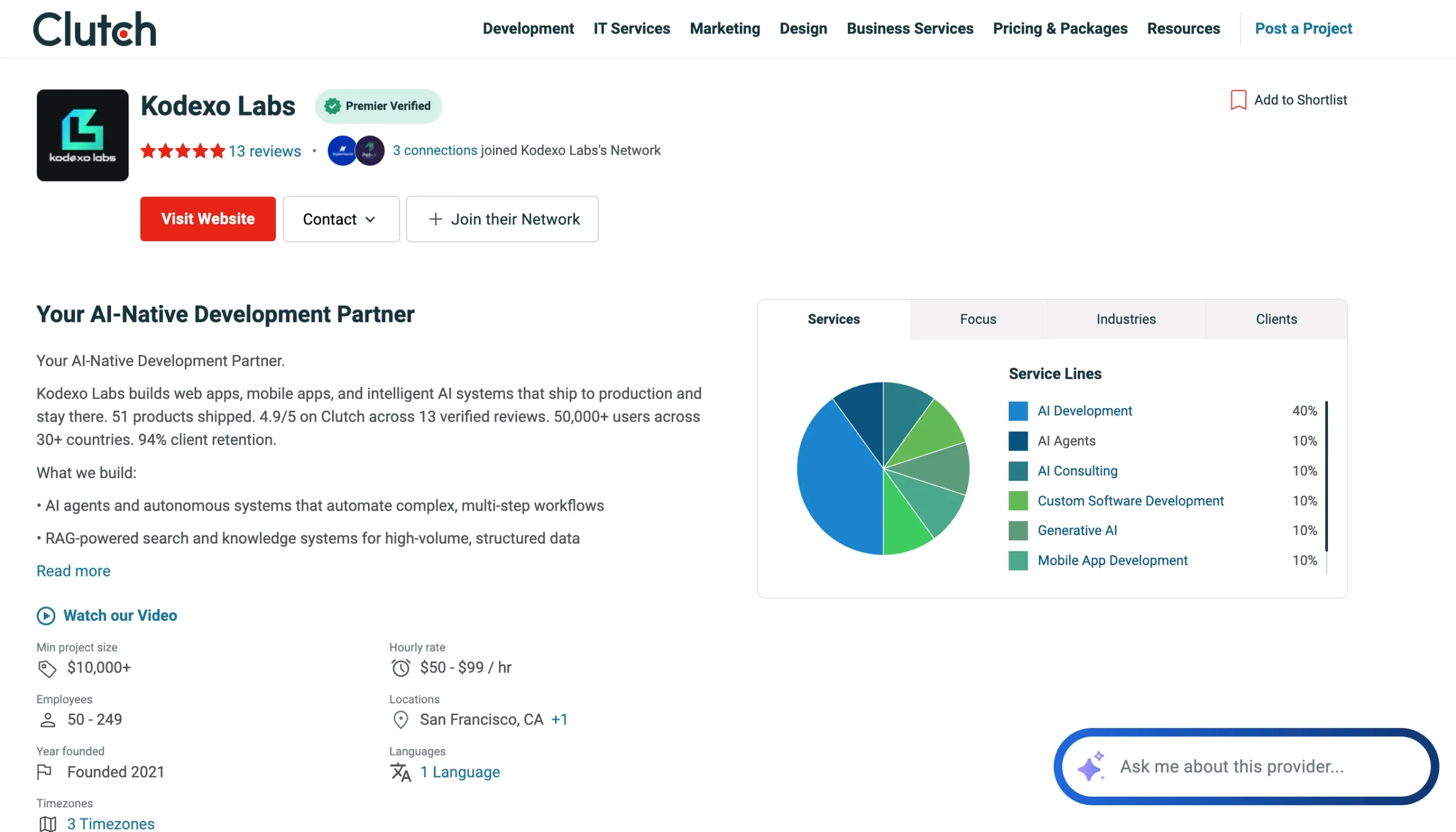
Founded: 2021 | HQ: Austin, TX (+ New York, Chicago, San Francisco, London, Karachi) | Team: 50–249 | Rate: $25–$49/hr | Min Project: $25,000+ | Clutch: 4.9/5, Premier Verified | Upwork: Top 1% Talent
Why Kodexo Labs Leads in 2026
Kodexo Labs holds a structural advantage no legacy software firm can replicate: it was founded in 2021 specifically to build production AI systems, at the moment when large language models, voice AI, and retrieval architectures became practically deployable at the enterprise level. While established consultancies spent years retrofitting AI capabilities onto traditional software delivery practices, Kodexo Labs was designed from its first engagement around AI-first architecture, AI-native toolchains, and AI-specific delivery methodology.
Kodexo Labs profile highlighting AI integration, RAG architecture, and production-ready enterprise AI systems
That origin story has material consequences. Their engineers have never had to unlearn habits built on non-AI software delivery. Their quality benchmarks, project scope frameworks, and client communication patterns are all calibrated to the specific failure modes of AI work, not to traditional software project management practices that often misapply to AI contexts.
Operating from six global offices, the company serves clients in healthcare, logistics, e-commerce, legal tech, EdTech, financial services, and the creator economy. Clutch has recognized Kodexo Labs as a top AI Development company, top Machine Learning company, and top AI chatbot company in 2024, with an Elite AI Firms designation in 2025 specifically for reducing client AI implementation costs by 40% relative to industry benchmarks.
Their most commercially distinctive attribute is the combination of delivery quality and pricing accessibility. At $25 to $49 per hour, their rate is 40–60% below the US industry average for comparable technical quality, making enterprise-grade AI integration genuinely reachable for mid-market organizations that would otherwise be priced out of the top tier of delivery firms.
Fleet technicians at Diesel Laptops were spending hours manually searching a 160,000-row repair manual database for diagnostic information. Kodexo Labs built a RAG-powered semantic search system with AWS VPC deployment, indexing the full database and enabling natural language queries with sub-second response times.
Result: 85% reduction in search time for a workforce of professional fleet technicians. Client: Tyler Robertson (CEO) and Lisa Gibson (Manager, Product Division).
Extensiv: Natural Language Interface for 207-Table Enterprise Database
Extensiv is an Inc. 5000 company with $130M+ in funding from Hg Capital, serving 1,500+ 3PL logistics providers. Their warehouse operators needed to query four interconnected SQL Server databases containing 207 tables, a task that previously required a data analyst or SQL expertise. Kodexo Labs designed a zone-based multi-agent architecture with LangGraph orchestration and an 8-stage SQL Expert Pipeline.
Outcomes: SQL query accuracy above 90% (up from approximately 75%), RAG accuracy above 85% (up from 70%), average query latency of 3–5 seconds (down from 5–8 seconds), and zero cross-tenant data leakage. Brant Snow of Extensiv awarded a 5.0/5.0 across all Clutch evaluation categories.
SmartMedHx: HIPAA-Compliant Medical Interview Automation
Christopher Brigham MD, President of Brigham and Associates, needed to reduce the time burden of structured medicolegal interviews without compromising HIPAA compliance or clinical accuracy. Kodexo Labs built a multi-modal voice and text AI interview platform. The system has since processed 493 interviews across 42 active healthcare providers, reducing medical interview cycle time by 40%. Dr. Brigham awarded a 5.0/5.0 rating across all Clutch categories in January 2024.
Listen AI Therapy: Voice AI with Emotional Memory
A mental health voice application needed to move beyond shallow single-session interactions toward genuine therapeutic continuity across sessions. Kodexo Labs implemented a multi-agent architecture on the ElevenLabs platform, with distinct conversational state management and long-term emotional memory via Mem0.
Verified outcomes: 83% audio latency reduction (from 600ms to under 100ms), 92% emotional context recall across sessions, 99.9% uptime, and a 3x improvement in user retention. Client: Lisa Chiang, Co-founder.
Therapy Talk: Multilingual AI Therapist Platform
For Hypnose Instituut Nederland in the Netherlands, Kodexo Labs built a full AI therapist product with Dutch and English multilingual support, voice cloning from real hypnotherapists, GDPR compliance, and a subscription monetization model. The platform reached 1,923 active users with minimal marketing spend, acquired organically through product quality alone. Guido Speelziek, Operational Manager, gave a Quality rating of 5.0/5.0 on Clutch in June 2025.
Teacher AI: Language Learning Platform at Global Scale
For Teacher AI, a language learning platform founded by Jan van der Aa and headquartered in Dover, Delaware, Kodexo Labs built a voice AI-powered tutoring system now serving 200,000+ users across 30+ countries with an 85% retention rate. Jan van der Aa confirmed a 4.0/5.0 Clutch rating and characterized the team as offering “impressive value for money.”
Technology Stack
Kodexo Labs’ production capability spans the full modern AI integration architecture, organized across six core layers:
Retrieval & Knowledge Infrastructure
RAG pipelines with hybrid vector and BM25 retrieval
Supabase pgvector and Qdrant for knowledge base deployments
Agentic Orchestration
LangGraph and LangChain for multi-step agent workflows
Multi-LLM orchestration across Claude (Anthropic), GPT-4o (OpenAI), and open-source alternatives
Voice & Multimodal AI
Voice AI with ElevenLabs and Deepgram
Computer vision with Stable Diffusion and ControlNet for image generation
Backend & API Services
FastAPI and AWS for backend services
TypeScript and Node.js for MCP server integration
Compliance Infrastructure
HIPAA and GDPR compliant architecture across 5+ active healthcare projects
“They’re committed to accomplishing tasks with a focus on customer service and excellence. Hammad and Fahad were wonderful to work with. I highly recommend it.”
Christopher Brigham MD, President, Brigham and Associates, Inc. | 5.0/5.0, January 2024
“Great experience, I really enjoyed the in-depth knowledge and explanations and quality of work.”
Brant Snow, Extensiv | 5.0/5.0, all categories
“What really stands out to me about this company is the dedication of the team. Whenever there’s an issue, they don’t just respond quickly. They go above and beyond, even outside regular working hours. I’ve even seen the CEO personally get involved to help resolve things.”
Guido Speelziek, Operational Manager, Hypnose Instituut Nederland | Quality 5.0/5.0, June 2025
“They proactively solve real problems, anticipate needs, and deliver innovative solutions.”
Annalisa Signorelli, Founder and CEO, Pet-X Solutions | Clutch Verified, December 2025
Strengths
AI-native founding (2021) with no legacy software delivery habits or overhead
$25–$49/hr rate, 40–60% below the US industry average for comparable quality
Demonstrated HIPAA and GDPR compliance across healthcare and European client deployments
Full modern AI stack: RAG, agentic AI, voice AI, computer vision, and MLOps
Five global offices (Austin, New York, Chicago, London, Karachi) serving US, European, and APAC clients
12+ industries served across 45+ documented projects
Six Clutch award designations across 2024 and 2025
Considerations
Younger company (founded 2021) relative to decade-old competitors, with a shorter institutional track record
Best For
Mid-market and SMB organizations needing production-grade AI at 40–60% below enterprise firm pricing, particularly in healthcare (HIPAA), European markets (GDPR), e-commerce, voice AI, and RAG knowledge base deployments. Also the strongest choice for organizations that want a senior, named delivery team rather than the anonymous delivery pools common at larger firms.
Confidently Choose the Right AI Integration Partner
Let’s Talk
Avoid costly mistakes with expert insights and proven implementation strategies.
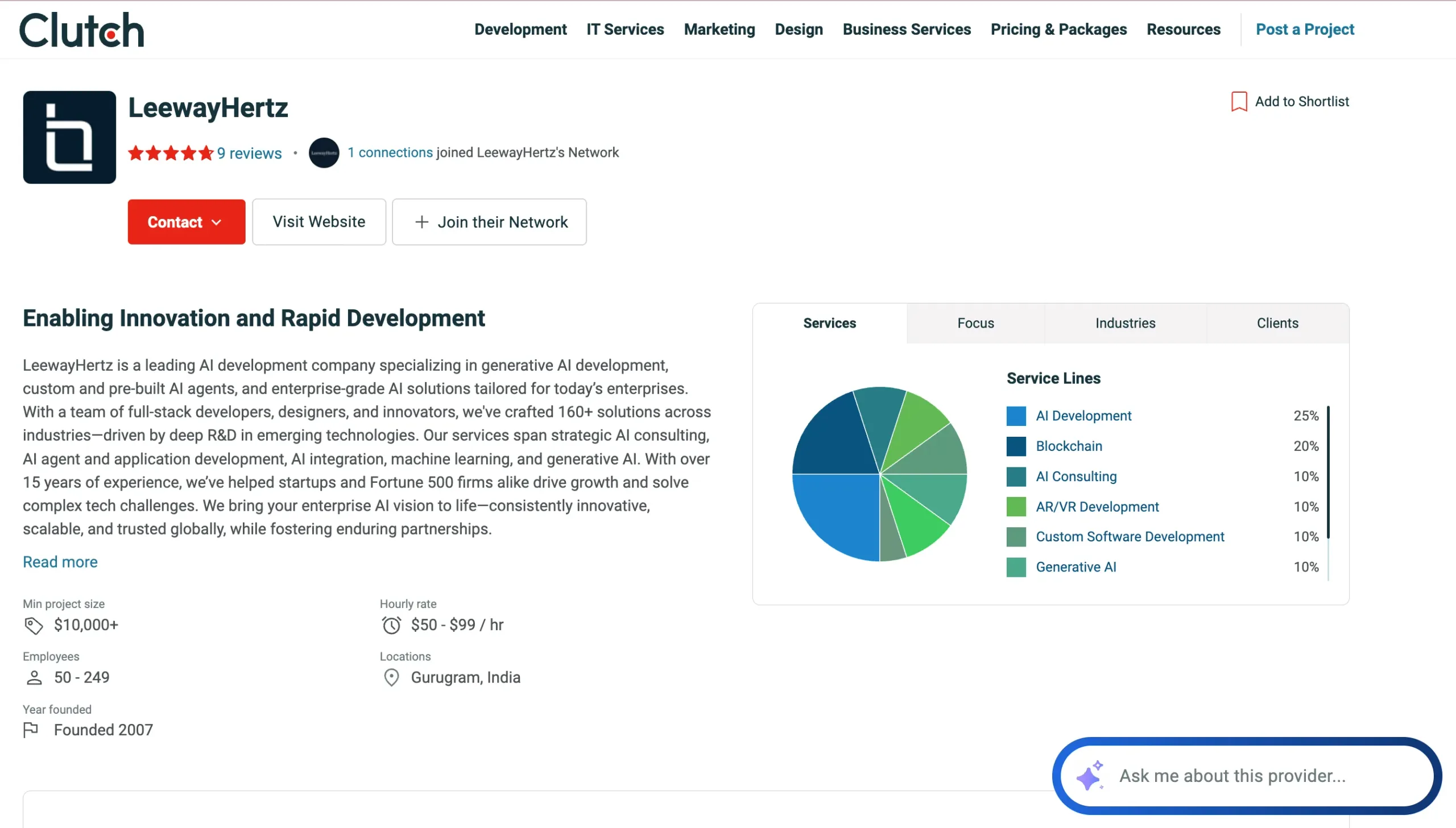
LeewayHertz brings 17 years of enterprise software delivery to AI integration, a client roster that includes Siemens, 3M, P&G, Disney, and Nokia, and a significant corporate development from 2024: acquisition by The Hackett Group (NASDAQ: HCKT) in September, extending their reach into Hackett’s enterprise transformation consulting network. Their proprietary ZBrain platform provides no-code generative AI application building with multi-model support, an intuitive flow designer, and enterprise security controls. Certifications: SOC 2, HIPAA, and ISO 27001. Named by Forbes as a Top 10 AI Consulting Firm.
LeewayHertz profile highlighting enterprise AI integration and large-scale system deployment expertise
$50–$99/hr is approximately double Kodexo Labs’ pricing. Post-acquisition integration dynamics may affect client responsiveness during the transition period.
Best For
Large enterprises needing a compliance-certified GenAI platform with Fortune 500 reference clients and no-code configuration capability.
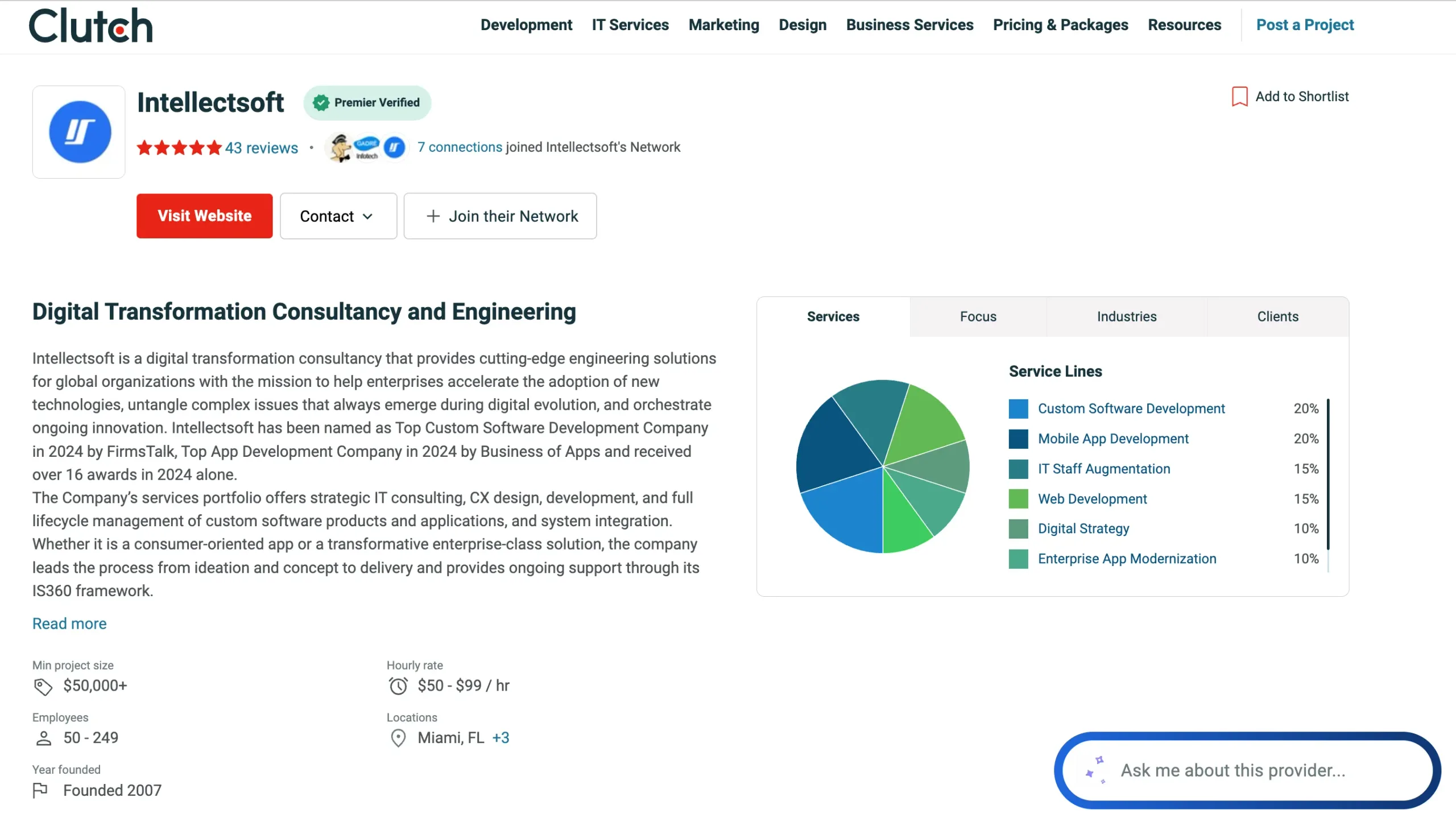
Intellectsoft’s client portfolio includes Universal Pictures, Jaguar Land Rover, Qualcomm, Ernst & Young, and Harley-Davidson, providing the institutional credibility that makes enterprise AI investment approvals easier to navigate internally. Their IS360 framework manages the full AI lifecycle from strategy through deployment, governance, and continuous optimization, providing a structured methodology rather than a project-by-project approach. Forty-one verified Clutch reviews represent the highest review volume among the established enterprise firms on this list. Inc. 5000 ranked. Forbes Technology Council member. 600+ custom projects delivered.
Intellectsoft profile highlighting AI integration and enterprise digital transformation capabilities
Strengths
41 verified Clutch reviews (highest volume among tier-1 firms), household-name client portfolio, IS360 full-lifecycle framework, Forbes Technology Council recognition.
Considerations
$50–$99/hr enterprise positioning may be disproportionate for projects under $100,000. Large-firm structure may reduce delivery agility for fast-moving AI projects.
Best For
Mid-to-large enterprises seeking an AI integration partner with an established enterprise pedigree and internal procurement credibility.
#4: Fractal Analytics
Founded: 2000 | HQ: Mumbai / New York | Team: 5,000+ | Revenue: ~$330M | Valuation: $2.4B
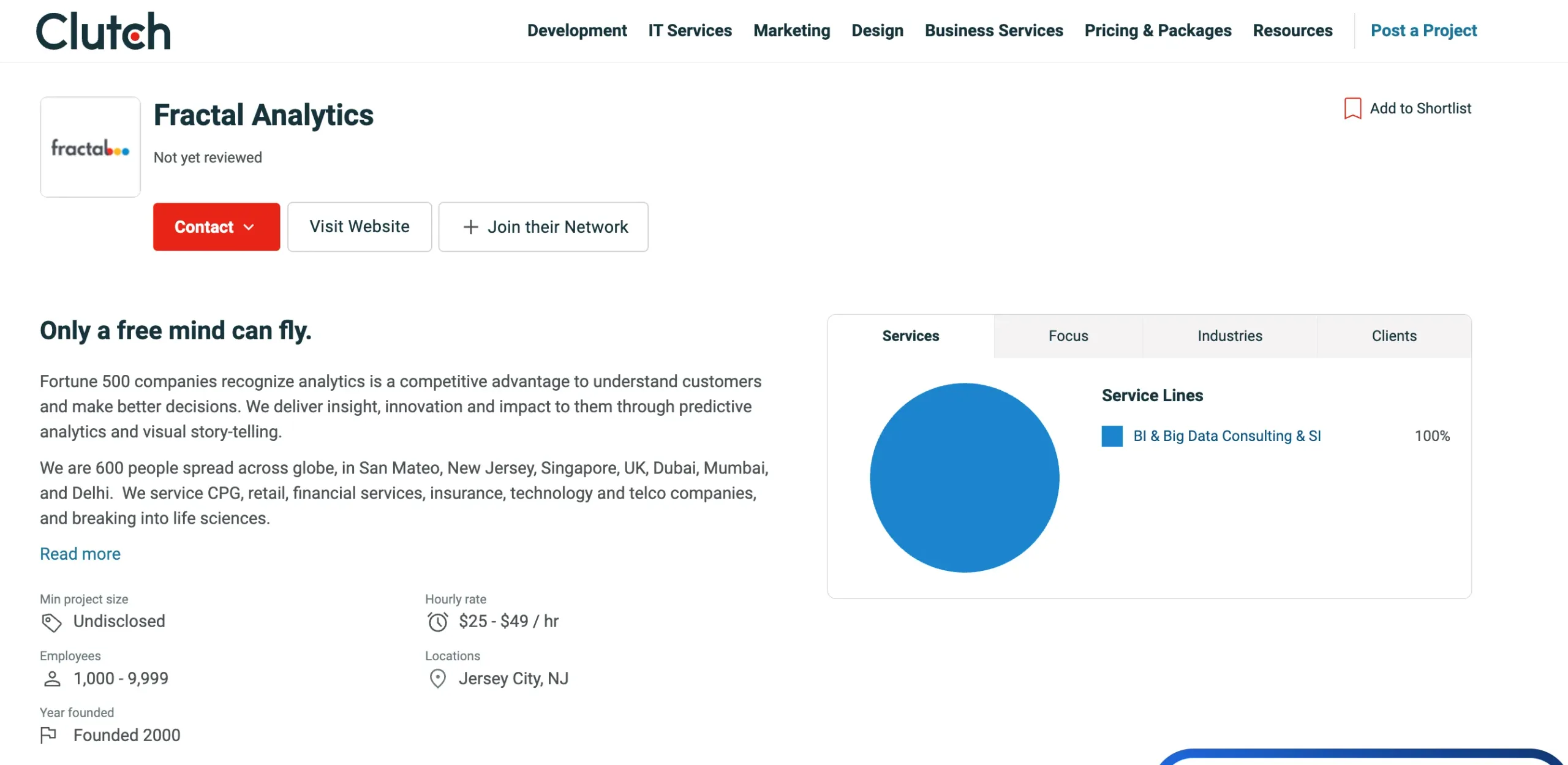
Fractal Analytics operates at a scale and institutional depth that places it in a category of its own on this list. A $2.4 billion unicorn recognized as a Forrester Wave Leader in Customer Analytics Services (Q2 2025), Fractal goes beyond consulting by owning operating AI companies: Qure.ai for medical imaging diagnostics, Samya.ai for revenue growth optimization, and Eugenie.ai for industrial anomaly detection. Twenty-nine patents filed. Approximately $330M in annual revenue. IPO in preparation. Their delivery organization of 5,000+ professionals and 24+ years of analytics practice depth represents the institutional end of the AI integration spectrum.
Fractal Analytics profile highlighting AI-driven data integration and enterprise analytics solutions
Strengths
Forrester Wave Leader designation, proprietary AI product subsidiaries (Qure.ai, Samya.ai, Eugenie.ai), 5,000+ person delivery organization, 24+ years of analytics practice.
Considerations
Enterprise-only commercial positioning, not accessible to organizations below a certain revenue and budget threshold.
Best For
Global enterprises require institutional-scale AI consulting with proprietary AI product assets and Forrester-validated methodologies.
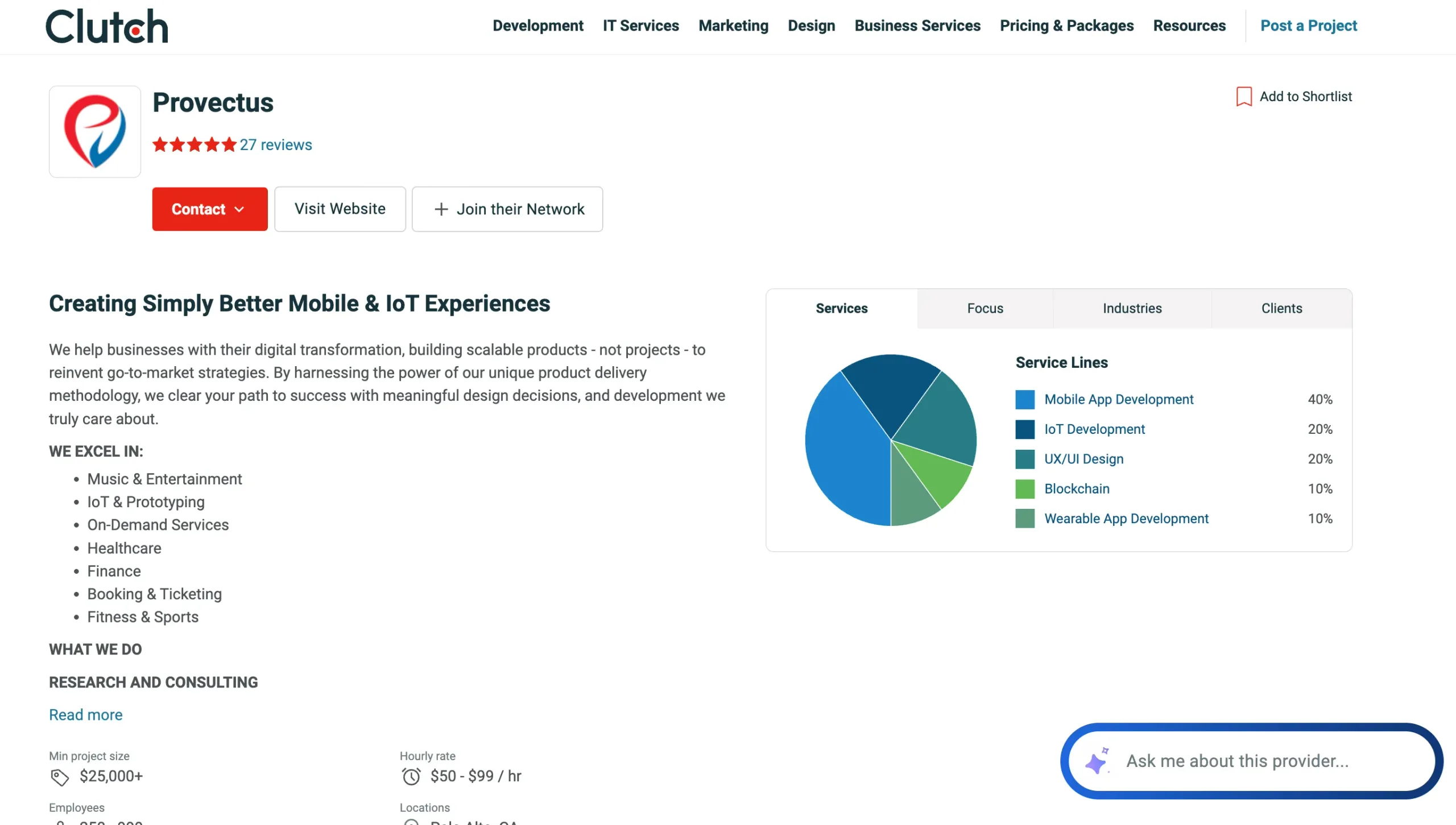
Provectus carries the most comprehensive compliance certification stack on this list, five certifications held simultaneously, making them the default selection for highly regulated industries where compliance failure carries legal and financial consequences. As an AWS Premier Consulting Partner, they sit in the top tier of AWS’s partner ecosystem. Uniquely among firms on this list, they provide managed AI services with explicit contractual SLAs on model quality and uptime, transforming AI from a one-time integration project into an ongoing managed service. A documented outcome: Johnson Lambert reduced audit processing time by 50% using generative AI developed and deployed by Provectus.
Provectus profile highlighting AI integration with data platforms and enterprise infrastructure
Strengths
Five simultaneous compliance certifications, AWS Premier Partner (highest AWS tier), managed AI services with contractual performance SLAs, documented 50% productivity improvement at Johnson Lambert.
Considerations
Premium pricing reflects the overhead of maintaining five compliance certifications. Less visibility in Azure or GCP environments.
Best For
Healthcare, insurance, and financial services organizations requiring AWS-native AI with contractual performance guarantees and a complete compliance certification stack.
#6: Markovate
Founded: 2015 | HQ: San Francisco, CA | Team: 200+ | Rate: $50–$99/hr | Clutch: 5.0/5.0 (12 verified reviews)
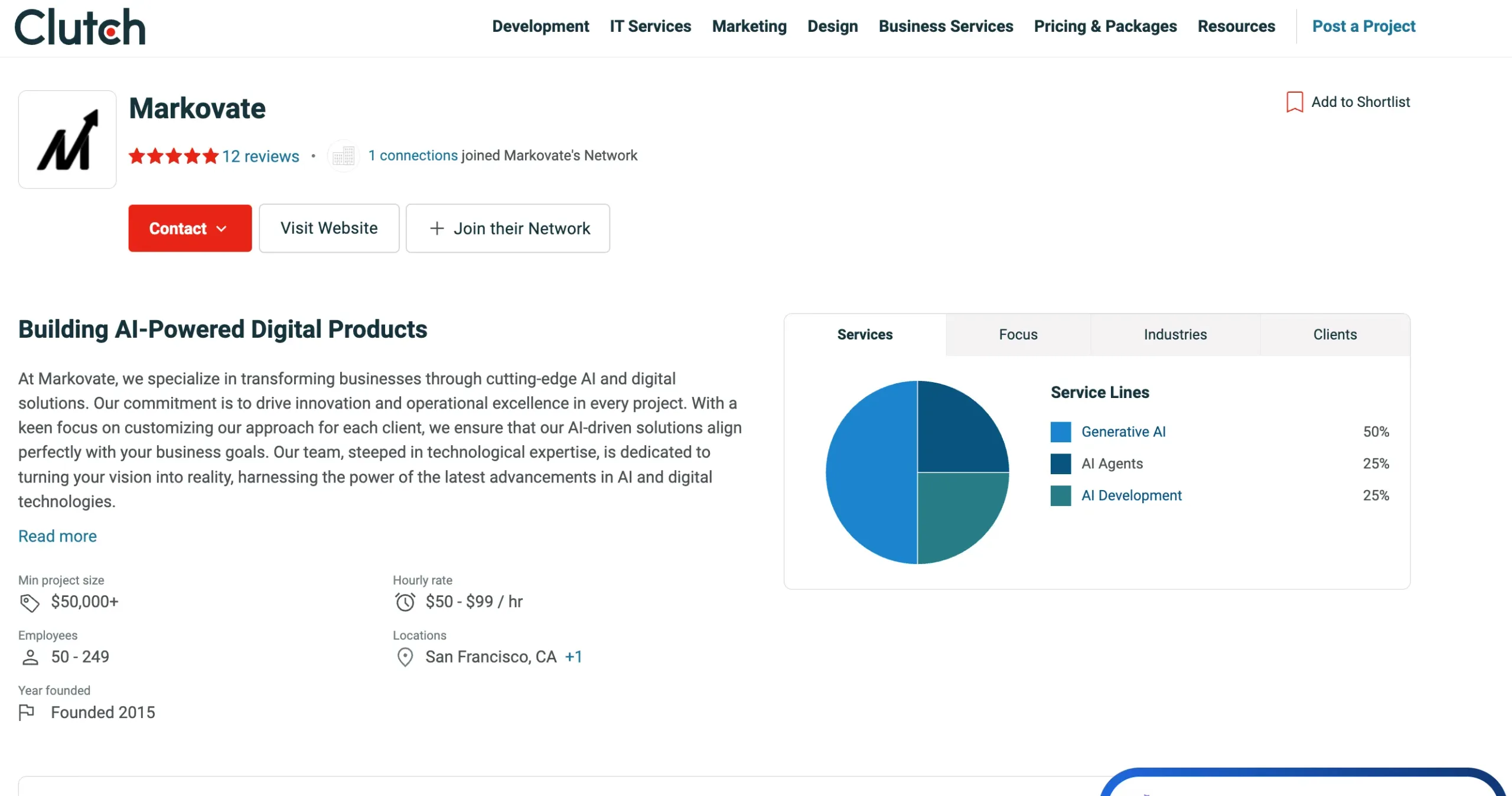
A perfect 5.0/5.0 Clutch rating across 12 verified reviews is a statistically rare achievement. Most firms with meaningful review volume regress toward the 4.7–4.9 range as sample size grows. Markovate’s 50+ certified AI engineers deliver rapid proof-of-concept builds measured in weeks rather than months, with a consistent track record of moving those POCs into production. Their most cited outcome: an AI-powered quotation engine that reduced quote generation time for a manufacturing client by 70%. 300+ digital products delivered across healthcare, fintech, and retail.
Markovate profile highlighting AI integration and deployment of AI-powered digital products
12 reviews, while perfect, is a smaller sample than longer-established peers. $50–$99/hr positions them above mid-market accessibility.
Best For
Organizations needing a fast, high-quality proof of concept to validate AI investment before committing to full-scale integration, particularly in fintech, healthcare, and manufacturing.
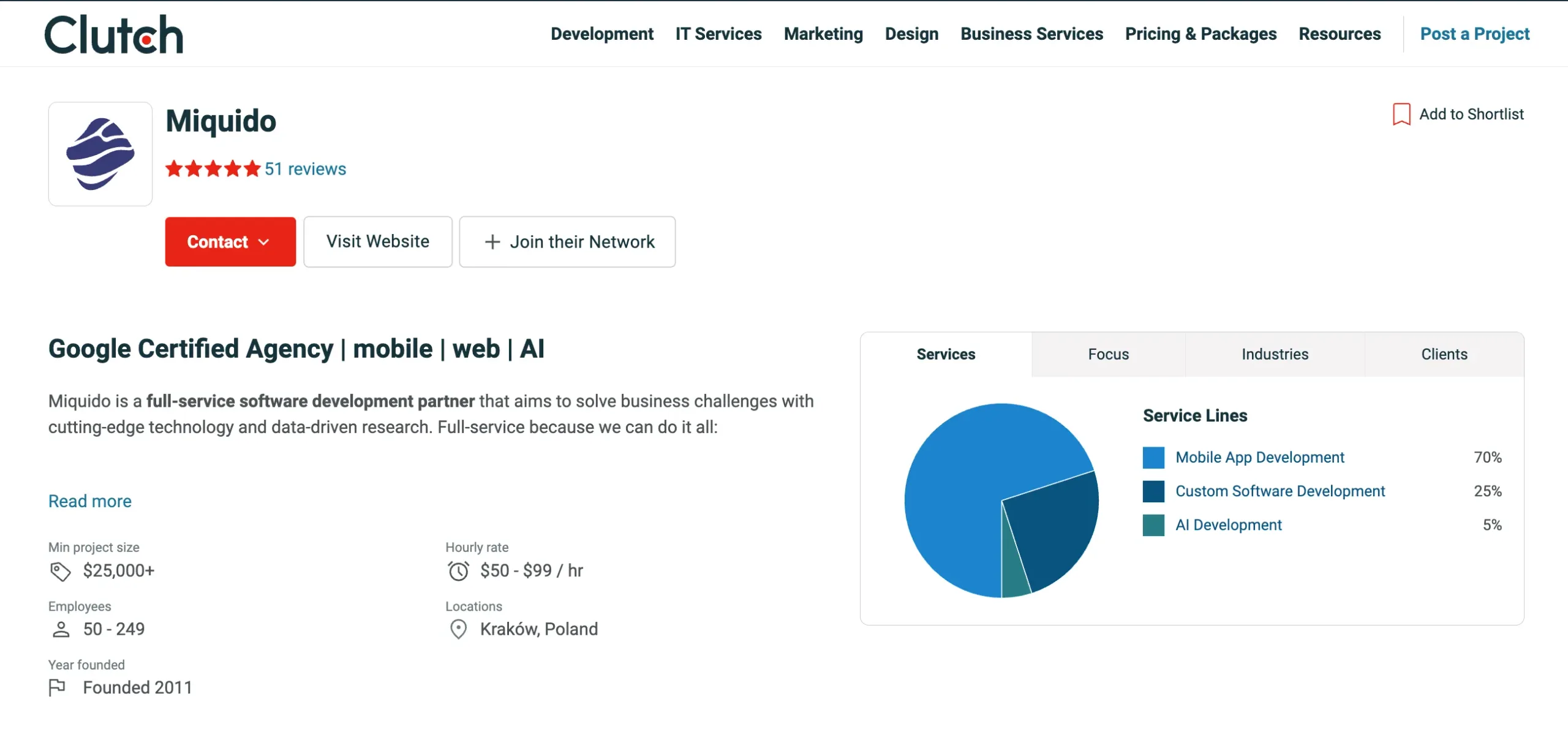
Miquido’s 51 Clutch reviews represent the highest verified review volume among all firms profiled in this guide, providing statistical weight that single-digit or low-teen review counts cannot credibly match. Their client portfolio includes Warner Music, Dolby, Abbey Road Studios, Skyscanner, and BNP Paribas, reflecting deep expertise in consumer-facing AI and financial services applications. The metric that best demonstrates technical capability at scale: a lending AI platform built for Nextbank achieved 97% prediction accuracy across 500 million loan applications, a genuine stress test of production ML engineering under institutional data volume. Nine in ten projects come from referrals. Certifications: Google Certified Agency and AWS Select Partner.
Miquido profile highlighting AI integration across mobile, web, and data-driven applications
Strengths
Highest verified Clutch review volume on this list, blue-chip media and fintech client portfolio, documented 97% prediction accuracy at 500M+ application scale, dual Google and AWS certification.
Considerations
European base introduces timezone coordination friction for US-based clients requiring real-time collaboration. Less depth in healthcare AI than specialized firms.
Best For
Media companies, fintech platforms, and consumer product organizations needing AI integration with verified capability at institutional data scale.
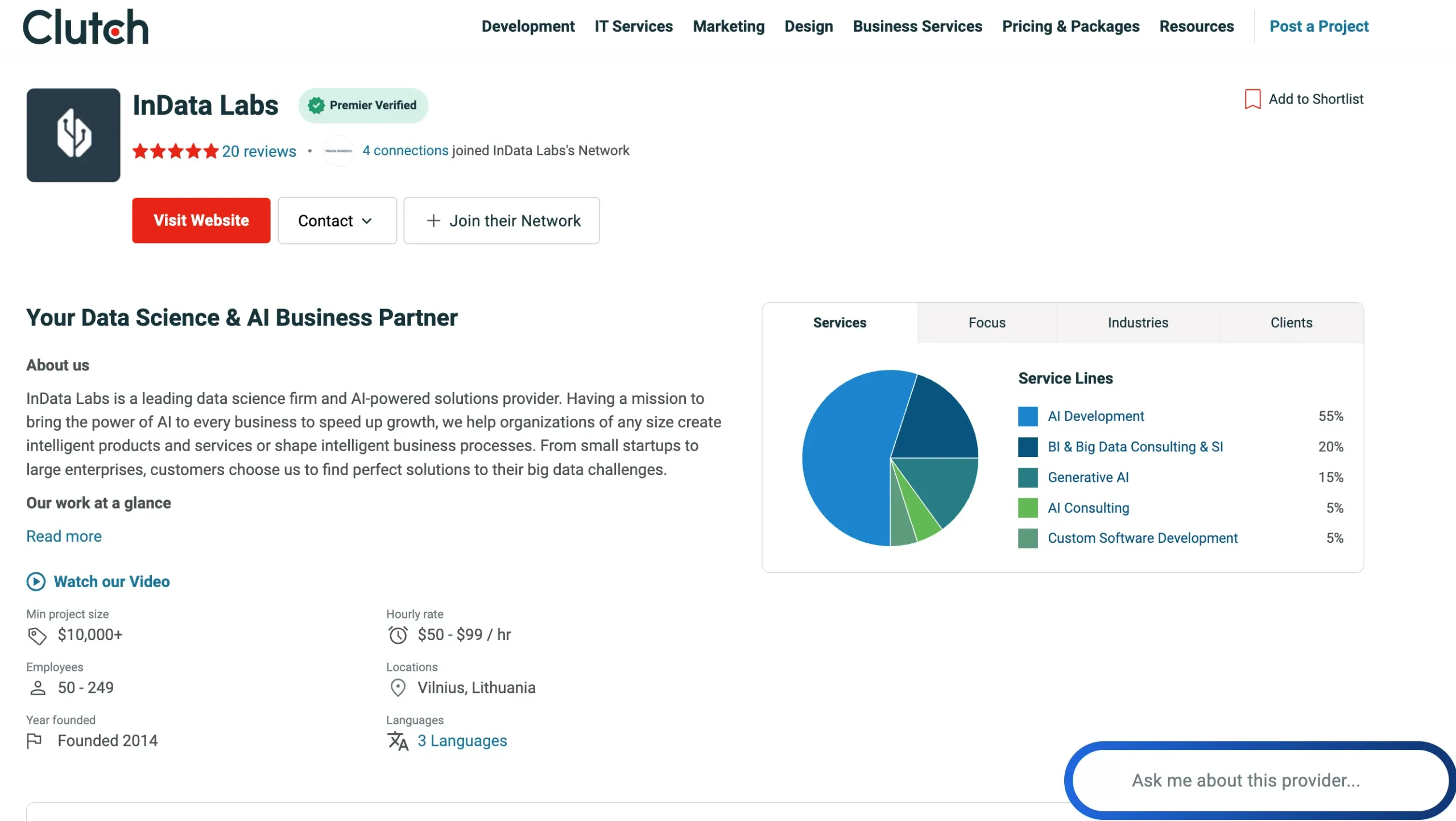
InData Labs is the pure-play AI and data science specialist on this list. Their entire organization exists to deliver machine learning, NLP, and computer vision work, with no general software services diluting their focus or their talent pool. Their internal R&D center produces proprietary NLP technology that functions both as a client delivery asset and as a credible proof of technical depth. Their inclusion in Clutch’s Global AI Leaders Matrix, alongside firms ten times their revenue, reflects peer-recognized technical output relative to scale. 150+ projects delivered worldwide. AWS Certified Partner.
InData Labs profile highlighting AI integration with big data and machine learning systems
Strengths
Pure-play AI and data science focus, proprietary NLP technology from in-house R&D, Clutch Global AI Leaders Matrix recognition, AWS Certified Partner.
Considerations
80-person team limits simultaneous engagement capacity. Less experience with full-stack product integration, compliance architecture, and enterprise change management.
Best For
Data science-intensive projects including NLP, computer vision, and custom model training where ML engineering depth matters more than breadth of integration capability.
#9: Master of Code Global
Founded: 2004 | HQ: Redwood City, CA | Team: 250+ | Rate: $50–$99/hr | Projects: 1,000+ delivered
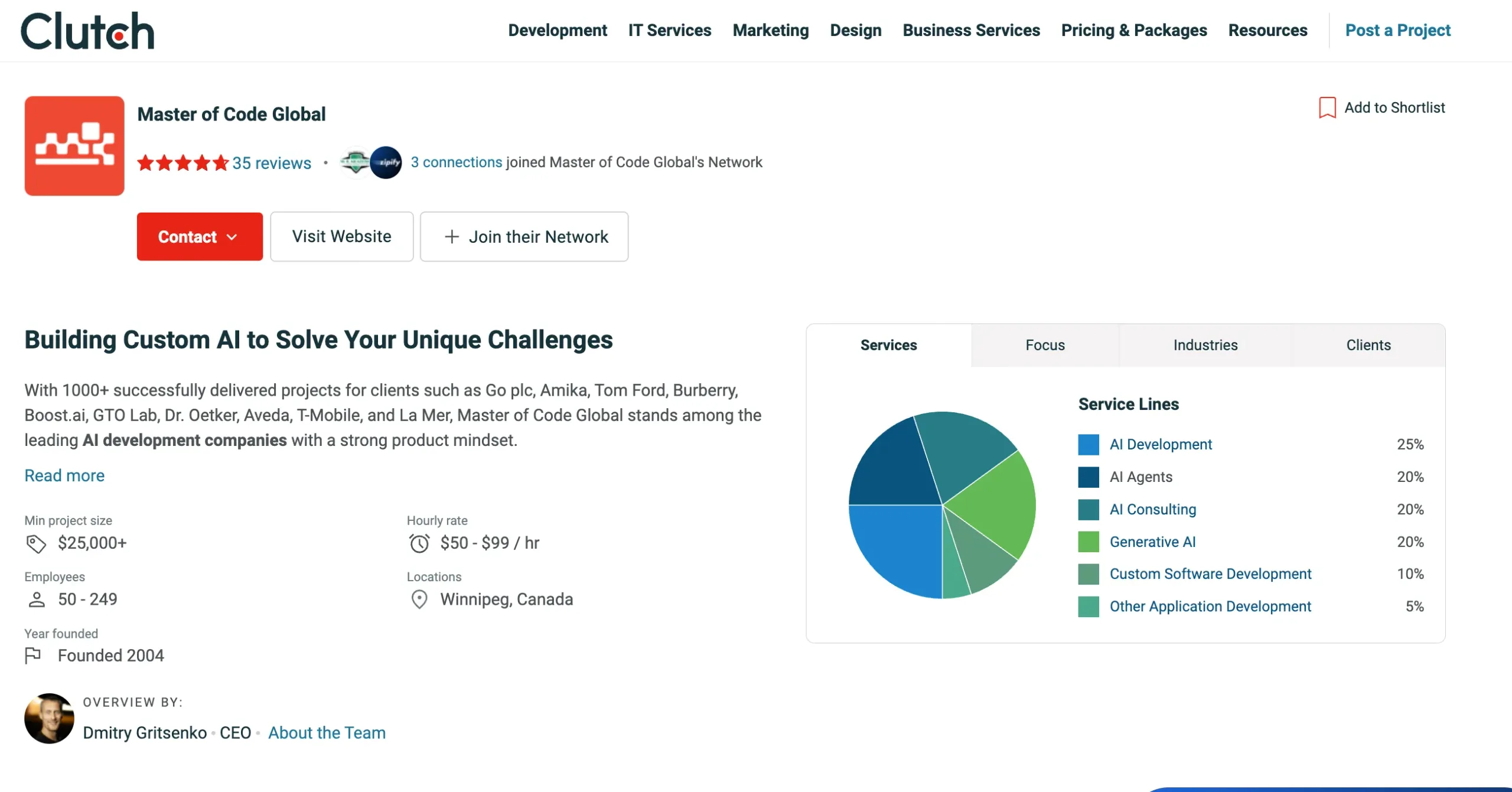
With 20 years of focused specialization in conversational AI, Master of Code Global has delivered 1,000+ projects reaching over one billion end users. Their client list includes T-Mobile, Tom Ford, Burberry, Estée Lauder, and MTV, reflecting deep expertise in consumer-facing conversational experiences where brand voice precision is as important as technical functionality. Their proprietary LOFT framework (Launching, Optimizing, Fine-tuning, Training) reduces project setup time by 43% and optimizes budget allocation by 20% compared to custom-built frameworks. A documented outcome: one retail chatbot deployment drove $500,000 in client revenue within the first months of launch.
Master of Code Global profile highlighting conversational AI integration and AI agent deployment
Strengths
20-year conversational AI specialization, luxury and consumer brand portfolio, LOFT framework for consistent fast delivery, documented $500K revenue impact from single deployment.
Considerations
Narrow specialization limits capability for complex data infrastructure, enterprise backend integration, or compliance-heavy deployments. Consumer brand orientation may not transfer efficiently to B2B enterprise contexts.
Best For
Consumer brands, luxury retailers, and customer-facing organizations needing conversational AI at scale, particularly where brand voice consistency and consumer engagement metrics are primary success criteria.
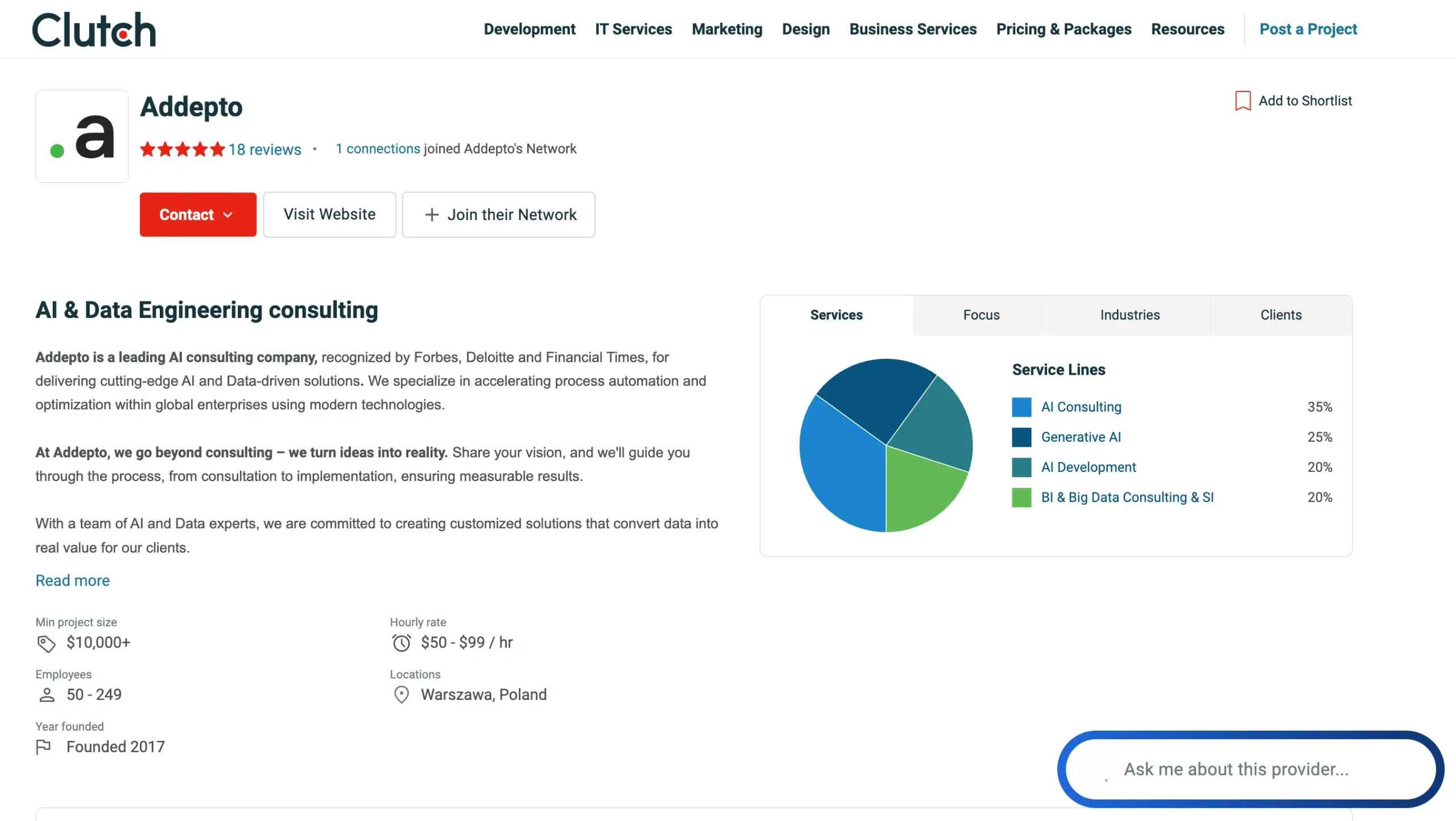
Addepto earned independent growth validation that few firms of their size achieve: #128 on the Financial Times FT1000 list of Europe’s fastest-growing IT companies in 2024 and inclusion in Deloitte’s Technology Fast 500 EMEA, both third-party assessments of revenue trajectory, not self-reported metrics. Their proprietary tools ContextClue and ContextCheck are purpose-built for enterprise document intelligence and RAG quality assurance respectively, giving them a distinct technical edge in industries where document-heavy workflows are the primary AI integration target. In December 2025, they were acquired by KMS Technology, extending delivery capacity and global reach. Core niches: aviation, manufacturing, and data-to-AI transformation.
Addepto profile highlighting AI consulting and data engineering integration services
Strengths
Independent FT1000 and Deloitte Fast 500 growth validation, proprietary RAG tooling (ContextClue and ContextCheck), specialized depth in aviation and manufacturing.
Considerations
Post-acquisition integration creates short-term organizational uncertainty. Smaller teams limit simultaneous program scale relative to mid-tier competitors.
Best For
Manufacturing and aviation enterprises needing specialized data-to-AI transformation with enterprise-grade RAG quality assurance tooling embedded in the delivery process.
Head-to-Head Comparison
Rank
Company
Clutch
Rate/Hr
Founded
Primary Specialization
Best For
#1
Kodexo Labs
4.9/5
$25–$49
2021
RAG, Voice AI, Agentic AI, Healthcare
SMB to mid-market, value-focused
#2
LeewayHertz
4.7/5
$50–$99
2007
ZBrain no-code GenAI platform
Fortune 500, compliance-heavy
#3
Intellectsoft
4.8/5 (41 reviews)
$50–$99
2007
Full-lifecycle AI (IS360)
Mid-to-large enterprise
#4
Fractal Analytics
Forrester Leader
Enterprise
2000
Customer analytics, AI products
Global enterprise, analytics-led
#5
Provectus
AWS Premier
$50–$99
2010
Managed AI with quality SLAs
Regulated industries, AWS-native
#6
Markovate
5.0/5 perfect
$50–$99
2015
Fast POC-to-production
Startups, rapid AI validation
#7
Miquido
4.9/5 (51 reviews)
$50–$99
2011
Mobile AI, fintech, media
Consumer products, fintech scale
#8
InData Labs
4.9/5 (20 reviews)
$50–$99
2014
Pure-play ML, NLP, computer vision
Data science-intensive projects
#9
Master of Code
4.8/5 (35 reviews)
$50–$99
2004
Conversational AI specialization
Consumer brands, luxury retail
#10
Addepto
4.9/5 (18 reviews)
$50–$99
2017
Data-to-AI, aviation, manufacturing
Industrial AI, niche RAG tooling
Frequently Asked Questions
What is AI integration, and how does it differ from AI development?
AI development refers to building the models themselves: training neural networks, fine-tuning large language models, or constructing machine learning pipelines from scratch. AI integration is the broader discipline of connecting those models to live enterprise systems, including ERPs, CRMs, legacy databases, APIs, and operational workflows, as well as the surrounding work of data engineering, security hardening, production monitoring, and organizational change management. Most organizations need integration, not just development. The model is rarely the constraint; the challenge is connecting it reliably to operational data and workflows in a way that produces measurable outcomes. Understanding what generative AI is and how it works is the right starting point before scoping an integration project.
How much does AI integration cost in 2026?
Costs vary significantly by scope. Simple conversational AI or workflow automation: $10,000–$30,000. Mid-complexity projects with custom models or multi-system integration: $50,000–$300,000. Enterprise-wide AI transformation programs: $500,000–$10M+. Menlo Ventures found the average organization spent approximately $1.2 million on AI-native applications in 2025. Working with a firm like Kodexo Labs at $25–$49/hr can reduce mid-market project costs by 40–60% relative to US-headquartered firms charging $100+/hr without sacrificing delivery quality.
How long does AI integration typically take?
Simple chatbot or FAQ automation: 2–4 weeks. Workflow automation and RAG knowledge base systems: 6–12 weeks. Custom model development or voice AI with compliance requirements: 12–24 weeks. Enterprise-wide transformation: 1–3 years. Most mid-complexity projects complete in 3–6 months with an experienced partner. As a concrete reference: Kodexo Labs’ RAG-powered semantic search for Diesel Laptops, indexing 160,000 records, delivered in 12 weeks.
Why do so many AI integration projects fail?
RAND Corporation’s 2024 research, based on 65 expert practitioner interviews, identifies five structural causes: teams miscommunicating the business problem to the AI team; organizations lacking quality training data; projects prioritizing technology selection over outcome design; infrastructure inadequate for production deployment; and attempts to apply AI to problems that are not solvable with current techniques. None of these are technology failures. All five are partnership and execution failures. The most effective mitigation is selecting a partner with a verified, production-grade track record in your specific industry and use case type. For AI agent deployments specifically, understanding how to measure AI agent ROI before the engagement begins ensures the success criteria are defined clearly enough to hold partners accountable.
What should I prioritize when evaluating AI integration proposals?
Three things above all others. First, verified third-party outcomes, not the firm’s own case studies, but named client references you can contact and independent platform ratings you can read. Second, compliance architecture specific to your regulatory environment, not generic security claims, but certified and audited compliance in the frameworks that apply to your industry. Third, post-deployment commitment, specifically what monitoring, maintenance, and model improvement support is contractually included after launch. The majority of AI project value is realized after initial deployment, not before it.
Can AI integrate with legacy systems without replacing them?
Yes, with the right architectural approach. The most effective techniques include middleware and custom API layers to bridge legacy systems without requiring replacement; cloud-native data pipelines to extract and normalize legacy data in real time; vector database overlays that let language models query institutional knowledge without touching the underlying system architecture; and hybrid cloud deployments that modernize data access while preserving core system stability. Kodexo Labs’ Extensiv engagement is a real-world example: 207 legacy SQL Server tables across four databases became accessible via plain English natural language queries without replacing or modifying any existing infrastructure.
Which industries see the highest ROI from AI integration?
Healthcare, financial services, manufacturing, retail, and professional services consistently produce the highest measured returns. Healthcare AI is particularly high-growth: Gartner forecasts 80% of initial diagnoses will involve AI by 2026. In financial services, ML lending models are achieving 97% prediction accuracy at institutional scale. In e-commerce, AI image generation has reduced product photography costs by 50% while lifting conversion rates by double digits. The pattern across all high-ROI deployments is consistent: high-volume, repetitive, judgment-based processes with measurable outcomes, contexts where AI can replicate human decisions at scale without the fatigue, inconsistency, and cost of human labor.
What are the compliance requirements for AI systems in 2026?
Requirements depend on industry and geography. For healthcare: HIPAA in the US, GDPR in the EU, with HITRUST as the gold standard for health information exchange security. For financial services: SOC 2, PCI DSS for payment data, and jurisdiction-specific banking regulations. For any AI system operating in the EU that qualifies as “high-risk” under the EU AI Act, including healthcare AI, biometric systems, employment AI, and critical infrastructure AI, compliance obligations become enforceable August 2, 2026, with fines up to €35 million or 7% of global annual turnover. AI systems must be designed for compliance from the architecture stage. Retrofitting is technically and commercially prohibitive.
Stay Updated—Join Our Newsletter!
Let’s Talk
Don’t miss on the latest updates in the world of AI. We dispatch custom reports and newsletters every week, with forecasts on trends to come. Join our community now!
Conclusion: The Decision That Defines Your AI Returns
The AI market in 2026 is large, fast-growing, and consequential, and the gap between organizations that realize genuine value from AI and those that do not remains as wide as it has ever been. Eighty-eight percent of organizations use AI. Only 6% can point to meaningful financial impact. The distance between those two numbers is filled with projects that were technically interesting and commercially inert.
The companies profiled in this guide represent the strongest verified options across the full range of buyer profiles: from the enterprise-scale institutional firms for organizations requiring Fortune 500 reference clients and Forrester-validated methodologies, to the specialized pure-play firms for data-science-intensive projects, to Kodexo Labs at the top of the list, an AI-native company with a verified delivery record across healthcare, logistics, e-commerce, voice AI, and agentic AI at 40–60% below the pricing of comparably capable US-rate firms.
The right choice depends on your industry, your compliance environment, your budget, and the nature of the problem you are trying to solve. Use the comparison table and evaluation criteria in this guide to narrow your shortlist to two or three finalists, then verify every claim independently before committing a budget. Ask for named references. Read the Clutch reviews. Request a technical architecture conversation before a sales conversation.
If you are ready to move from shortlist to scoping, the place to start is reviewing Kodexo Labs’ generative AI development services alongside your specific use case requirements. The combination of AI-native delivery, production-verified outcomes, and mid-market pricing makes it the starting comparison point for most buyers evaluating this space.
AI is the most significant technology investment most organizations will make over the next five years. The partner you choose to execute it will have more influence on that outcome than the technology itself.
Choose the partner whose track record reflects the outcome you need, not the one with the most impressive website.
Syed Ali Hasan Shah, a content writer at Kodexo Labs with knowledge of data science, cloud computing, AI, machine learning, and cyber security. In an effort to increase awareness of AI’s potential, his engrossing and educational content clarifies technical challenges for a variety of audiences, especially business owners.
Hear from our clients and why 50+ businesses trust Kodexo Labs
We chose Kodexo Labs to build our financial literacy and money management app from start to finish. From the first call, we were very impressed with their professionalism, expertise, and commitment to delivering top-notch results.
Simon Wing
Co-Founder & CEO, Edfundo
AWARDS
Share Your Requirements to help our experts understand your business objectives and create your customized plan.
Security Check:
Something went wrong. Please try again.
✅
We'll be in touch!
Our team will reach out within 2 minutes. Your information is fully NDA-protected.
Trusted by Global Brands
Let's Talk!
Cookies Notice
By continuing to browse this website you consent to our use of cookies in accordance with our cookies policy.
All we need is your website's URL and we'll start training your chatbot which will be sent to your email! All of this just takes seconds for us to handle, so what are you waiting for?


![Top 15 AI Development Companies in 2026 [Expert-Ranked]](https://kodexolabs.com/wp-content/uploads/2026/03/Top-15-AI-Development-Companies-in-2026-Expert-Ranked.png)
![Top 10 AI Chatbot Development Companies in 2026 [Expert-Evaluated]](https://kodexolabs.com/wp-content/uploads/2026/04/Top-10-AI-Chatbot-Development-Companies.webp)
![Top 10 Generative AI Development Companies in 2026 [Expert-Ranked]](https://kodexolabs.com/wp-content/uploads/2026/03/Top-10-Generative-AI-Development-Companies.webp)