Offshore development is no longer just a cost-saving tactic — it’s now a strategic growth engine.
In 2025, offshore software development is no longer just a cost-saving tactic—it’s a transformative strategy. The offshore development market is projected to grow from $156 billion in 2024 to $179 billion in 2025 (CAGR ~14.8%), driven by demand for scalable engineering talent and 24/7 delivery models. Companies are tapping into this trend not only to optimize spend—achieving average cost reductions of 52% on development services—but also to access global experts, accelerate time-to-market by up to 40%, and build enterprise-grade solutions more quickly.
What is Offshore Software Development and Why It Matters in 2025
Offshore software development involves partnering with development teams located in different countries to build software solutions. It matters in 2025 because companies can access global talent pools, reduce operational costs by around 50% compared to in-house teams, and scale tech capabilities quickly while focusing on core strengths. In fact, 66% of U.S. companies now use offshore development to solve local hiring shortages and improve scalability.
Why It Matters in 2025
50–52% lower operational costs through offshore development partnerships
Fast access to AI, blockchain, and mobile specialists across borders, helping companies scale faster
Accelerated go-to-market by up to 40% using 24/7 development cycles across time zones
Understanding Offshore Development Companies
An offshore software development company operates from a different country than its clients, providing specialized technical services remotely. These companies leverage advanced project management tools and communication platforms to deliver seamless collaboration despite geographical distances. Unlike nearshore (neighboring countries) or onshore (same country) models, offshore development maximizes cost advantages through strategic location arbitrage.
The offshore development services model has evolved significantly with cloud infrastructure and AI-powered collaboration tools. Companies now offer comprehensive solutions including AI development, web app development, and machine learning engineering. This evolution enables businesses to access cutting-edge expertise previously available only in tech hubs.
How Offshore Development Companies Operate
Modern offshore partners act as global tech arms for your business. Using AI-driven tools, they bridge distance with:
Real-time collaboration
Time zone overlapping
Specialized delivery squads
Unlike freelancers, offshore firms bring structure, security, and long-term continuity.
Stay Updated—Join Our Newsletter!
Newsletter
Don’t miss on the latest updates in the world of AI. We dispatch custom reports and newsletters every week, with forecasts on trends to come. Join our community now!
The Evolution of Software Offshore Development
Remote work adoption has accelerated dramatically, according to a McKinsey American Opportunity Survey, 58% of Americans have the opportunity to work remotely at least one day per week—normalizing distributed collaboration, including offshore development across time zones. Modern AI features like real-time translation and automated project tracking now streamline communication and eliminate traditional language or coordination barriers.
Digital transformation demands have opened unprecedented opportunities for offshore development services. Companies require expertise in emerging technologies like generative AI, blockchain, and IoT—skills that offshore teams provide cost-effectively. A 2025 MoldStud analysis shows that AI-powered infrastructure and tooling enhance offshore team productivity by around 40%, automating repetitive tasks and enabling developers to focus on innovation.
Significant Cost Savings and Cost Optimization
Offshore development services now provide 40–60% cost savings compared to local hiring—driven by significantly lower hourly rates in regions such as Eastern Europe and Latin America. For example, average offshore rates range from $25–50/hr in Eastern Europe and $30–50/hr in Latin America, versus $100/hr+ in the U.S. These savings go beyond salaries, covering infrastructure, benefits, and operational costs.
Breaking Down Cost Efficiency
Offshore labor cost differences provide significant savings across global markets. In Eastern Europe, senior developers typically charge $45–65/hr, compared to $150–200/hr in North America. Latin America offers competitive rates around $38–58/hr for mid-level roles in Latin America, while maintaining strong cultural and timezone alignment with U.S. teams.
Region
Senior Developer Rate
Mid-Level Rate
Junior Rate
North America
$150-200/hr
$100-150/hr
$70-100/hr
Western Europe
$100-180/hr
$80-120/hr
$60-80/hr
Eastern Europe
$45-65/hr
$30-50/hr
$20-30/hr
Latin America
$38-58/hr
$25-40/hr
$18-28/hr
Southeast Asia
$25-45/hr
$20-35/hr
$15-25/hr
Offshore partnerships unlock significant hidden savings beyond hourly rates. Companies eliminate recruitment costs, lower office and infrastructure expenses, and avoid expensive employee benefits. MoldStud research shows firms leveraging offshore models report total savings of up to 60% compared to traditional hiring, as contractors provide equipment, licenses, and dev environments. These combined benefits—when properly structured—frequently exceed 50% of on-premises hiring costs.
ROI of Offshore Software Development Benefits
Real-world case studies highlight the tangible value of offshore investments. According to Deloitte’s 2024 Global Outsourcing Survey, 59% of businesses outsource primarily to reduce costs, and 80% plan to maintain or increase outsourcing budgets—underlining its strategic importance. Additionally, surveys of mature offshore partnerships show some organizations achieving multi-million‑dollar annual savings, although results vary by scale and engagement model.
Offshore development support extends beyond coding—it delivers real savings in maintenance and uptime. With 24/7 coverage by offshore teams, companies have seen mean time to resolution improve dramatically, resulting in 19% fewer IT outages and 30% less downtime overall. Those savings free up budgets to fund innovation, marketing, and expansion initiatives that drive revenue.
Access to Global Talent Pool and Specialized Expertise
The best offshore software development services provide access to a vast global talent pool of software engineers, UX/UI designers, and solution architects. Companies can find specialized expertise in emerging technologies like AI, blockchain development, and cloud computing that may be scarce locally.
Offshore teams offer access to:
AI/ML engineers
Cloud architects
Mobile and Web App Developers
Example: Ukraine produces a modest but growing number of STEM graduates, while Brazil’s UX design industry is booming, backed by rising internet penetration and educational investment.
Hire Offshore Developers You Can Trust — Vetted, Proven and Ready to Deliver
Let’s Talk
Our global network of developers is handpicked for their technical excellence, reliability and alignment with your business goals, so you can scale with confidence from day one.
Dedicated offshore developers bring focused expertise to long-term projects. These specialists integrate seamlessly with internal teams while maintaining deep domain knowledge in areas like blockchain, AI, or enterprise systems. A recent KineticStaff survey found structured offshore partnerships enable follow-the-sun workflows, allowing projects to finish 30–40% faster and increasing engineering output by 25%.
Building Your Offshore Development Team
Effective team composition balances diverse skills for comprehensive project coverage. Whether you’re assembling a flexible remote squad or planning a full offshore development center setup, the right team structure lays the foundation for long-term success. A well-configured offshore team typically includes 2-3 backend developers, 1-2 frontend specialists, a UX/UI designer, and a technical lead. This structure ensures full-stack capabilities while maintaining efficient communication channels.
Role
Typical Team Size
Core Responsibilities
Technical Lead
1
Architecture, code review, team coordination
Backend Developer
2-3
API development, database design, server logic
Frontend Developer
1-2
UI implementation, responsive design, user interactions
UX/UI Designer
1
Interface design, user research, prototyping
QA Engineer
1
Testing, automation, quality assurance
Integration strategies determine offshore team effectiveness within existing structures. Successful companies implement overlapping work hours, shared documentation systems, and regular video conferences. IT staff augmentation models enable flexible scaling while maintaining team cohesion and knowledge transfer.
How to Hire Offshore Software Developers Successfully
To hire offshore developers successfully, start by defining project scope and required skills clearly. Research offshore development companies with proven track records, conduct thorough technical assessments, and establish clear communication protocols. Consider time zones and cultural fit alongside technical capabilities.
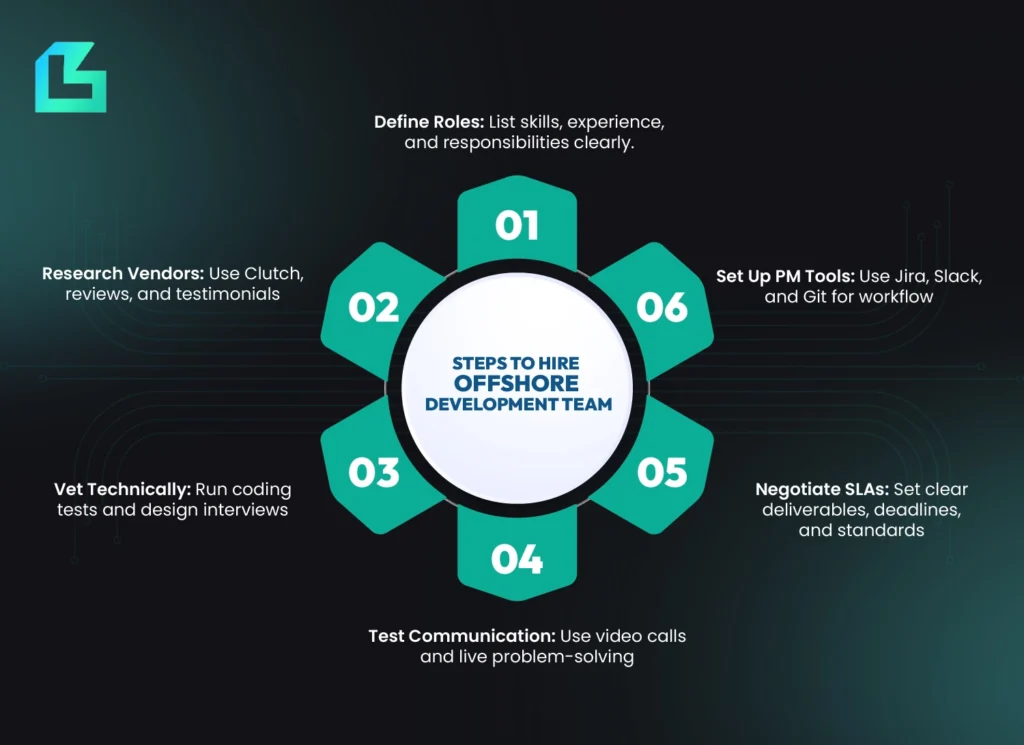
Steps to Hire Offshore Development Team
Define project requirements comprehensively before initiating the hiring process. Document technical specifications, preferred programming languages, framework requirements, and project timelines. Clear requirements enable offshore software development companies to propose appropriate team structures and accurate cost estimates.
Research offshore development companies through platforms like Clutch and client testimonials
Conduct multi-stage technical interviews including coding tests and system design discussions
Evaluate communication skills through video interviews and collaborative problem-solving sessions
Negotiate comprehensive service-level agreements covering deliverables, timelines, and quality standards
Establish robust project management systems using tools like Jira, Slack, and Git workflows
Follow these key steps to successfully hire offshore developers and build a high-performing offshore software development team.
Technical assessment methodologies ensure quality offshore software developer hires. Implement practical coding challenges relevant to your tech stack, conduct pair-programming sessions, and review project portfolios. In fact, 94% of employers report that skills-based hiring is more predictive of on-the-job success than resumes, underscoring how comprehensive technical evaluations lead to smarter, more reliable recruiting.
Choosing Between Models
Dedicated offshore developers offer continuity and deep project knowledge for long-term initiatives. This model suits product companies needing consistent development velocity and team stability. According to a MoldStud analysis, dedicated teams deliver a 25% increase in efficiency and reduce project timelines by around 20% compared to project-based engagements.
Project-based teams excel in defined-scope initiatives with clear deliverables. This approach suits startups testing MVPs or enterprises executing specific features. Independent contractors provide flexibility for specialized tasks, while established offshore software development services company partnerships ensure accountability and scalability.
Hybrid engagement models combine dedicated core teams with flexible project resources. Companies maintain 3-5 dedicated developers for continuity while scaling with project teams during peak periods. This approach optimizes costs while ensuring knowledge retention and development consistency.
Choose the fit:
Dedicated Teams – Long-term, deep product knowledge
Project-Based – Rapid, scope-defined execution
Hybrid Models – Scalable + stable
Hybrid teams achieve 2-3x efficiency during peak cycles.
24/7 Development Cycles Through Time Zone Advantages
Time zone differences enable continuous development cycles, with teams in Eastern Europe, Latin America, and Southeast Asia working while Western companies sleep. This “follow-the-sun” model can extend total development time to nearly 16–24 hours per day, potentially reducing project duration by up to 67% when properly implemented. Firms adopting FTS report faster milestone completion and quicker bug resolution, though success hinges on robust handoff processes and coordination.
Maximizing Time Zone Difference Benefits
Strategic team distribution enables seamless 24-hour development workflows. By positioning Eastern European teams to overlap with both Asian and American working hours, organizations enable real-time handoffs and continuous progress. Meanwhile, Latin American developers typically maintain 3–8 hours of daily overlap with U.S. teams—facilitating smooth collaboration throughout the day.
Asynchronous communication excellence defines successful global teams. Implement detailed documentation practices, recorded sprint reviews, and comprehensive pull request descriptions. Tools like Loom for video updates and detailed Confluence pages ensure knowledge transfer across time zones without delays.
Team Location
Time Zone
US EST Overlap
Best For
Eastern Europe
UTC+2 to UTC+3
2-4 hours
Morning handoffs, EU compliance
Latin America
UTC-3 to UTC-6
4-8 hours
Real-time collaboration
Southeast Asia
UTC+7 to UTC+8
0-2 hours
Overnight development
India
UTC+5:30
0-2 hours
24/7 support coverage
Handoff protocols ensure smooth transitions between global teams. Establish end‑of‑day status reports, morning briefings, and shared task boards. Organizations with structured handoff procedures report improved communication, fewer misalignments, and faster resolution of critical issues.
Regional Advantages
Latin America offers exceptional cultural alignment with North American businesses. Shared work ethics, similar business practices, and minimal language barriers create smooth collaboration. Countries like Argentina and Mexico provide highly educated developers with strong English proficiency and US time zone overlap.
Eastern Europe combines technical excellence with EU regulatory compliance expertise. Polish, Ukrainian, and Romanian developers bring strong engineering education and experience with enterprise-scale systems. GDPR compliance knowledge and data protection expertise make Eastern European teams ideal for privacy-sensitive projects.
Southeast Asia delivers unmatched cost-effectiveness and rapid scalability. Vietnamese and Filipino developers offer competitive rates while maintaining quality standards. The region’s growing tech ecosystem produces specialists in mobile development, e-commerce platforms, and AI integration services.
Enhanced Project Management and Communication Tools
Modern project management tools and communication platforms have eliminated traditional offshore collaboration barriers. Teams use Microsoft Teams, task tracking tools, and remote collaboration tools to maintain transparency, ensure quality assurance, and deliver projects efficiently despite geographical distances.
Slack + Loom = async video + chat
Jira + GitHub = agile + version control
Notion + Figma = docs + design
AI-translations & transcription boost clarity across borders.
Overcoming Communication Barriers
Essential collaboration tools for 2025 integrate AI-powered features that transform offshore communication. Platforms like Slack (with real-time translation), Miro for visual collaboration, and Notion for centralized documentation create seamless workflows. Organizations using tools such as Slack and Microsoft Teams report a 25% improvement in team communication clarity, significantly reducing misunderstandings over traditional email coordination.
Slack or Microsoft Teams for instant messaging with channel organization
Jira or Azure DevOps for comprehensive project tracking
Figma for collaborative design work with real-time feedback
GitLab or GitHub for code collaboration and version control
Confluence or Notion for centralized documentation
Zoom or Google Meet for video conferences with recording capabilities
Real-Time, Human-Centered Communication, Without the Offshore Friction
Let’s Talk
Our offshore teams use AI-enhanced tools & proven communication workflows to stay aligned with your vision, ensuring every update $ feedback loop feels effortless and personal.
Daily standups maintain team alignment across distributed locations. Implement 15-minute video calls focusing on yesterday’s achievements, today’s plans, and blockers. Rotate meeting times quarterly to share timezone burden fairly among team members.
Sprint planning adaptations accommodate offshore team dynamics. Conduct planning sessions during overlapping hours, record detailed session videos for absent members, and maintain living documents outlining sprint goals. Successful teams achieve 90% sprint completion rates through structured planning processes.
Metric
Measurement Method
Target
Code Quality
Automated code reviews, test coverage
90% coverage, <5% defect rate
Velocity
Story points completed per sprint
10% improvement quarterly
Communication
Response time, standup attendance
<4hr response, 95% attendance
Delivery
On-time feature completion
85% on-schedule delivery
Scalability and Flexible Resource Allocation
Offshore software development services company partnerships enable rapid scaling of development capacity. Businesses can quickly add or reduce team members based on project demands without the long-term commitments of local hiring, providing flexibility to respond to market changes.
Dynamic Team Scaling Strategies
Ramp-up protocols ensure smooth team expansion without productivity loss. Successful scaling involves phased onboarding, pairing new developers with experienced team members, and maintaining a 1:3 ratio of new to existing developers. This approach preserves team velocity while adding capacity.
Resource pooling through offshore development companies provides instant access to specialized skills. Partner firms maintain bench strength across technologies, enabling rapid deployment of experts in data engineering, MLOps, or specific frameworks within 48-72 hours.
Seasonal workforce adjustments accommodate business cycles efficiently. E-commerce companies scale up 3-4x during holiday seasons, while tax software firms peak during filing periods. Offshore partnerships enable this flexibility without permanent hiring costs or layoff concerns.
Long-term vs. Short-term Engagements
Long-term contracts with offshore development teams yield significant compound benefits. Over time, teams deepen their product knowledge, streamline workflows, and align with company culture—factors that drive superior performance. For example, firms that establish long-term offshore partnerships typically achieve 150% ROI within three years, according to Bain & Company, and see 35% improved coordination and efficiency, according to MIT Sloan research.
Project-based flexibility suits well-defined, discrete initiatives. MVPs, feature add-ons, or migration projects benefit from dedicated short-term teams without long-term commitments. Studies show outsourcing these specific projects can be 30–50% more cost-effective than in-house development, while preserving quality and accelerating delivery times.
Hybrid models balance stability with adaptability for optimal results. Maintain core teams of 5-10 dedicated offshore developers supplemented by project-based resources. This structure provides institutional knowledge while enabling 2-3x scaling during peak periods without disrupting core development.
Focus on Core Business Competencies
Offshore development services allow companies to delegate technical tasks while focusing on core competencies like strategy, marketing, and customer relationships. This division of labor improves overall business efficiency and enables faster market positioning.
Strategic Advantages of Outsourcing
Resource allocation optimization transforms business performance through strategic outsourcing. By redirecting technical work to specialized offshore partners, companies gain flexibility and focus. A 2025 Statista survey found that 55% of businesses outsourcing software development achieved faster product launches, while 72% reported improved access to high-quality talent. Leadership teams also regain valuable time—on average 3 hours per week per manager—allowing them to spend over 12 hours monthly on strategic initiatives.
Competitive advantages emerge when businesses concentrate on unique value propositions. While offshore teams handle technical implementation, internal teams develop market insights, customer relationships, and business innovations. This focus drives 3x faster market share growth compared to companies managing all functions internally.
Critical functions requiring deep business knowledge remain in-house priorities. Product strategy, customer experience design, and core algorithm development often benefit from internal ownership. These areas represent competitive differentiation and require intimate market understanding.
Offshore custom software development provides access to cutting-edge technology stacks and programming languages. Teams specialized in Artificial Intelligence, blockchain development, and Cloud Computing bring innovation capabilities that might be expensive or unavailable locally.
Blockchain development expertise remains scarce globally, with offshore teams filling critical gaps. Eastern European developers lead in Ethereum smart contract development, while Asian teams often specialize in Hyperledger and permissioned blockchain implementations. This distributed expertise allows companies to accelerate Web3 initiatives by accessing targeted skillsets and reducing ramp-up time.
IoT and edge computing solutions require specialized hardware-software integration skills. Offshore teams provide embedded systems expertise, real-time processing capabilities, and sensor integration knowledge. For example, smart platforms in offshore oil and gas environments have improved operational efficiency and safety, with IoT-driven automation reducing unplanned downtime by up to 25% — underscoring the deep value of offshore-enabled IoT capabilities.
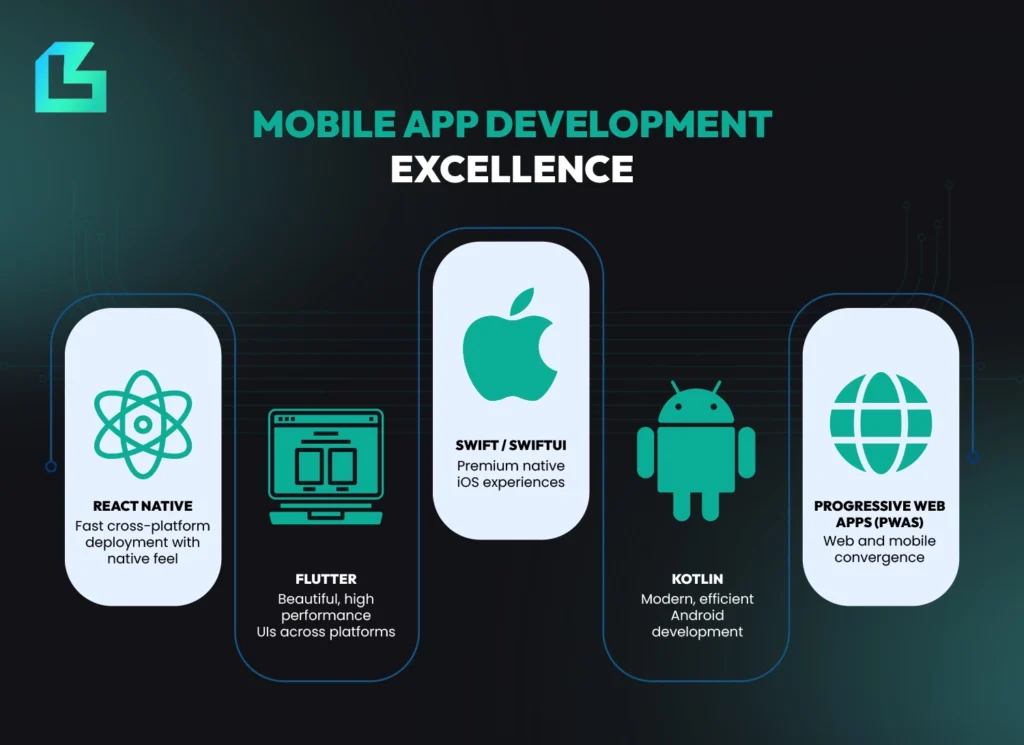
Mobile App Development Excellence
Cross-platform development expertise maximizes mobile reach efficiently. Offshore teams specializing in React Native and Flutter enable companies to build and deploy apps up to 40% faster than with fully native development—by leveraging single codebases for both iOS and Android. This approach not only accelerates development but also reduces long-term maintenance costs while delivering native-like performance across platforms.
Native development remains crucial for performance-critical applications. Offshore iOS developers bring Swift expertise and Apple ecosystem knowledge, while Android specialists master Kotlin and material design principles. Mobile app development teams achieve 4.8+ star ratings through platform-specific optimizations.
React Native for rapid cross-platform deployment
Flutter for beautiful, performant UI across platforms
Swift/SwiftUI for premium iOS experiences
Kotlin for modern Android development
Progressive Web Apps for web-mobile convergence
Quality Assurance and Compliance Standards
Professional offshore software development companies maintain rigorous QA practices, ISO certifications (including ISO 27001), and comply with international standards like GDPR. This ensures delivered software meets quality benchmarks while addressing security concerns and regulatory requirements.
Security Protocols and Compliance
GDPR compliance strategies protect user data across international boundaries. Offshore development companies implement data processing agreements, maintain EU representative offices, and ensure privacy-by-design principles. These measures satisfy regulatory requirements while enabling global collaboration.
Security policies encompass comprehensive protection layers. ISO 27001 certified partners implement access controls, encryption standards, and regular security audits. Penetration testing, vulnerability assessments, and SOC 2 compliance ensure enterprise-grade security throughout development lifecycles.
Compliance Standard
Coverage Area
Key Benefits
ISO 27001
Information Security
Risk management, data protection
GDPR
Data Privacy
EU compliance, user rights
SOC 2
Service Organization
Security, availability, confidentiality
HIPAA
Healthcare Data
PHI protection, audit trails
PCI DSS
Payment Processing
Transaction security, fraud prevention
Quality Control Processes
Code review methodologies ensure consistent quality across distributed teams. Implement peer reviews for all pull requests, automated linting, and architectural reviews for major changes. Research shows that well-structured code reviews can reduce production defects by up to 36%, making them one of the most effective bug-prevention practices in modern software development.
Testing strategies combine automated and manual approaches for comprehensive coverage. Unit tests typically aim for 75–80% code coverage, ensuring robust coverage of logic paths. Integration tests validate end-to-end system interactions, while user acceptance testing confirms alignment with business requirements. Offshore QA teams often provide 24/7 testing coverage, enabling continuous testing cycles that significantly speed up release timelines.
Development methodologies align offshore teams with modern practices. Agile frameworks using two-week sprints suit most projects, while DevOps practices and CI/CD enable continuous delivery. Teams implementing CI/CD pipelines deploy code 30× more frequently and experience 50% fewer failures, making them faster and more reliable in production environments.
At a Glance: Key Takeaways
Benefit
Impact
Key Metric
Cost Savings
Reduce development costs significantly
40-70% cost reduction
Global Talent Access
Tap into specialized expertise worldwide
3x larger talent pool
24/7 Development
Accelerate project timelines
30-40% faster delivery
Scalability
Adjust team size on demand
2-3x scaling capability
Technology Innovation
Access cutting-edge tech expertise
6 months faster to market
Quality Standards
Enterprise-grade security and compliance
90% fewer security issues
Focus on Core Business
Redirect resources to strategy
45% faster product launches
Frequently Asked Questions
Why offshore software development is preferred by startups in 2025?
Startups choose offshore software development for rapid scaling, access to diverse tech expertise, and significant cost reduction. With limited budgets, they can build enterprise-grade solutions by leveraging global talent pools while maintaining lean operations. The 40-70% cost savings enable startups to extend runway and invest more in growth.
How to work with offshore software development teams effectively?
Effective collaboration requires clear project scope definition, regular communication schedules, proper project management tools, and cultural sensitivity. Establish overlapping work hours, use collaborative platforms like Slack and Jira, maintain detailed documentation, and conduct daily standups for seamless coordination.
What are the main advantages of offshore software development over freelancer developers?
Offshore development companies offer structured processes, dedicated teams, quality assurance, and reliability compared to individual freelancers. They provide scalability, diverse expertise, professional project management, accountability through service-level agreements, and business continuity that freelancers cannot match.
Which regions offer the best offshore software development services?
Eastern Europe excels in technical expertise and EU compliance, Latin America offers cultural alignment with North America, and Southeast Asia provides cost-effective solutions. The best region depends on your specific needs, budget, time zone preferences, and required technical expertise.
How do offshore development companies ensure data security?
Reputable firms implement ISO 27001 standards, sign comprehensive NDAs, use secure development environments, conduct regular security audits, and comply with international regulations like GDPR. They establish clear security protocols, access controls, and separate development from production environments.
Stay Updated—Join Our Newsletter!
Newsletter
Don’t miss on the latest updates in the world of AI. We dispatch custom reports and newsletters every week, with forecasts on trends to come. Join our community now!
Conclusion
The benefits of offshoring software development in 2025 extend far beyond cost savings. From accessing global expertise and enabling 24/7 development cycles to leveraging cutting-edge technologies and maintaining quality standards, offshore development services have become essential for competitive businesses. As remote workflows continue evolving and AI-powered tools enhance collaboration, the offshore development model will become even more seamless and productive.
Companies that strategically leverage offshore partnerships gain significant competitive advantages through faster innovation, reduced costs, and access to specialized expertise. The key lies in selecting the right offshore software development company, establishing clear communication protocols, and maintaining focus on quality and security standards.
Ready to explore how offshore software development can transform your business? Our team at Kodexo Labs specializes in connecting companies with top-tier offshore development partners that align with your technical requirements, budget, and business goals. Contact us today to discuss your project needs and discover how our offshore developer services can accelerate your digital transformation journey.
In 2025’s competitive landscape, the question isn’t whether to consider offshore development services, but how to leverage them most effectively for sustainable growth and innovation. Start your offshore development journey today and unlock the full potential of global talent for your business success.
Syed Ali Hasan Shah, a content writer at Kodexo Labs with knowledge of data science, cloud computing, AI, machine learning, and cyber security. In an effort to increase awareness of AI’s potential, his engrossing and educational content clarifies technical challenges for a variety of audiences, especially business owners.
Hear from our clients and why 50+ businesses
trust Kodexo Labs
Kodexo Labs has delivered a fully functional MVP on time, and testers
reported faster check-ins after the product launch. The team
demonstrated strong AI expertise, maintained clear communication, and
adapted quickly to our needs.
Annalisa Signorelli
Founder & CEO, Pet-X Solutions
AWARDS
Share Your Requirements to help our experts understand your business objectives and create your customized plan.
By providing a telephone number and submitting this form, you agree to receive SMS text messages from Kodexo Labs. Message and Data Rates may apply. Message frequency may vary. You can STOP messaging by sending STOP and get more help by sending HELP. See our privacy policy.
Trusted by Global Brands
Cookies Notice
By continuing to browse this website you consent to our use of cookies in accordance with our cookies policy.
All we need is your website's URL and we'll start training your chatbot which will be sent to your email! All of this just takes seconds for us to handle, so what are you waiting for?