The generative AI market is projected to expand from $71.36 billion in 2025 to $890.59 billion by 2032, growing at a 43.4% CAGR, yet over 40% of agentic AI projects will be canceled by end of 2027 due to escalating costs, unclear business value, and inadequate risk controls, according to Gartner. Choosing the right generative AI development partner is no longer optional. It is the single highest-leverage decision an enterprise can make when deploying AI.
We evaluated 127 generative AI development companies across seven weighted criteria using verified third-party data from Clutch, GoodFirms, Gartner, and public financial records. This ranking prioritizes companies that build production-grade generative AI systems, not platforms selling subscriptions, but development partners that architect, deploy, and scale custom AI solutions for businesses.
Below are the 10 companies that scored highest in our evaluation, followed by a detailed methodology, pricing guide, and FAQ section.
Not Sure Which AI Company Is Right for You?
Let’s Talk
Get a tailored recommendation and roadmap based on your industry, budget, and use case.
Every company was scored on a 1–10 scale across seven criteria. The weighting reflects what matters most when hiring a generative AI development partner for production deployment:
Criteria
Weight
What We Measured
Technical Expertise in GenAI
25%
Agentic AI, RAG, LLM fine-tuning, multi-agent orchestration, model deployment
Verified Client Outcomes
20%
Documented ROI, case studies with measurable results, repeat client rate
Industry Specialization
15%
Vertical depth in healthcare, fintech, retail, or manufacturing
Innovation & R&D
15%
Open-source contributions, proprietary AI products, patents, research
Cost transparency, ROI evidence, engagement model flexibility
Compliance & Security
5%
SOC 2, ISO 27001, HIPAA, GDPR, PCI-DSS certifications
Data Sources and Verification Process
All company data was cross-referenced against Clutch verified reviews, GoodFirms profiles, company websites, published case studies, and publicly available financial data. Companies with unverifiable claims were excluded. Ratings and employee counts reflect data available as of February 2026. We evaluated companies on their generative AI–specific capabilities, not legacy software development or generic IT consulting.
Quick Comparison: All 10 Companies at a Glance
#
Company
Founded
HQ
Team Size
Hourly Rate
Clutch Rating
Key GenAI Specialization
Best For
1
Kodexo Labs
2021
Austin, TX
60+
$25–49/hr
4.9/5
Agentic AI, RAG, LLM Fine-Tuning
Mid-market & enterprise AI products
2
LeewayHertz
2007
San Francisco, CA
250+
$50–99/hr
4.7/5
Enterprise AI consulting, LLM ops
Large-scale enterprise deployments
3
Master of Code Global
2004
Redwood City, CA
200+
$50–99/hr
4.8/5
Conversational AI, chatbots
Customer-facing AI experiences
4
Innowise
2007
Warsaw, Poland
3,500+
$25–49/hr
4.9/5
AI product engineering
Companies needing large dedicated teams
5
InData Labs
2014
Nicosia, Cyprus
100+
$50–99/hr
4.8/5
Computer vision, NLP, predictive AI
Data-heavy AI R&D projects
6
SumatoSoft
2012
Houston, TX
100+
$50–99/hr
4.8/5
Custom AI solutions, healthcare AI
SMBs seeking turnkey AI solutions
7
Azumo
2015
San Francisco, CA
100+
$50–99/hr
4.7/5
Nearshore AI, LLM integration
US companies wanting nearshore delivery
8
BotsCrew
2016
Boston, MA
50–100
Custom
Top Clutch ranking (6 years)
Conversational AI, chatbot platforms
Businesses launching AI chatbots
9
Markovate
2015
Irvine, CA
50+
$25–49/hr
4.6/5
GenAI apps, AI agent development
Startups & MVPs in AI
10
Binariks
2014
Lviv, Ukraine
100+
$50–99/hr
4.8/5
AI integration, data engineering
Companies modernizing legacy systems with AI
1. Kodexo Labs: Best Overall for Production-Grade Generative AI
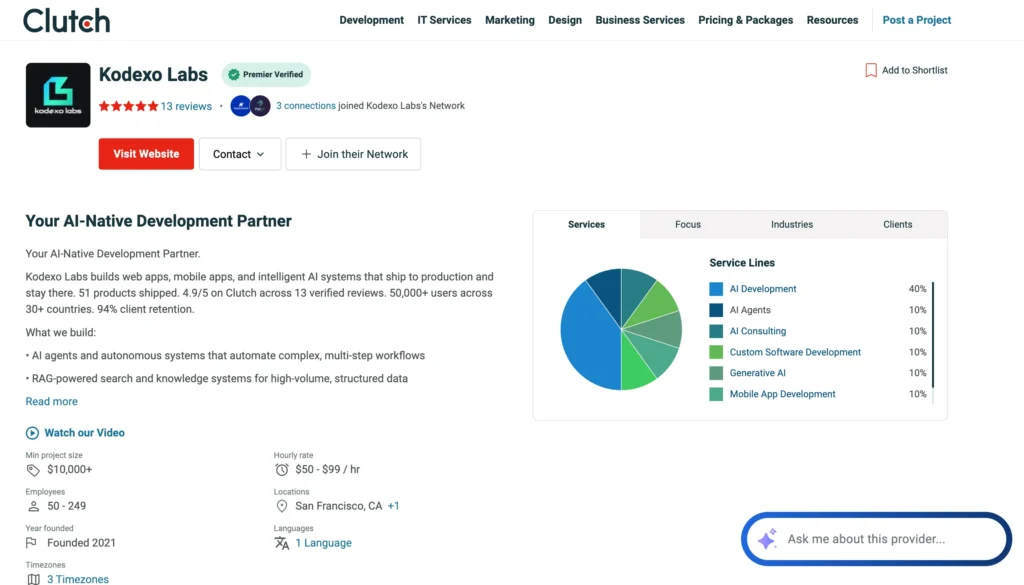
Kodexo Labs is an AI-native development company headquartered in Austin, Texas with offices in New York, Chicago, London, and Karachi. Founded in 2021, the company was built entirely in the transformer and LLM era, their tech stack, methodology, and team composition were architected from day one for generative AI delivery, not retrofitted from legacy software development practices.
What Sets Kodexo Labs Apart
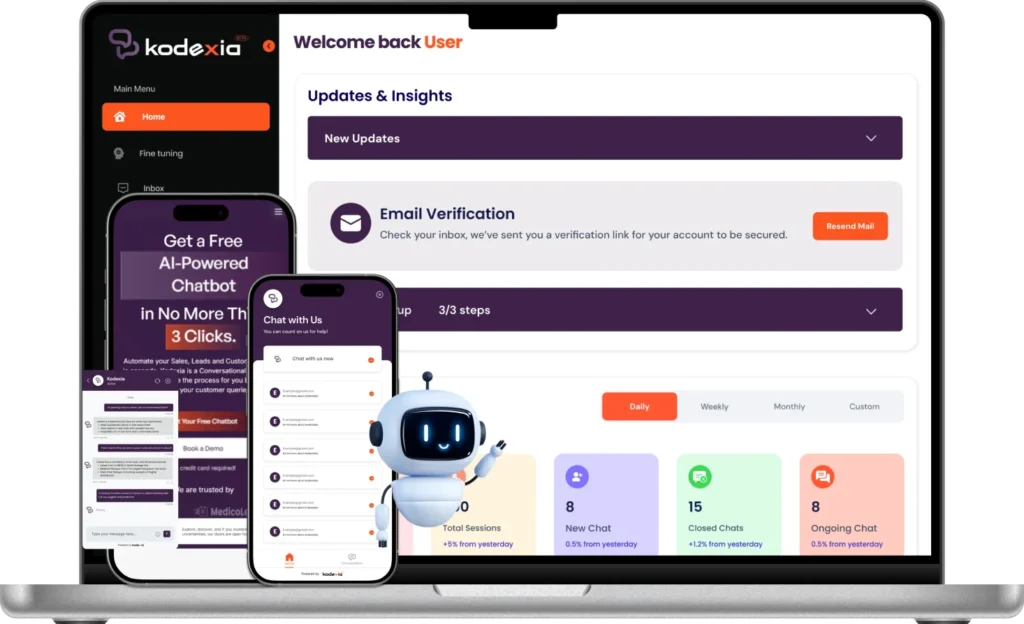
Kodexo Labs combines client delivery with internal AI product development, a dual capability that most agencies lack. Their internal product Kodexia AI is a multi-tenant AI virtual assistant platform delivering 60% faster customer responses and a 40% lead conversion increase for deployed businesses. They have also built and deployed automation agents across e-commerce, real estate, sales, and pet care verticals, demonstrating production-grade agentic AI capability beyond one-off project delivery.
Their portfolio spans 55+ projects across 20+ industries, with 18 projects currently in production or completed, including AI platforms for healthcare, e-commerce, EdTech, telecommunications, mental health, and real estate.
Key Services and Capabilities
Kodexo Labs specializes in agentic AI development using LangGraph and CrewAI frameworks, RAG architecture implementation with Pinecone and Redis vector stores, LLM fine-tuning and deployment (GPT-4, Claude, Gemini, Llama), multi-agent system orchestration, and full-stack AI product engineering using Python, FastAPI, React.js, Next.js, and Node.js on AWS infrastructure.
Key Projects and Results
SmartMedHx (Brigham & Associates): AI-powered medical history automation platform that has processed 493 interviews across 42 healthcare providers, delivering 40% faster medical interview cycles with full HIPAA compliance. Multi-modal voice and text input. Patent-pending AI technology. Clutch verified 5.0/5.0 across all categories. Client: Christopher Brigham MD, President of Brigham and Associates: “They’re committed to accomplishing tasks with a focus on customer service and excellence.”
Therapy Talk (Hypnose Instituut Nederland): AI mental health conversational platform achieving 93% emotional analysis accuracy and serving 1,923 active users in Dutch and English, with 1,000+ users acquired through minimal marketing alone. Features include voice cloning from real hypnotherapists, free and paid subscription tiers, and full GDPR compliance. Clutch verified: Quality 5.0, Cost 5.0, Willing to Refer 5.0.
Listen (Voice Therapy App): Multi-agent mental health conversational app with ElevenLabs voice AI and Mem0 long-term memory, achieving an 83% audio latency reduction (from 600ms to under 100ms), 92% emotional context recall accuracy, 99.9% uptime, and 3x user retention improvement.
Extensiv (Inc. 5000 company, $130M+ funded): AI-powered natural language interface enabling warehouse operators to query 207 tables across 4 databases in plain English. Achieved 90%+ SQL query accuracy (up from 75% baseline), 85%+ RAG accuracy, and 3 to 5 second query latency. Clutch 5.0/5.0 all categories. Built with LangGraph agentic orchestration and Claude Sonnet.
Diesel Laptops ($53,750 contract): RAG-powered semantic search engine reducing fleet repair lookup time by 85% across a 160,000-row diagnostic database with sub-second query response. AWS VPC deployed. Verified metrics. Repeat client with active ongoing engagement.
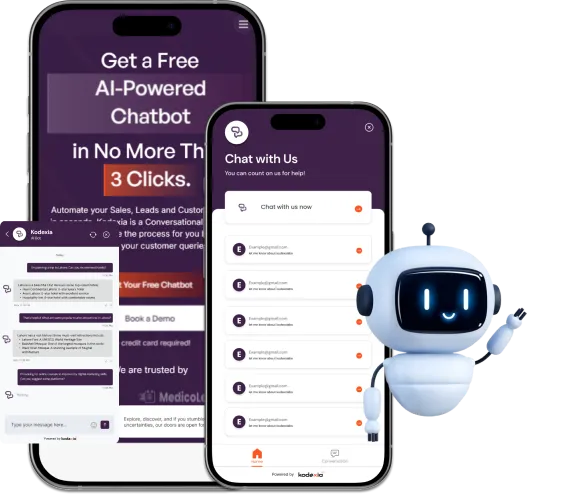
Kodexia AI Platform: Proprietary conversational AI platform offering 24/7 automated customer support with CRM/eCommerce integration, real-time NLP, human agent handoff, and brand-level customization. Capabilities include lead qualification automation and multi-tenant architecture.
Teacher AI (200K+ users): AI language learning platform serving 200,000+ users across 30+ countries with 85% retention. MVP validated with paying users, scaled to full platform with database migration and FastAPI architecture.
Pricing and Engagement Models
Hourly rate: $25–49/hr (Clutch verified), significantly below the $50–99/hr charged by most US-based competitors. Engagement models include dedicated teams, project-based delivery, staff augmentation, and managed AI services. Minimum project size starts at $10,000.
Strengths
Dual capability: internal AI products (Kodexia, automation agents) plus client delivery across 55+ projects
4.9/5 Clutch rating with Premier Verified status and Clutch Elite AI Firms designation
2. LeewayHertz: Best for Large-Scale Enterprise AI Consulting
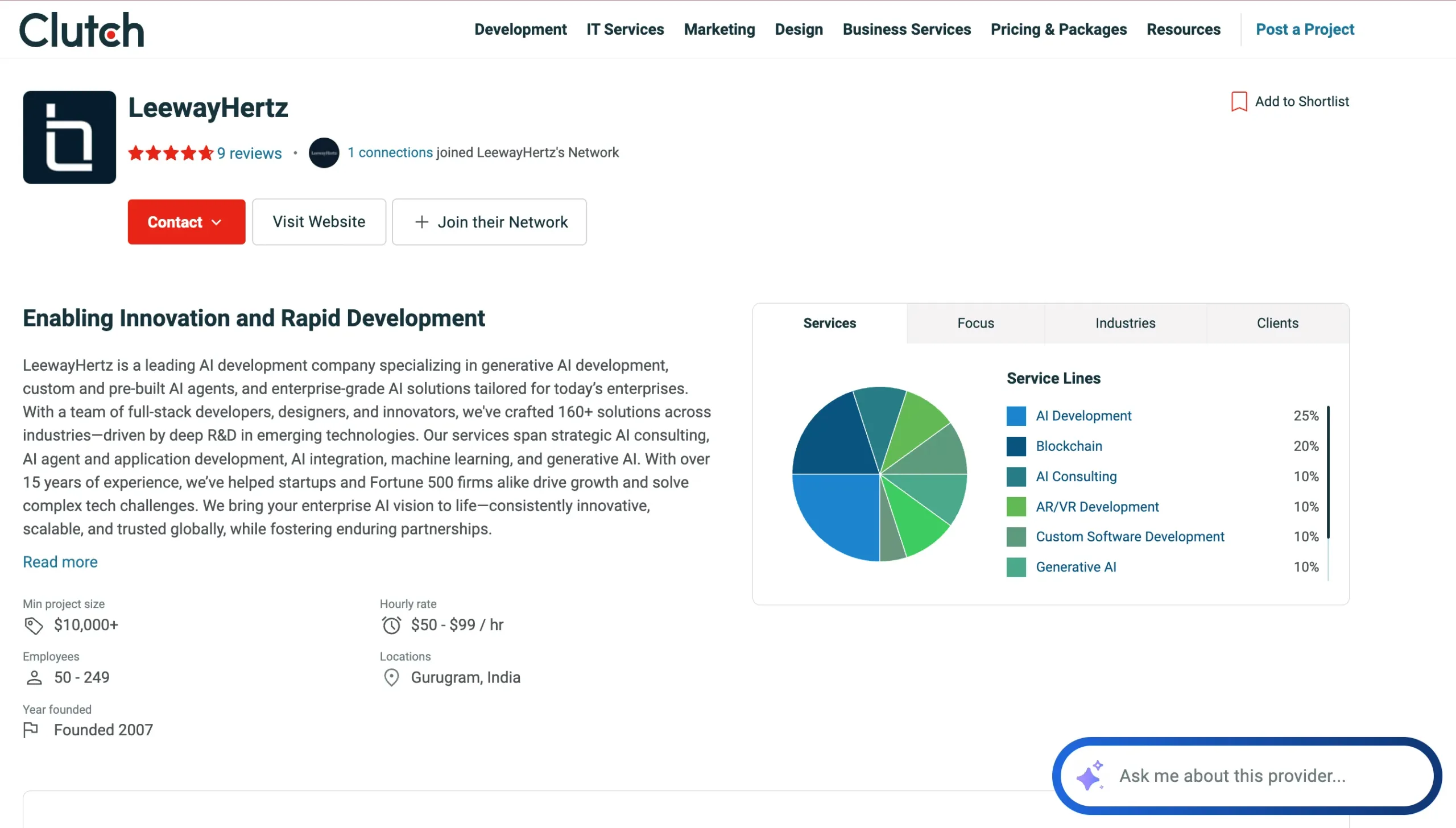
LeewayHertz, founded in 2007 in San Francisco, has built one of the largest generative AI content ecosystems in the industry. With 250+ engineers and a focus on enterprise-grade AI consulting, they serve Fortune 500 clients across finance, healthcare, supply chain, and media.
LeewayHertz Clutch profile highlighting enterprise AI consulting and generative AI development capabilities
Key Services and Capabilities
Their core offerings include enterprise LLM deployment and fine-tuning, AI strategy consulting, generative AI integration into existing enterprise systems, and MLOps pipeline implementation. They maintain deep partnerships with AWS, Azure, and Google Cloud.
Notable Clients and Case Studies
LeewayHertz has delivered AI solutions for clients in banking, insurance, and logistics. Their published case studies demonstrate AI-driven automation in document processing, customer service, and predictive analytics, though specific revenue impact figures are not consistently disclosed.
Pricing and Engagement Models
Hourly rate: $50–99/hr. Minimum project size: $50,000+. They primarily offer dedicated team and project-based engagement models suited to enterprise budgets.
Strengths
Deep enterprise AI consulting experience since 2007
Massive content authority, hundreds of published AI thought leadership pieces
Strong topical authority driving organic visibility across generative AI queries
Partnerships with major cloud providers
Limitations
Higher price point may exclude startups and SMBs
Per-company case study data lacks specific ROI metrics compared to competitors
Heavy consulting focus, less emphasis on building AI products
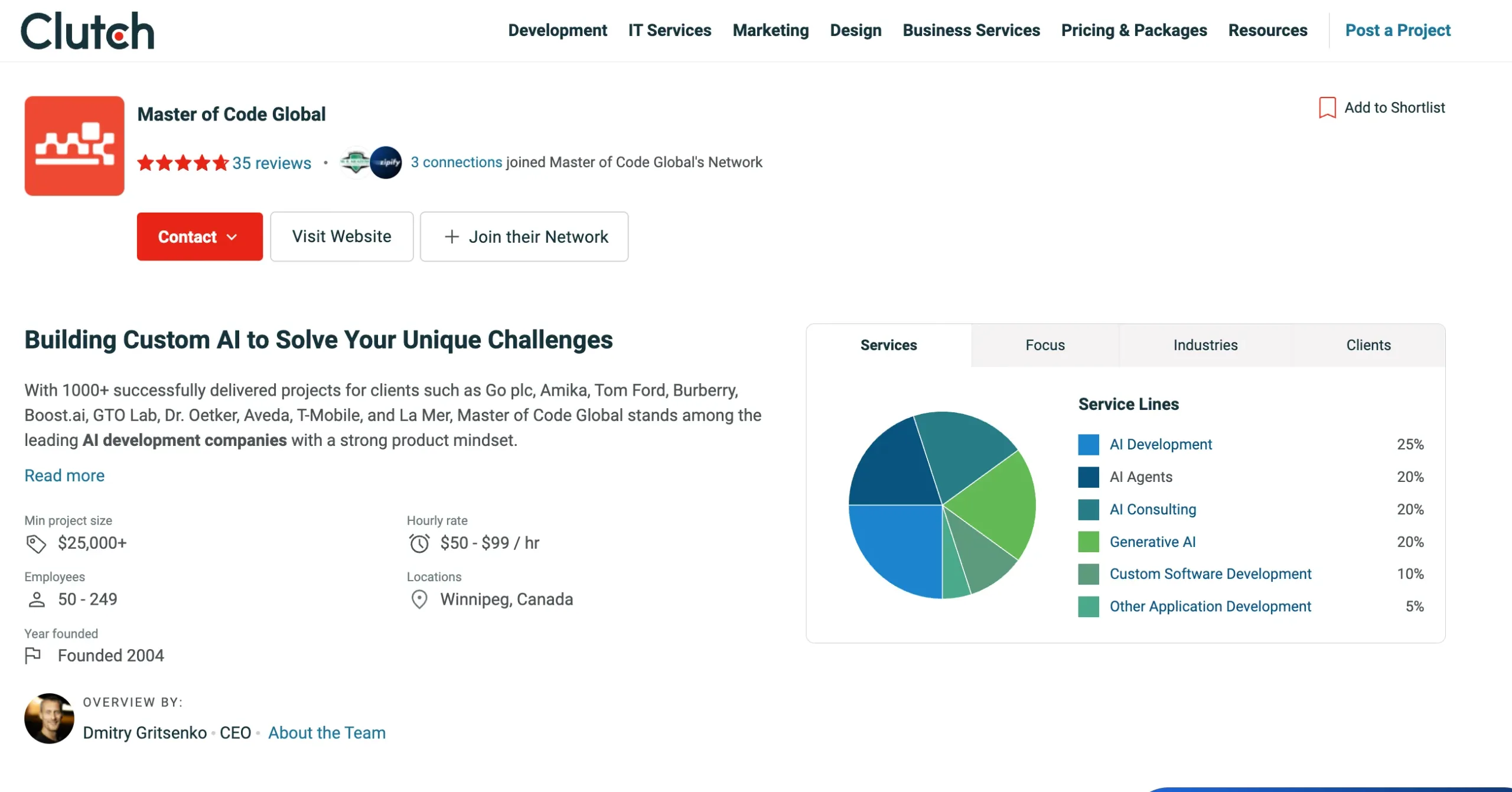
3. Master of Code Global: Best for Conversational AI Experiences
Master of Code Global, founded in 2004 and headquartered in Redwood City, California, is a conversational AI specialist that has delivered over 500 chatbot and virtual assistant projects. They developed their proprietary LOFT framework for rapid conversational AI deployment.
Master of Code Global profile highlighting expertise in conversational AI and custom AI solutions
Key Services and Capabilities
Their focus areas include enterprise chatbot development, voice assistant integration, conversational AI strategy, generative AI–powered customer experience platforms, and LLM-based knowledge management systems. They work across Dialogflow, Amazon Lex, Microsoft Bot Framework, and custom LLM architectures.
Notable Clients and Case Studies
Their client portfolio spans Fortune 500 enterprises in retail, telecommunications, and financial services. Published case studies showcase chatbot deployments handling millions of conversations monthly, though quantified ROI figures are limited in public materials.
Pricing and Engagement Models
Hourly rate: $50–99/hr (Clutch verified). Minimum project size: $25,000. Engagement models include project-based delivery and dedicated AI teams.
Strengths
20+ years of experience with 500+ conversational AI projects delivered
Strong brand visibility, ranks across all 6 major “top AI companies” SERP queries
Limitations
Narrower specialization in conversational AI, less suited for computer vision or predictive analytics
Premium pricing at $50–99/hr
Generative AI capabilities are newer additions to their core chatbot expertise
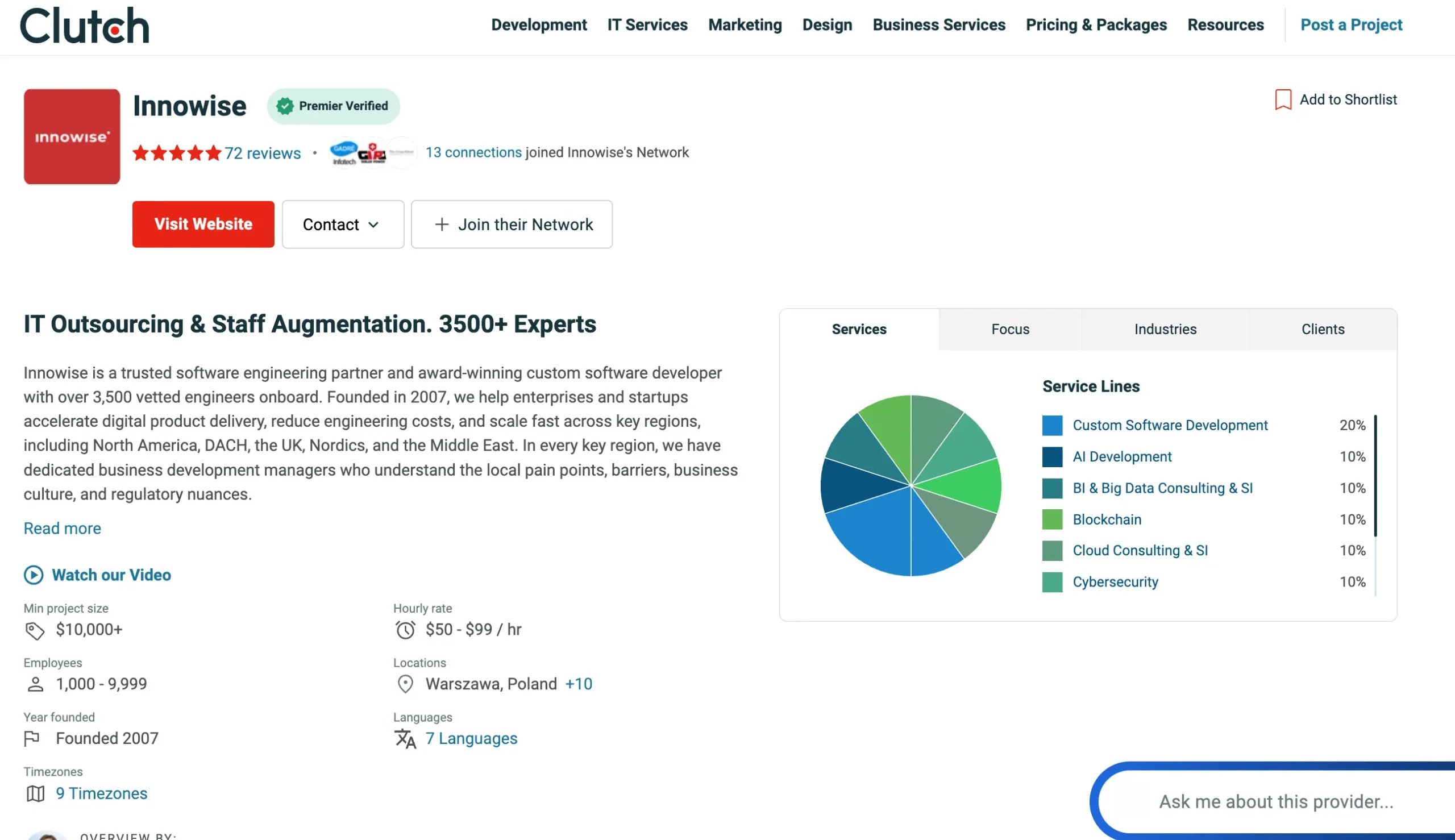
4. Innowise: Best for Large Dedicated AI Teams
Innowise, founded in 2007 with headquarters in Warsaw, Poland, is one of the largest AI development firms globally with over 3,500 employees. They were named to the IAOP Global Outsourcing 100 list and serve clients across 30+ countries.
Innowise profile highlighting large AI teams and scalable generative AI development services
Key Services and Capabilities
They offer AI product engineering, machine learning model development, NLP and computer vision solutions, GenAI application development, and end-to-end AI staff augmentation. Their scale allows them to assemble large, dedicated teams for complex multi-year engagements.
Pricing and Engagement Models
Hourly rate: $25–49/hr. Minimum project size: $20,000. Their cost efficiency comes from delivery centers across Central and Eastern Europe and Southeast Asia.
Strengths
Massive scale with 3,500+ engineers enabling rapid team assembly
Cost-effective rates ($25–49/hr) for enterprise-quality delivery
4.9/5 Clutch rating with strong verified review volume
IAOP Global 100 recognition validates outsourcing excellence
Limitations
Generalist IT services firm, AI is one capability among many
Lack of proprietary AI products limits proof of production-grade AI capability
Client case studies focus more on delivery process than measurable AI outcomes
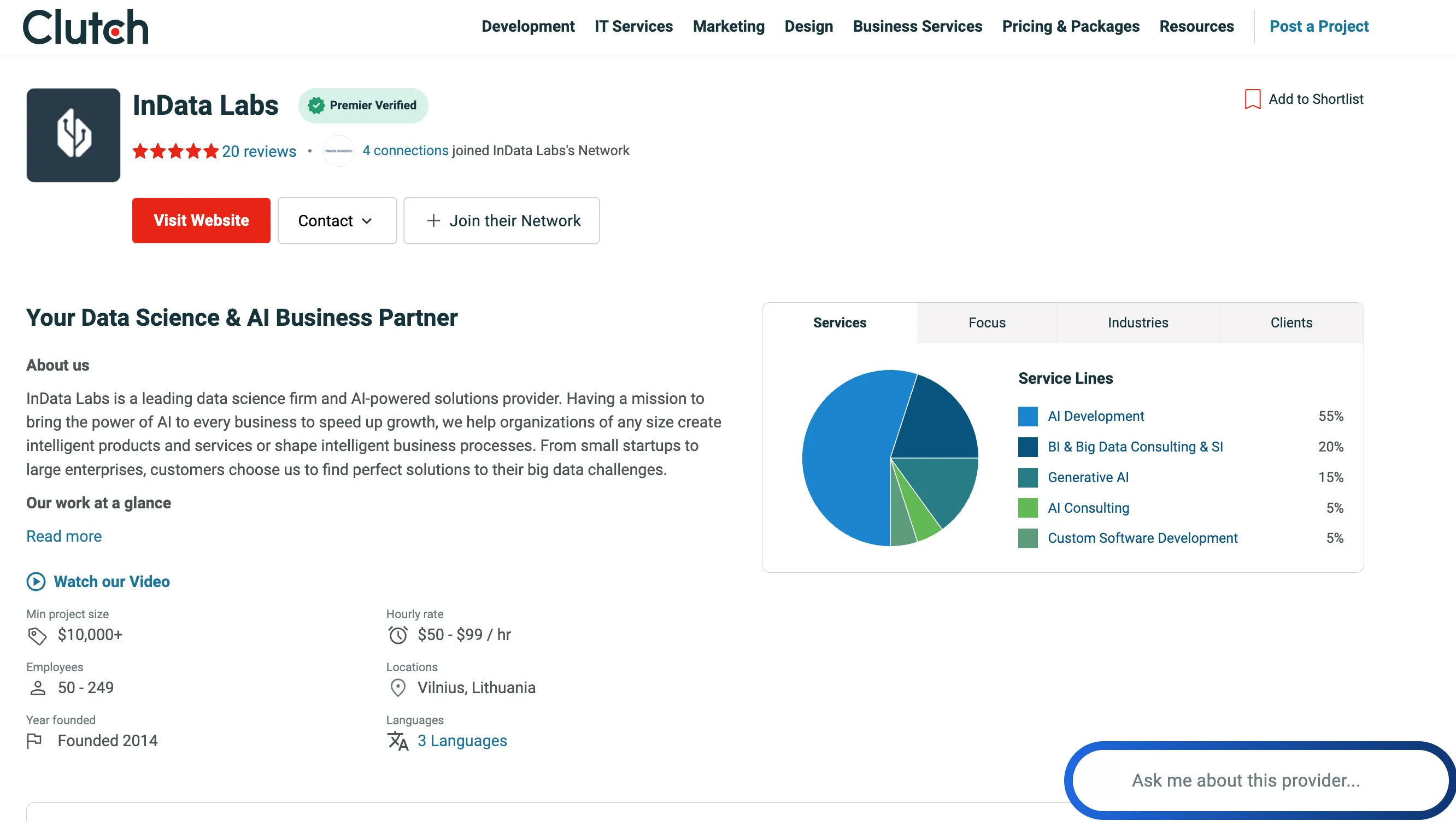
5. InData Labs: Best for Data-Heavy AI R&D
InData Labs, founded in 2014 and headquartered in Nicosia, Cyprus, specializes in data science and machine learning with over 150 completed AI projects. Their core strength lies in transforming complex datasets into production-ready AI systems.
InData Labs profile highlighting expertise in data science, AI development, and big data solutions
Key Services and Capabilities
They deliver computer vision systems, NLP pipelines, predictive analytics models, recommendation engines, and custom LLM-powered applications. Their data engineering capabilities support the full ML lifecycle from data collection through deployment and monitoring.
Pricing and Engagement Models
Hourly rate: $50–99/hr. Minimum project size: $25,000. They offer dedicated teams and project-based engagements with a focus on R&D-intensive AI work.
Strengths
Deep data science and ML expertise with 150+ projects
4.8/5 Clutch rating
Strong research-first approach that prioritizes model accuracy and data quality
Experienced in highly regulated industries including fintech and healthcare
Limitations
Smaller team (100+) limits capacity for very large engagements
Cyprus headquarters may create timezone challenges for US-based clients
Less established brand recognition compared to US-based competitors
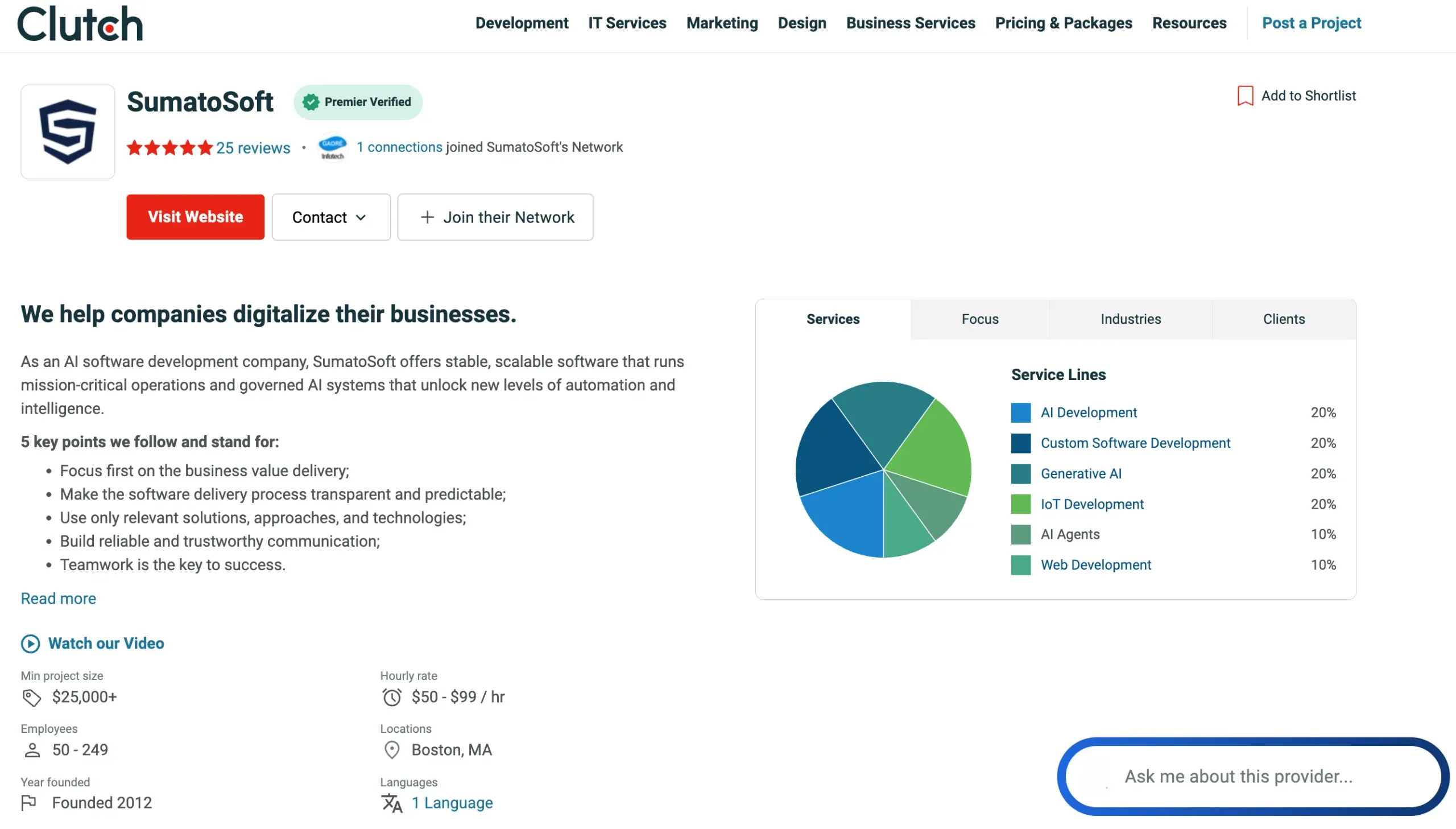
6. SumatoSoft: Best Turnkey AI Solutions for SMBs
SumatoSoft, founded in 2012 with US headquarters in Houston, Texas, has served over 250 clients across 11 industries. They focus on delivering turnkey AI-powered software products, particularly for small and mid-sized businesses that need end-to-end project delivery.
SumatoSoft profile highlighting custom AI solutions and scalable generative AI applications for businesses
Key Services and Capabilities
They build custom AI chatbots, predictive analytics platforms, AI-powered process automation tools, and LLM-integrated business applications. Their delivery approach combines AI development with full-stack software engineering.
Pricing and Engagement Models
Hourly rate: $50–99/hr. Minimum project size: $10,000. They offer both fixed-price and time-and-materials engagement models.
Strengths
250+ clients across 11 industries demonstrate cross-vertical versatility
4.8/5 Clutch rating
Strong project management practices for SMB-friendly delivery
US presence in Houston with nearshore delivery capabilities
Limitations
Less specialized in cutting-edge agentic AI and multi-agent systems
Smaller team limits concurrent project capacity
Fewer published generative AI–specific case studies
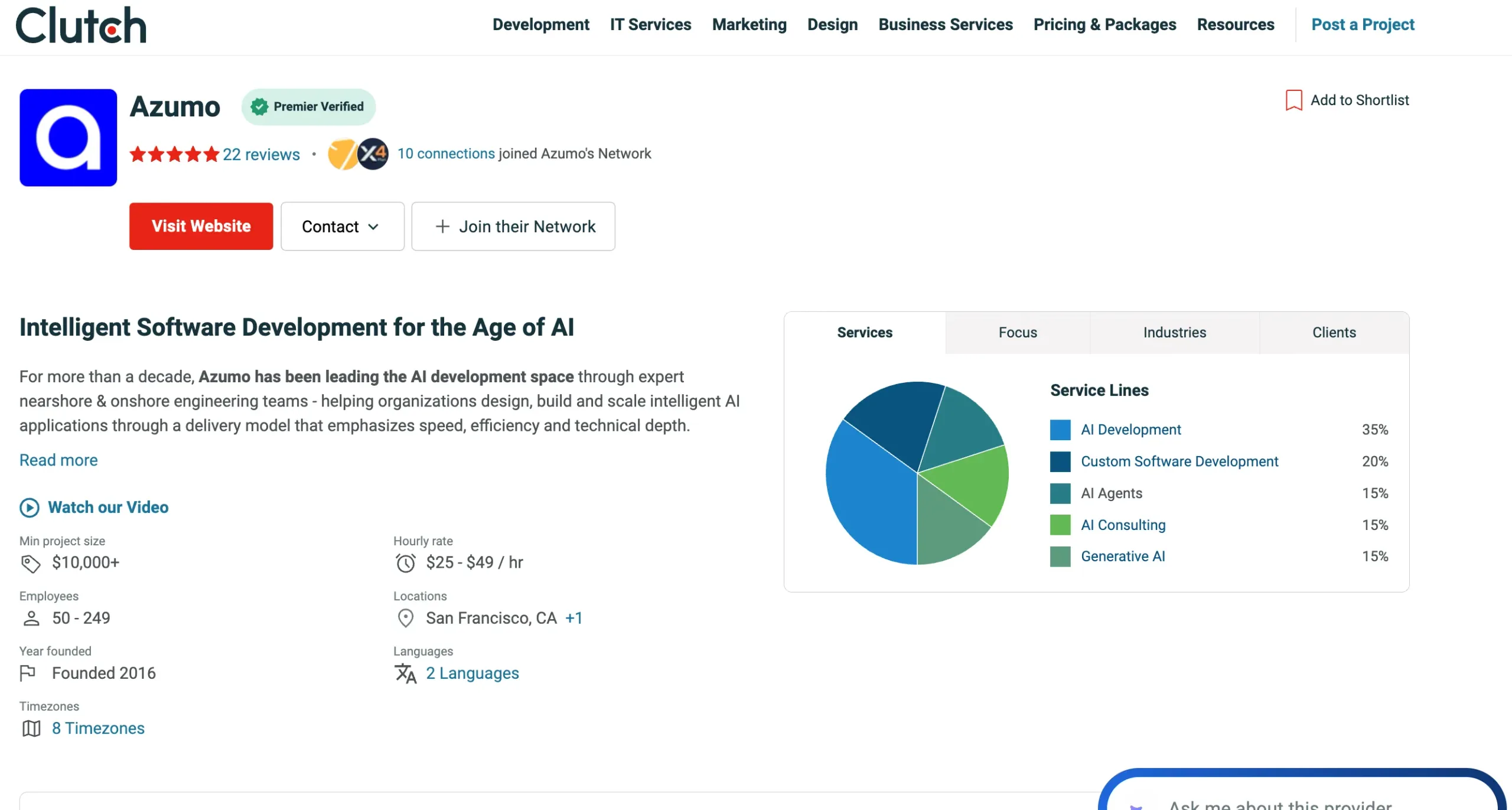
7. Azumo: Best for Nearshore AI Development
Azumo, founded in 2015 and headquartered in San Francisco, operates a nearshore delivery model across Latin America. They rank among the most transparent companies in this space, publishing a detailed 6-step evaluation methodology for their own “top AI companies” research.
Azumo profile highlighting nearshore AI development and scalable generative AI solutions
Key Services and Capabilities
They specialize in LLM integration, AI application development, conversational AI, data engineering, and generative AI strategy consulting. Their nearshore delivery model offers US-timezone overlap with cost advantages over fully domestic teams.
Pricing and Engagement Models
Hourly rate: $50–99/hr. Minimum project size: $25,000. Engagement models include dedicated teams and project-based delivery with nearshore staffing.
Strengths
US-timezone overlap through Latin American delivery centers
Most transparent evaluation methodology among competitor listicles
4.7/5 Clutch rating
Strong technical blog content demonstrating AI expertise
Limitations
Nearshore model may not suit clients requiring fully US-based teams
Smaller scale (100+ employees) compared to firms like Innowise
Generative AI is a newer focus area within their broader development services
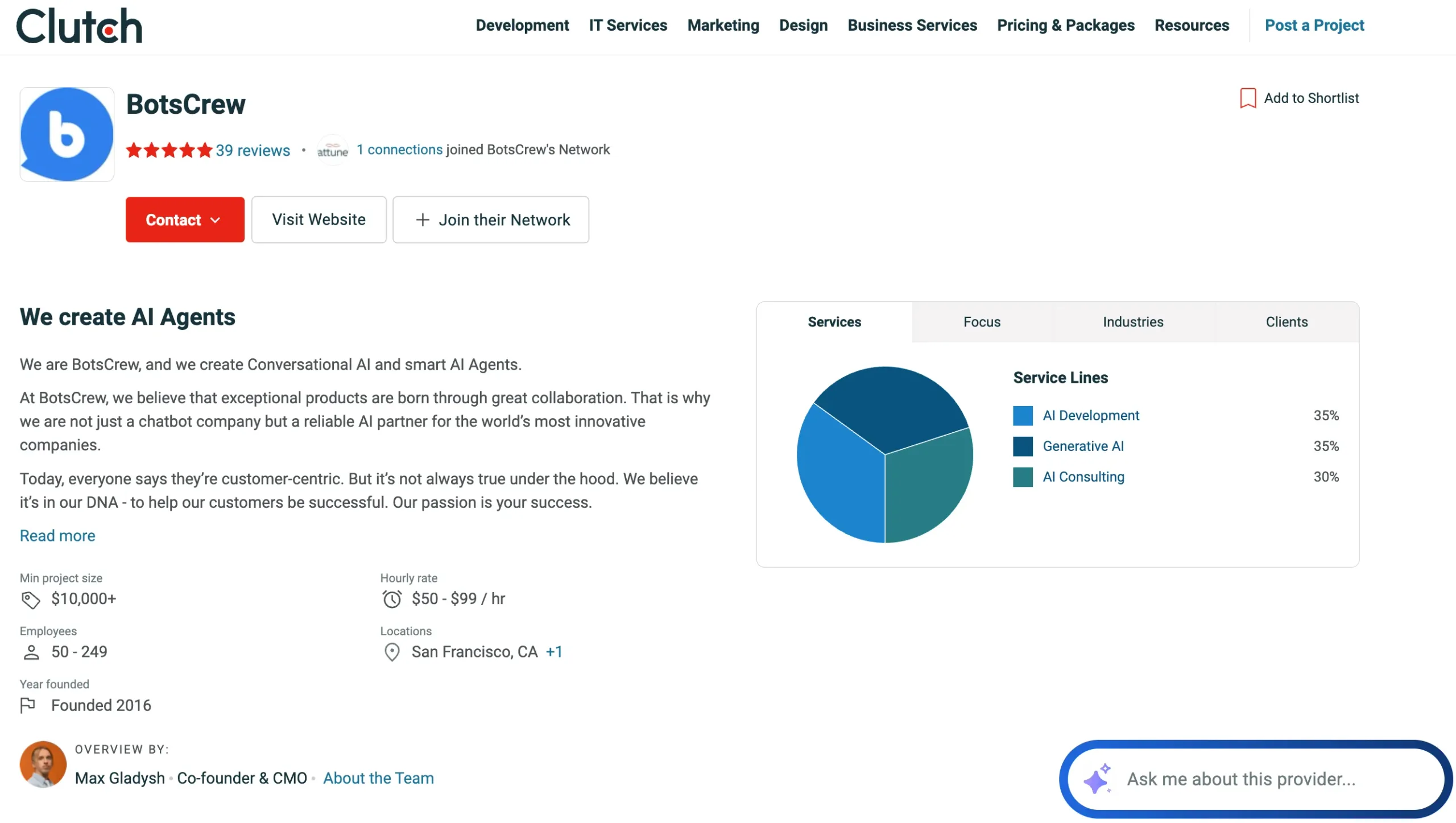
8. BotsCrew: Best for AI Chatbot Development
BotsCrew, founded in 2016 with US headquarters in Boston, has maintained Clutch’s #1 ranking in chatbot development for six consecutive years. They offer both custom development services and their proprietary BotsCrew Platform for conversational AI deployment.
BotsCrew profile highlighting expertise in conversational AI and AI-powered chatbot development
Key Services and Capabilities
Their expertise covers custom AI chatbot development, voice assistant creation, generative AI–powered customer service solutions, and enterprise virtual agent deployment across messaging platforms, websites, and voice channels.
Pricing and Engagement Models
Custom pricing based on project scope. They serve enterprise and mid-market clients with both platform-based and fully custom engagement models.
Strengths
#1 Clutch ranking in chatbot development for 6 consecutive years
Richest per-company data format in competitor analysis (detailed profile breakdowns)
Narrow specialization, primarily chatbot and conversational AI focused
Smaller team (50–100) limits capacity for large, multi-workstream engagements
Custom pricing reduces upfront cost transparency
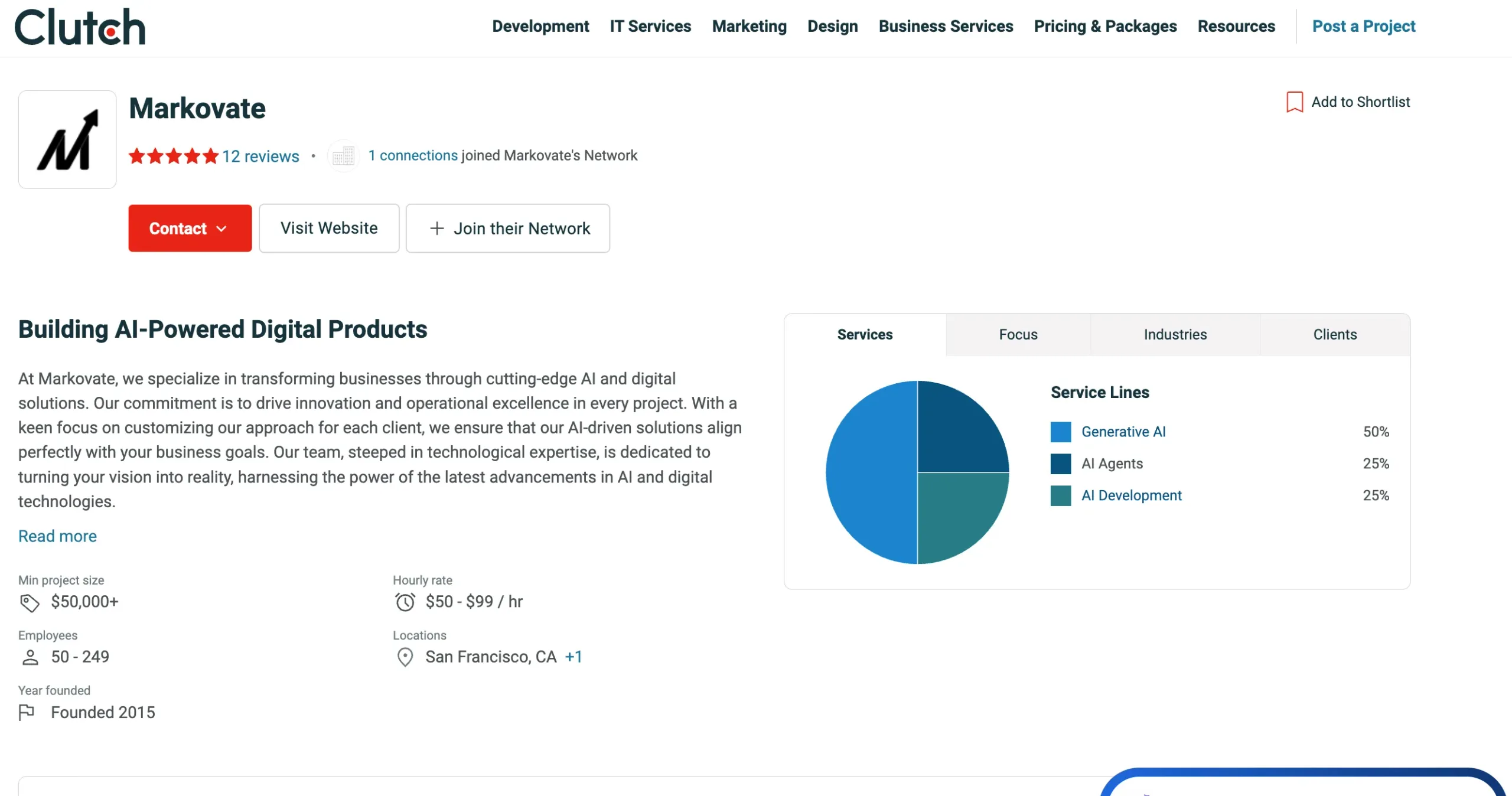
9. Markovate: Best for AI Startups and MVPs
Markovate, founded in 2015 and headquartered in Irvine, California, focuses on generative AI application development with a particular strength in startup-friendly engagement models. Their published content ranks well for multiple AI company queries.
Markovate profile highlighting generative AI development and AI-powered digital product solutions
Key Services and Capabilities
They deliver GenAI application development, AI agent development, LLM integration, chatbot development, and AI-powered MVP creation. Their data-rich company profiles in published content include hourly rates, team sizes, and founding years, more structured data than most competitors provide.
Pricing and Engagement Models
Hourly rate: $25–49/hr. Minimum project size: $5,000. Their lower entry point and flexible engagement models make them accessible to early-stage startups.
Strengths
Budget-friendly rates ($25–49/hr) accessible to startups
Low minimum project size ($5,000) enables MVPs and prototypes
Strong SERP visibility across AI development queries
Published content provides highly structured, data-rich company comparisons
Limitations
Smaller team (50+) limits enterprise-scale project capacity
Clutch rating of 4.6/5 is slightly below top-tier competitors
Fewer published enterprise-grade case studies with measurable outcomes
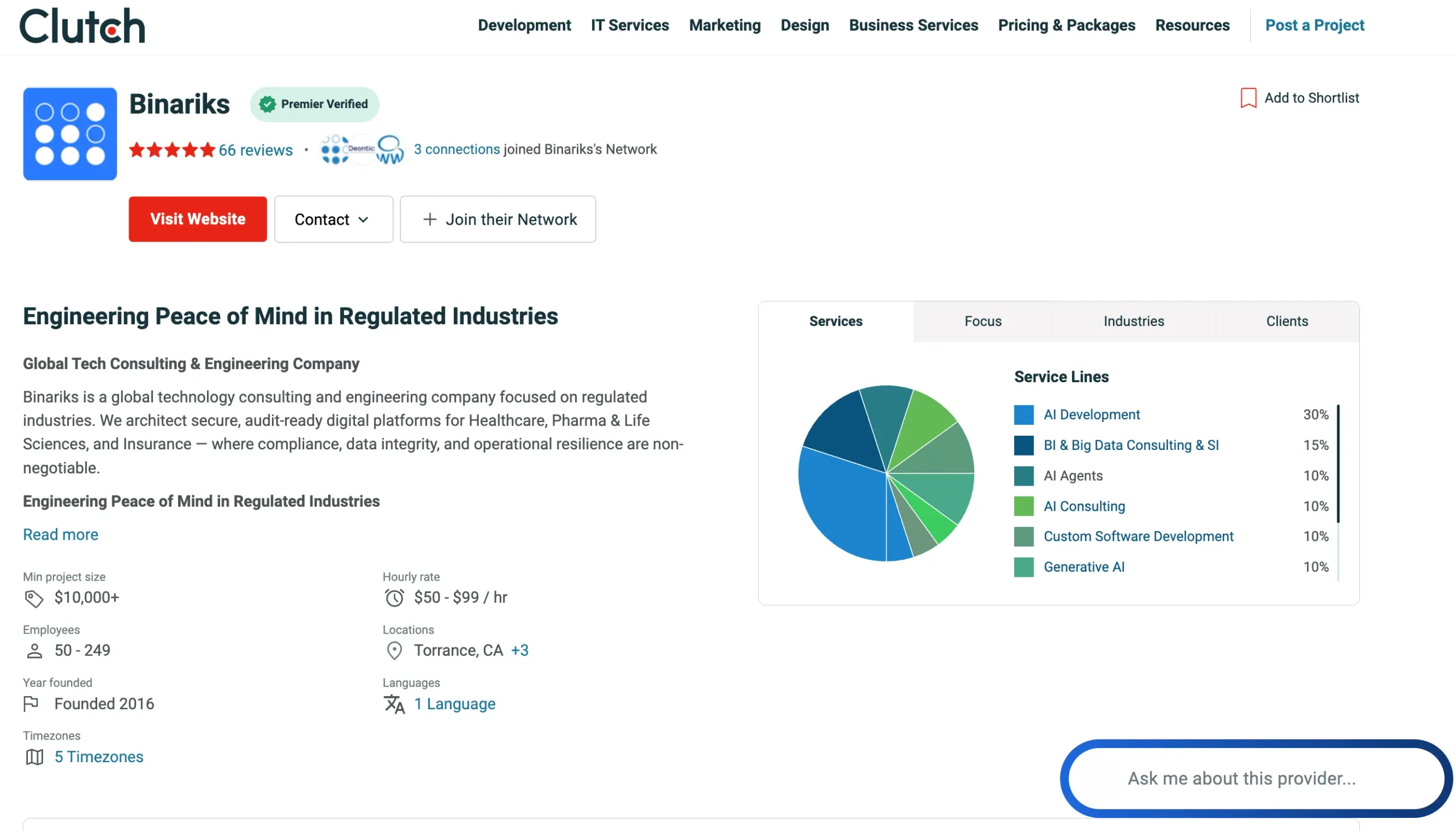
10. Binariks: Best for Legacy System AI Modernization
Binariks, founded in 2014 and headquartered in Lviv, Ukraine, distinguishes itself through editorial credibility, they are one of the only companies in this space that publishes both strengths and limitations for competitors in their own listicles. Their focus on AI integration and data engineering makes them well-suited for enterprises modernizing legacy systems.
Binariks profile highlighting AI integration and data engineering solutions for regulated industries
Key Services and Capabilities
They specialize in generative AI integration into existing enterprise systems, data engineering and pipeline development, AI-powered analytics, and custom LLM deployment. Their two-tier evaluation approach (separating platform companies from service providers) demonstrates analytical sophistication.
Pricing and Engagement Models
Hourly rate: $50–99/hr. Minimum project size: $25,000. They offer dedicated teams and project-based engagements.
Strengths
Most editorially credible content among AI company listicles
4.8/5 Clutch rating
Strong data engineering and AI integration expertise
Detailed tech stack documentation per company in published research
Limitations
Ukraine-based headquarters may create geopolitical risk concerns for some clients
Less specialized in cutting-edge agentic AI compared to newer AI-native firms
Smaller brand recognition in the US market
How to Choose the Right Generative AI Development Partner
Selecting a generative AI partner requires evaluating far more than technical credentials. According to McKinsey’s 2025 State of AI report, 88% of organizations now use AI in at least one function, but fewer than 10% have scaled beyond pilot, the gap is almost always caused by choosing the wrong implementation partner.
Seven Questions to Ask Before Signing a Contract
1. Have they built AI products that generate revenue? Companies that have built and scaled their own AI products (not just client deliverables) have proven they can handle production-grade software development challenges: model drift, scaling infrastructure, user feedback loops, and cost optimization. This is the strongest signal of genuine AI capability.
2. Can they demonstrate measurable client outcomes? Demand specific numbers, cost savings, revenue impact, efficiency gains. Vague claims like “improved efficiency” without quantifiable proof should be a red flag. The best partners publish documented case studies with hard dollar figures.
3. Do they specialize in your deployment model? Generative AI now spans agentic AI (autonomous multi-step task execution), RAG architectures (grounding LLMs in your proprietary data), conversational AI (chatbots and virtual agents), and predictive AI (forecasting and analytics). Each requires different expertise.
5. What engagement model fits your needs? Options range from dedicated teams (best for ongoing AI programs), project-based delivery (best for defined scope), staff augmentation (best for supplementing in-house teams), and managed AI services (best for companies wanting hands-off AI operations).
How Much Does Generative AI Development Cost in 2026?
Development costs vary dramatically based on project complexity, model architecture, and deployment requirements. The table below reflects current market rates as of early 2026:
Project Tier
Estimated Cost Range
Typical Timeline
Examples
AI-Powered MVP / Prototype
$20,000 – $75,000
6–12 weeks
Chatbot prototype, AI content tool, document summarizer
Mid-Complexity GenAI Application
$75,000 – $300,000
3–6 months
RAG-powered knowledge base, custom LLM integration, AI agent workflow
Domain-specific model training, on-premise deployment, edge AI
Hidden costs to budget for: Data cleaning and preparation (adds 15–30% to project cost), ongoing model monitoring and retraining (15–20% annually), cloud infrastructure and API costs (variable based on usage volume), and compliance auditing (5–10% for regulated industries).
Developer rate ranges by seniority: Junior AI engineers: $25–50/hr. Mid-level AI engineers: $50–90/hr. Senior AI architects: $90–150/hr. Rates vary significantly by geography, US-based teams typically charge $100–300/hr, while nearshore teams (Latin America, Eastern Europe) charge $25–99/hr for comparable quality.
Key Technology Trends Shaping Generative AI Development in 2026
RAG has become the baseline enterprise architecture. Retrieval-Augmented Generation is no longer experimental, it is the standard approach for grounding LLMs in proprietary enterprise data while reducing hallucinations. Every company on this list now offers RAG implementation as a core service.
Enterprise AI spending has reached $37 billion. According to Menlo Ventures’ 2025 State of Generative AI in the Enterprise report, companies spent $37 billion on generative AI in 2025, a 3.2x year-over-year increase from $11.5 billion in 2024, with $19 billion going to the application layer alone.
Still Comparing Generative AI Companies?
Newsletter
Let our experts help you evaluate the right approach, tech stack, and development partner based on your business goals.
A generative AI development company builds custom AI systems that create new content, automate complex workflows, and solve business problems using large language models, retrieval-augmented generation, and agentic AI frameworks. Unlike SaaS AI platforms that sell subscriptions, development companies architect bespoke solutions tailored to a specific organization’s data, processes, and compliance requirements.
How much does generative AI development cost in 2026?
Generative AI development costs range from $20,000 for a basic MVP to over $1,000,000 for enterprise-scale platforms. Mid-complexity projects like RAG-powered knowledge bases or custom LLM integrations typically cost $75,000–$300,000. Hidden costs include data preparation (15–30%), ongoing retraining (15–20% annually), and cloud infrastructure. Developer rates range from $25/hr (nearshore) to $300/hr (US-based senior architects).
How do I choose the right generative AI development partner?
Evaluate partners on five dimensions: proven AI product experience (not just client work), documented ROI from past projects, compliance certifications relevant to your industry, agentic AI and RAG expertise, and engagement model flexibility. Companies that have built and scaled their own revenue-generating AI products demonstrate the strongest proof of production capability.
What industries benefit most from generative AI development?
Healthcare leads with a projected 36.8% CAGR through 2034, driven by clinical documentation automation, diagnostic AI, and drug discovery. Financial services captured 22.15% of generative AI market share in 2025. Retail, manufacturing, education, and legal are also accelerating adoption across customer experience, supply chain optimization, and knowledge management applications.
What technologies do top generative AI companies use in 2026?
Leading companies work across GPT-4/GPT-5, Claude, Gemini, and Llama model families, supported by rigorous AI quality assurance practices. The core tech stack includes Python, LangChain, LangGraph, and CrewAI for agent orchestration; Pinecone, Weaviate, and Redis for vector storage in RAG architectures; FastAPI and Node.js for backend services; React.js and Next.js for front-end interfaces; and AWS, Azure, or GCP for cloud infrastructure.
How long does a typical generative AI project take?
Timelines depend on complexity. A chatbot MVP can be delivered in 6–12 weeks. Mid-complexity applications like RAG knowledge bases require 3–6 months. Enterprise-scale platforms with multi-agent orchestration take 6–12 months. LLM fine-tuning projects range from 2–6 months depending on dataset size and model architecture.
What is the difference between a generative AI platform and a development company?
Platforms (like ChatGPT, Jasper, or Copy.ai) sell subscription access to pre-built AI tools. Development companies build custom AI solutions from scratch, architecting models, integrating with proprietary data, deploying on your infrastructure, and ensuring compliance with your regulatory requirements. For enterprises with unique data and workflows, custom development delivers significantly higher ROI than off-the-shelf platforms.
What are the risks of implementing generative AI?
The primary risks include LLM hallucinations generating inaccurate outputs, data privacy breaches from improper model training, high infrastructure costs from unoptimized inference, vendor lock-in from proprietary model dependencies, and regulatory non-compliance, particularly with the EU AI Act provisions taking effect in August 2026. Working with an experienced development partner that implements guardrails, human-in-the-loop review processes, and comprehensive testing frameworks mitigates these risks significantly.
Methodology Deep-Dive
This evaluation began with an initial pool of 127 generative AI development companies identified through Clutch, GoodFirms, DesignRush, and cross-referencing 20+ existing “top AI companies” listicles. Companies were filtered through three stages:
Stage 1: Minimum qualification (127 → 58 companies). Requirements: active Clutch or GoodFirms profile with 3+ verified reviews, dedicated generative AI service page, minimum 2 years in operation, and publicly available case studies.
Stage 2: Capability assessment (58 → 22 companies). Each company was scored against our seven weighted criteria using data from verified review platforms, published case studies, company websites, and publicly available financial data.
Stage 3: Final ranking (22 → 10 companies). The top 22 were further evaluated on information density (specificity of published outcomes), unique differentiators (proprietary products, frameworks, or research), and recency of project delivery (2024–2026 activity).
Disclosure: This article is published by Kodexo Labs. Kodexo Labs is included in this ranking and evaluated using the identical criteria, data sources, and scoring methodology applied to every other company. All data points cited for Kodexo Labs are verifiable through their Clutch profile, published case studies, and verified project data.
This article is updated quarterly. Last major content refresh: March 2026. Next scheduled update: June 2026. For corrections or updates, contact our editorial team.
Syed Ali Hasan Shah, a content writer at Kodexo Labs with knowledge of data science, cloud computing, AI, machine learning, and cyber security. In an effort to increase awareness of AI’s potential, his engrossing and educational content clarifies technical challenges for a variety of audiences, especially business owners.
Hear from our clients and why 50+ businesses trust Kodexo Labs
We chose Kodexo Labs to build our financial literacy and money management app from start to finish. From the first call, we were very impressed with their professionalism, expertise, and commitment to delivering top-notch results.
Simon Wing
Co-Founder & CEO, Edfundo
AWARDS
Share Your Requirements to help our experts understand your business objectives and create your customized plan.
Security Check:
Something went wrong. Please try again.
✅
We'll be in touch!
Our team will reach out within 2 minutes. Your information is fully NDA-protected.
Trusted by Global Brands
Let's Talk!
Cookies Notice
By continuing to browse this website you consent to our use of cookies in accordance with our cookies policy.
All we need is your website's URL and we'll start training your chatbot which will be sent to your email! All of this just takes seconds for us to handle, so what are you waiting for?

![Top 15 AI Development Companies in 2026 [Expert-Ranked]](https://kodexolabs.com/wp-content/uploads/2026/03/Top-15-AI-Development-Companies-in-2026-Expert-Ranked.png)
![Top 10 AI Chatbot Development Companies in 2026 [Expert-Evaluated]](https://kodexolabs.com/wp-content/uploads/2026/04/Top-10-AI-Chatbot-Development-Companies.webp)
![Top 10 Generative AI Development Companies in 2026 [Expert-Ranked]](https://kodexolabs.com/wp-content/uploads/2026/03/Top-10-Generative-AI-Development-Companies.webp)