Customer churn costs businesses over $1.6 trillion annually, with banking and telecom sectors among the most affected. Traditional retention methods often react too late—after a customer has already disengaged or switched providers.
AI-powered churn prediction changes this by analyzing customer behavior, usage patterns, service interactions, and transaction trends to identify at-risk customers before they leave. With prediction accuracy reaching 90%, organizations can intervene early with proactive, personalized retention strategies.
What is AI Customer Churn Prediction and How Does It Transform Business Outcomes?
AI customer churn prediction uses machine learning algorithms and predictive analytics to analyze customer behavior patterns, transaction history, and engagement metrics, identifying at-risk customers with 90% accuracy before they actually leave. This proactive approach enables businesses to intervene with targeted retention strategies rather than reacting after customers have already churned.
Modern AI systems process vast amounts of customer data in real-time, identifying subtle patterns that human analysts might miss. By analyzing factors like transaction frequency, customer service interactions, usage patterns, and payment behaviors, these systems create comprehensive risk profiles for each customer. The result is actionable intelligence that enables proactive engagement strategies.
Understanding Churn Prediction Models
Churn prediction models are sophisticated algorithms trained on historical customer data to identify patterns that precede customer departures. These models analyze hundreds of variables simultaneously, from basic demographics to complex behavioral sequences. Unlike traditional approaches that rely on simple rules or thresholds, AI models continuously learn and adapt to changing customer behaviors.
What is Customer Churn Rate?
Customer churn rate is the percentage of customers who stop using a company’s services within a specific time period, calculated by dividing customer losses by total customers at the period’s start.
Don’t miss on the latest updates in the world of AI. We dispatch custom reports and newsletters every week, with forecasts on trends to come. Join our community now!
Key Components of AI-Driven Churn Detection
AI-driven churn detection systems integrate multiple data sources and analytical techniques to create comprehensive customer risk assessments. These systems combine supervised learning algorithms trained on historical churn data with unsupervised learning techniques that discover new behavioral patterns. Machine learning development expertise is crucial for implementing these complex systems effectively.
Component
Function
Accuracy Impact
Data Integration
Combines multiple data sources
15-20% improvement
Feature Engineering
Creates predictive variables
20-25% improvement
Model Ensemble
Combines multiple algorithms
10-15% improvement
Real-time Processing
Enables immediate responses
5-10% improvement
Business Impact Metrics
Companies implementing AI-driven churn prediction typically see immediate improvements in key business metrics. According to 2024 research, organizations using AI for customer retention achieve 25-35% reduction in churn rates within the first year of implementation. The return on investment often exceeds 5:1 within 18 months.
How Can AI Help in Predicting and Preventing Customer Churn in Banking & Telecom?
AI helps banking and telecom companies predict churn by analyzing transaction patterns, service usage, customer support interactions, and payment behaviors, enabling targeted retention campaigns that improve customer satisfaction and reduce subscriber churn by 12-18%. These industry-specific applications leverage domain expertise to create highly accurate predictive models.
The banking and telecommunications sectors generate enormous volumes of customer data daily, creating ideal conditions for AI-powered churn prediction. Each customer interaction, transaction, or service usage event provides valuable signals about satisfaction levels and likelihood to churn. AI development services specialized for these industries can unlock this data’s predictive potential.
Banking Sector Applications
Banks possess rich datasets spanning transaction histories, account balances, credit behaviors, and digital banking interactions. AI systems analyze these data streams to identify early warning signs of customer dissatisfaction or changing financial needs. Predictive models can detect patterns like declining account balances, reduced transaction frequency, or increased customer service contacts that often precede account closures.
Transaction Pattern Analysis
AI analyzes spending patterns, payment behaviors, and account usage to identify customers whose financial habits suggest they may be considering switching banks or reducing their relationship depth.
Declining transaction frequency detection
Balance transfer pattern recognition
Cross-selling opportunity identification
Payment behavior anomaly detection
Telecommunications Sector Implementation
Telecom providers have access to detailed usage data, call detail records, network performance metrics, and billing information. AI systems can process this information to identify customers experiencing service issues, billing concerns, or changing usage patterns that indicate potential churn risk. The challenge lies in processing massive data volumes in real-time to enable immediate intervention.
Data Source
Churn Indicators
Prediction Window
Call Detail Records
Usage pattern changes
30-60 days
Network Quality
Service complaint patterns
14-30 days
Billing Data
Payment delays, disputes
60-90 days
Customer Service
Contact frequency, sentiment
7-14 days
Proactive Prevention Strategies
Once AI systems identify at-risk customers, automated workflows trigger personalized retention campaigns. These might include special offers, service upgrades, or proactive customer service outreach. The key is timing interventions when customers are still receptive to retention efforts but before they’ve made firm decisions to leave.
Fintech software development expertise enables banks to implement sophisticated retention automation, while telecom providers benefit from systems that can adjust service offerings dynamically based on churn risk scores.
Essential AI Techniques and Machine Learning Algorithms for Churn Prediction
Effective churn prediction employs multiple machine learning techniques including random forest for feature importance, neural networks for complex pattern recognition, and classification algorithms like logistic regression and SVM for accurate customer segmentation. The choice of algorithm depends on data characteristics, business requirements, and accuracy targets.
Modern churn prediction systems typically use ensemble methods that combine multiple algorithms to achieve higher accuracy than any single approach. This requires sophisticated machine learning expertise to design and implement effectively.
Popular Machine Learning Algorithms
Different algorithms excel at different aspects of churn prediction. Random forests provide excellent feature importance insights, helping businesses understand which factors most strongly predict churn. Neural networks can capture complex, non-linear relationships between variables that simpler algorithms might miss. Support vector machines excel at creating clear decision boundaries between likely churners and loyal customers.
What are Random Forest Algorithms?
Random Forest is an ensemble learning method that combines multiple decision trees to improve prediction accuracy and reduce overfitting, providing robust churn predictions across diverse customer segments.
Algorithm
Strengths
Typical Accuracy
Random Forest
Feature interpretation, robustness
85-90%
Neural Networks
Complex pattern recognition
88-95%
Support Vector Machine
Clear decision boundaries
82-88%
Gradient Boosting
High predictive power
90-95%
Feature Engineering Best Practices
Feature engineering transforms raw customer data into predictive variables that machine learning algorithms can use effectively. This process requires domain expertise to identify meaningful patterns and relationships within the data. Effective feature engineering can improve model accuracy compared to using raw data alone.
Comparative features: Peer group comparisons, industry benchmarks
Model Selection and Validation
Selecting the right model requires careful evaluation of multiple factors including accuracy, interpretability, computational efficiency, and business requirements. Cross-validation techniques ensure models perform well on unseen data, while A/B testing validates real-world effectiveness. Machine learning consulting helps organizations navigate these complex decisions.
Model validation must consider business metrics alongside statistical accuracy. A model with 91% accuracy that generates too many false positives might overwhelm retention teams with unnecessary interventions, reducing overall effectiveness.
Customer Data Sources and Integration Strategies for Effective Churn Prediction
Successful churn prediction integrates data from CRM systems, transaction history, customer support interactions, social media engagement, and behavioral patterns, creating a 360-degree customer view that improves prediction accuracy. Data quality and integration architecture are critical success factors.
The most accurate churn prediction models combine structured data from operational systems with unstructured data from customer interactions, social media, and support channels. This requires sophisticated data engineering capabilities to process and integrate diverse data sources effectively.
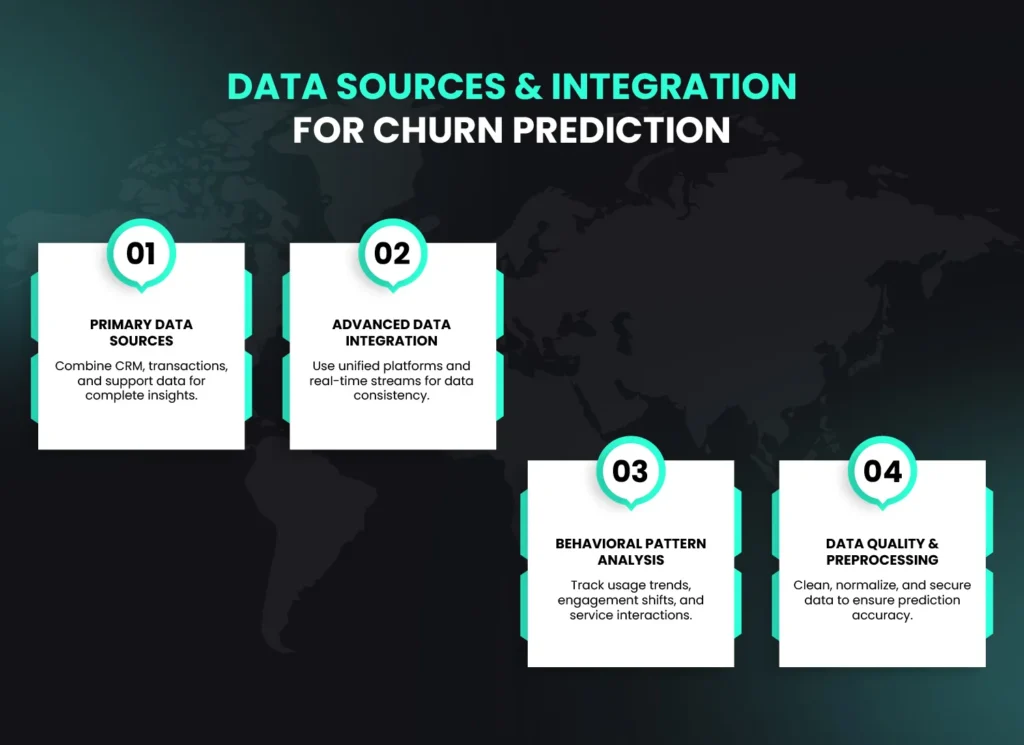
Core data sources and integration steps that power AI in customer churn prediction.
Primary Data Sources
Customer relationship management systems form the foundation of most churn prediction efforts, containing demographic information, account details, and interaction histories. Transaction systems provide behavioral data showing how customers actually use products and services. Support systems capture problems, complaints, and resolution outcomes that strongly predict future churn risk.
What are CRM Systems?
Customer Relationship Management systems store and manage customer interactions, providing centralized data repositories that feed AI churn prediction models with relationship history and engagement patterns.
Data Source
Information Type
Prediction Value
CRM Systems
Demographics, preferences, history
High
Transaction Data
Usage patterns, spending behavior
Very High
Support Interactions
Problems, satisfaction, resolution
Very High
Digital Engagement
Website, app, email interactions
Medium-High
Advanced Data Integration
Modern data integration approaches use customer data platforms to create unified customer profiles that combine all available data sources. Real-time data streaming enables immediate response to changing customer behaviors, while data lakehouse architectures provide flexibility to incorporate new data sources as they become available.
The challenge lies in maintaining data quality and consistency across multiple systems while enabling real-time processing for immediate churn predictions. Data analytics services help organizations build robust integration architectures that scale with business growth.
Behavioral Pattern Analysis
Customer behavior analysis goes beyond basic demographics and transaction data to understand how customers interact with products, services, and channels over time. This includes digital engagement patterns, communication preferences, and service usage trends that reveal changing needs or satisfaction levels.
Channel preference shifts: Changes in how customers prefer to interact
Usage pattern evolution: Increasing or decreasing service utilization
Response rate changes: Declining engagement with marketing communications
Support escalation patterns: Increasing complexity or frequency of issues
Data Quality and Preprocessing
High-quality data is essential for accurate churn prediction. Data preprocessing includes cleaning inconsistent records, handling missing values, and normalizing data from different sources. Poor data quality can reduce model accuracy, making preprocessing a critical investment area.
Privacy and compliance considerations must be built into data processing workflows from the beginning. GDPR, CCPA, and industry-specific regulations affect how customer data can be collected, processed, and used for predictive modeling.
Churn Prediction Software and Analytics Platforms for Banking & Telecom
Leading churn prediction software includes Salesforce Marketing Cloud for CRM integration, Power BI for visualization, specialized platforms like enterprise AI solutions, and custom solutions built on cloud-based analytics frameworks. Platform selection depends on existing infrastructure, budget constraints, and specific business requirements.
The software landscape includes both comprehensive platforms that handle end-to-end churn prediction workflows and specialized tools that focus on specific aspects like data visualization, model development, or campaign automation. Software consulting services help organizations evaluate options and select optimal solutions.
Enterprise Analytics Platforms
Enterprise analytics platforms provide comprehensive environments for developing, deploying, and managing churn prediction models. These platforms typically include data integration capabilities, machine learning development environments, visualization tools, and deployment infrastructure. The advantage is having all necessary components in a single, integrated solution.
Platform
Strengths
Best For
Salesforce Marketing Cloud
CRM integration, campaign automation
Existing Salesforce users
Microsoft Power BI
Visualization, Office integration
Microsoft-centric environments
Tableau CRM
Advanced analytics, data discovery
Complex analytical requirements
Custom Solutions
Tailored functionality, full control
Unique business requirements
Specialized Churn Prediction Tools
Specialized tools focus specifically on churn prediction and retention management. These solutions often provide pre-built models for banking and telecom industries, reducing implementation time and complexity. However, they may offer less customization flexibility compared to building solutions from scratch.
Cloud-based prediction platforms offer scalability and reduced infrastructure requirements, making them attractive for organizations wanting to minimize upfront investments. API-based integration capabilities enable connection with existing systems without major architectural changes.
Platform Selection Criteria
Selecting the right platform requires careful evaluation of technical capabilities, integration requirements, scalability needs, and total cost of ownership. Organizations should consider not just initial implementation costs but ongoing maintenance, training, and upgrade expenses. Custom product development may be justified when standard platforms can’t meet specific business requirements.
Scalability: Ability to handle growing data volumes and user counts
Integration: Compatibility with existing systems and data sources
Customization: Flexibility to adapt to changing business needs
Support: Vendor support quality and availability
Model Deployment and Monitoring
Successful deployment requires robust monitoring systems to track model performance over time. Customer behaviors change, market conditions evolve, and model accuracy can degrade without proper maintenance. Real-time monitoring enables immediate detection of performance issues and triggers for model retraining.
Production deployment strategies must consider scalability, reliability, and response time requirements. High-volume organizations may need specialized infrastructure to handle millions of predictions daily while maintaining sub-second response times for real-time applications.
Advanced AI Technologies Transforming Customer Churn Prediction
Advanced AI technologies like Natural Language Processing for sentiment analysis, Reinforcement Learning for dynamic strategy optimization, and Edge AI for real-time processing are revolutionizing churn prediction with improved accuracy and faster response times. These technologies enable more sophisticated understanding of customer behavior and more effective intervention strategies.
Emerging technologies are expanding the boundaries of what’s possible in churn prediction, enabling analysis of unstructured data sources like customer communications, social media interactions, and voice conversations. Natural language processing capabilities unlock insights from these previously untapped data sources.
Let Our AI Team Turn Your Churn Data into Retention Results
Let’s Talk
Our experts design and implement AI-driven customer churn prediction tailored to your banking or telecom data, turning risk signals into proactive engagement strategies that measurably improve retention.
NLP transforms how organizations analyze customer communications, support interactions, and feedback. By processing emails, chat conversations, call transcripts, and social media posts, AI systems can detect sentiment changes, identify emerging issues, and predict satisfaction trends that precede churn decisions.
What is Sentiment Analysis?
Sentiment analysis uses NLP to determine emotional tone in customer communications, identifying satisfaction levels and potential dissatisfaction before it leads to churn.
Email and chat sentiment tracking
Social media mention analysis
Voice conversation emotion detection
Support ticket satisfaction scoring
Reinforcement Learning for Dynamic Optimization
Reinforcement learning enables AI systems to continuously optimize retention strategies based on results. Unlike traditional models that make static predictions, reinforcement learning systems adapt their recommendations based on the success or failure of previous interventions, learning which retention tactics work best for different customer segments.
Technology
Application
Benefit
Natural Language Processing
Communication analysis
Earlier churn detection
Reinforcement Learning
Strategy optimization
Improved retention rates
Edge AI
Real-time processing
Immediate responses
Knowledge Graphs
Relationship mapping
Better customer understanding
Emerging Technologies
Edge AI enables real-time churn prediction directly on mobile devices or local systems, reducing latency and improving privacy by keeping sensitive data local. AI agents can automate customer engagement workflows, while digital twins create virtual representations of customers to simulate and test retention strategies before implementing them.
These technologies are still emerging but show significant promise for enhancing churn prediction effectiveness. Organizations implementing agentic AI systems are beginning to see improved automation capabilities in customer retention workflows.
Knowledge Graphs and Contextual Understanding
Knowledge graphs map relationships between customers, products, services, and interactions to provide deeper context for churn predictions. By understanding how customers relate to each other and how their behaviors influence peers, organizations can identify network effects that traditional models might miss.
Graph neural networks analyze these relationship networks to predict how churn might spread through customer segments and identify key customers whose retention could prevent broader churn cascades.
How to Evaluate AI Solutions for Customer Churn Prediction
Evaluating AI churn prediction solutions requires assessing model accuracy (target: 85%+ precision), SHAP values for interpretability, A/B testing results, integration capabilities, and total cost of ownership including implementation and maintenance costs. Comprehensive evaluation ensures solutions deliver measurable business value.
Evaluation must consider both technical performance and business outcomes. A highly accurate model that’s difficult to implement or maintain may deliver less value than a simpler solution that integrates seamlessly with existing workflows. AI consulting expertise helps organizations navigate these evaluation challenges.
Model Performance Metrics
Statistical accuracy metrics provide the foundation for model evaluation, but must be interpreted in business context. Precision measures how many predicted churners actually churn, while recall measures how many actual churners were correctly identified. F1-score balances these metrics, while ROC-AUC curves show performance across different threshold settings.
What is Model Accuracy?
Model accuracy measures the percentage of correct predictions, but must be balanced with precision and recall metrics to ensure practical business value in churn prediction applications.
Metric
Measurement
Target Range
Accuracy
Overall correct predictions
85-95%
Precision
True positive rate
80-90%
Recall
Actual churn detection rate
75-85%
F1-Score
Balanced precision/recall
78-88%
Interpretability and Explainability
Model interpretability is crucial for business adoption and regulatory compliance. SHAP values explain which factors most strongly influence individual predictions, enabling retention teams to understand why specific customers are at risk. This interpretability also helps identify potential bias in models and ensure decisions are fair and justified.
Regulatory environments increasingly require explainable AI, particularly in financial services where decisions affect customer access to products and services. Organizations must balance model complexity with interpretability requirements.
A/B Testing and Validation
A/B testing validates real-world model effectiveness by comparing outcomes between customers who receive AI-driven interventions and control groups who don’t. This testing provides definitive evidence of business value and helps optimize intervention strategies. Statistical significance requirements ensure results are reliable and not due to random variation.
Control group establishment with matched customer segments
Statistical significance testing (typically p < 0.05)
Business metric tracking: retention rates, revenue impact
Long-term performance monitoring over multiple quarters
Implementation Assessment
Implementation complexity affects time-to-value and total project success. Organizations should evaluate integration requirements, infrastructure needs, team training requirements, and ongoing maintenance demands. Some solutions may appear cost-effective initially but require significant ongoing investment to maintain effectiveness.
Custom software development may be necessary when standard solutions don’t meet specific integration or functionality requirements, but comes with higher implementation complexity and longer development timelines.
Regional Variations and Market-Specific Churn Prediction Strategies
Churn prediction strategies vary globally based on digital infrastructure maturity, regulatory frameworks, cultural payment preferences, and market competition levels, with developed regions showing higher AI adoption rates. Understanding these variations is crucial for multinational organizations implementing churn prediction systems.
Regional differences affect everything from data availability and quality to customer behavior patterns and regulatory requirements. Organizations must adapt their churn prediction strategies to local market conditions while maintaining consistency in core methodologies.
Factors Influencing Regional Differences
Infrastructure maturity determines what data sources are available and how quickly AI systems can be implemented. Digitally advanced regions offer rich data environments and sophisticated customer expectations, while emerging markets may have limited data but also less customer acquisition competition. Regulatory environments shape how customer data can be collected and used for predictive modeling.
What is Digital Infrastructure Maturity?
Digital infrastructure maturity refers to the availability and sophistication of technology systems that support data collection, processing, and analysis for AI applications like churn prediction.
Banking Sector Regional Variations
Banking churn prediction varies significantly across regions based on digital adoption rates, regulatory environments, and competitive landscapes. Markets with high digital banking adoption provide rich datasets for AI analysis, while cash-heavy economies may have limited digital transaction data but different churn patterns altogether.
Region Type
Key Characteristics
Churn Prediction Focus
Digitally Advanced
High AI adoption, strong infrastructure
Advanced ML models, real-time processing
Emerging Markets
Growing digital adoption, cost sensitivity
Mobile-first solutions, simplified models
Highly Regulated
Strict compliance requirements
Explainable AI, privacy-preserving techniques
Telecommunications Regional Patterns
Telecom churn prediction must account for vastly different market structures across regions. Prepaid-dominant markets have different churn patterns than postpaid markets, while network quality expectations vary based on infrastructure development levels. Competitive intensity also affects how aggressively companies must pursue retention strategies.
Mobile-first markets may offer sophisticated usage data but lack fixed-line interaction patterns, requiring different modeling approaches than markets with diverse service portfolios. Mobile app development expertise becomes crucial for implementing churn prediction in mobile-centric environments.
Adaptation Strategies for Global Implementation
Global organizations must balance standardization with localization when implementing churn prediction systems. Core AI methodologies can remain consistent while data sources, feature engineering, and intervention strategies adapt to local conditions. This approach maximizes learning across markets while respecting local differences.
Standardized core algorithms with localized feature sets
Regional data privacy and compliance adaptations
Culturally appropriate intervention strategies
Market-specific competitive response capabilities
Customer Engagement Strategies and Retention Campaigns Powered by AI
AI-powered customer engagement strategies include personalized offers based on behavioral analysis, proactive customer service interventions, dynamic pricing adjustments, and targeted loyalty programs, resulting in 45-55% improvement in customer retention rates. The key is translating churn predictions into effective action plans that address specific customer needs.
Successful engagement strategies require tight integration between churn prediction systems and customer communication platforms. AI chatbot development enables automated engagement workflows that can respond immediately to changing churn risk scores.
Proactive Engagement Strategies
Proactive engagement involves reaching out to customers before they express dissatisfaction or initiate service cancellation processes. AI systems identify optimal timing and channels for these interventions, ensuring messages reach customers when they’re most receptive. The goal is addressing issues before they escalate into churn decisions.
What is Proactive Customer Service?
Proactive customer service anticipates and addresses customer issues before customers need to contact support, reducing friction and improving satisfaction levels that prevent churn.
Predictive issue resolution before customer contacts support
Personalized communication timing based on engagement patterns
Channel optimization for maximum message effectiveness
Escalation prevention through early intervention
Personalization and Dynamic Offers
AI enables hyper-personalized retention offers by analyzing individual customer preferences, usage patterns, and price sensitivity. Dynamic pricing systems can adjust offers in real-time based on competitive intelligence and customer value calculations. This personalization significantly improves offer acceptance rates compared to generic retention campaigns.
Engagement Type
Personalization Level
Typical Success Rate
Generic Offers
Segment-based
5-10%
Personalized Offers
Individual-based
15-25%
Dynamic Offers
Real-time optimization
25-35%
Predictive Engagement
AI-driven timing
30-40%
Retention Campaign Automation
Marketing automation systems integrate with churn prediction models to trigger appropriate campaigns based on risk scores and customer segments. Multi-channel orchestration ensures consistent messaging across email, SMS, phone, and digital channels. Campaign performance tracking enables continuous optimization of messaging, timing, and offers.
Automation reduces the time between churn risk identification and intervention, critical for effectiveness. However, automation must be balanced with human oversight to ensure appropriateness and avoid over-communication that might irritate customers.
Measuring Engagement Success
Success measurement goes beyond immediate campaign response rates to include long-term customer satisfaction and retention outcomes. Net Promoter Score tracking shows how retention efforts affect overall customer advocacy. Customer lifetime value changes demonstrate the financial impact of successful retention campaigns.
Advanced analytics platforms can track the full customer journey from churn risk identification through intervention and outcome, enabling detailed ROI calculations and campaign optimization. AI customer segmentation helps optimize engagement strategies for different customer types.
Implementation Roadmap and Best Practices for AI Churn Prediction Projects
Successful AI churn prediction implementation follows a structured roadmap including data assessment, model development, integration planning, pilot testing, and gradual rollout, typically requiring 6-12 months for full deployment with 3-6 month ROI realization. Proper planning and phased implementation reduce risks and accelerate time-to-value.
Implementation success depends heavily on organizational readiness, data quality, and change management effectiveness. Organizations with strong AI development capabilities and clear business objectives achieve better outcomes than those rushing into implementation without proper preparation.
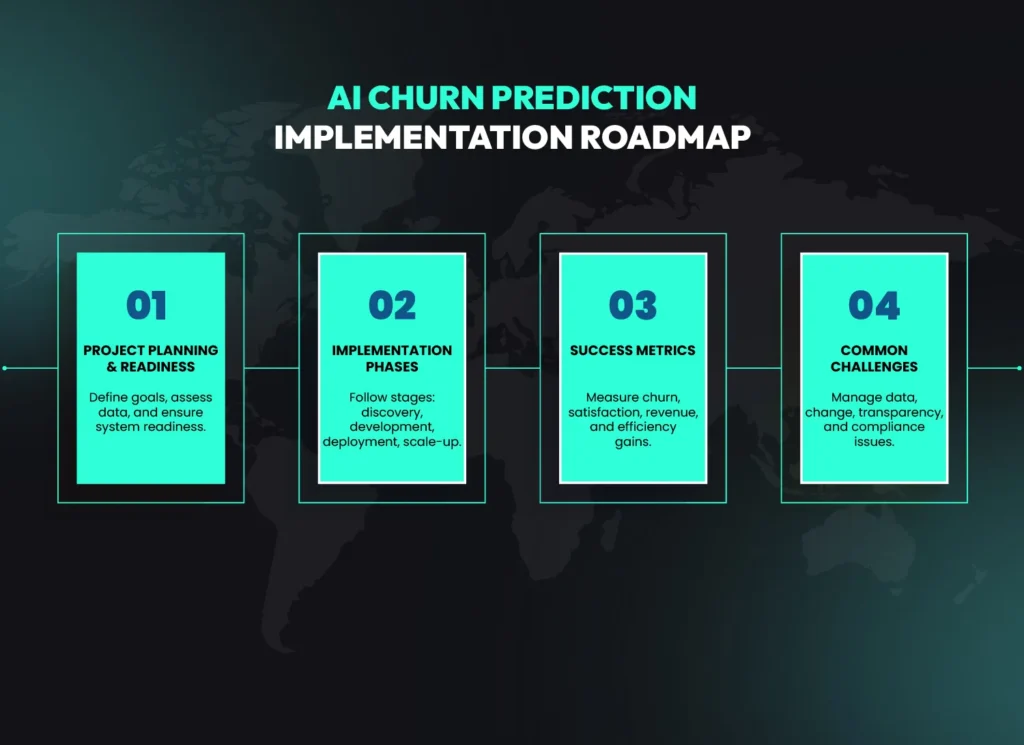
Roadmap for AI in customer churn prediction, outlining phases from planning to success measurement.
Project Planning and Prerequisites
Successful projects begin with clear business case development and realistic ROI projections. Data readiness assessment identifies gaps in data quality, completeness, and accessibility that must be addressed before model development begins. Technology infrastructure evaluation ensures systems can support AI workloads and integration requirements.
What is Data Readiness Assessment?
Data readiness assessment evaluates data quality, completeness, accessibility, and integration requirements to ensure sufficient foundation for accurate AI churn prediction model development.
Business case development with clear success metrics
Data quality audit and gap identification
Infrastructure capacity assessment
Team skill evaluation and training planning
Implementation Phases
Phased implementation reduces risks and enables learning from early phases to improve later stages. The discovery phase establishes foundation requirements and stakeholder alignment. Development phase focuses on building and testing core capabilities. Deployment phase validates real-world performance before full-scale rollout.
Phase
Duration
Key Activities
Discovery
1-2 months
Requirements, data mapping, vendor selection
Development
3-6 months
Model building, integration development
Deployment
2-3 months
Pilot launch, training, optimization
Scale-up
3-6 months
Full deployment, advanced features
Success Metrics and KPIs
Success metrics should align with business objectives and provide clear evidence of value creation. Churn rate reduction is the primary metric, but should be supplemented with customer satisfaction, revenue impact, and operational efficiency measures. Regular metric tracking enables course correction and continuous improvement.
Leading indicators like model accuracy and engagement rates provide early warning of potential issues, while lagging indicators like customer lifetime value changes demonstrate long-term success. Balanced scorecards help stakeholders understand project impact across multiple dimensions.
Common Implementation Challenges
Data integration complexity often exceeds initial expectations, requiring additional time and resources to resolve. Change management challenges emerge when business users resist adopting AI-driven recommendations or workflows. Model interpretability becomes critical when stakeholders question AI decision-making processes.
Regulatory compliance and privacy concerns can delay implementations, particularly in highly regulated industries. Organizations should engage legal and compliance teams early in the process to identify and address potential issues. Professional software development outsourcing can help overcome technical implementation challenges.
Future Trends and Innovations in AI-Powered Customer Retention
Future AI churn prediction will leverage quantum computing for complex pattern analysis, real-time edge AI processing, advanced personalization through digital twins, and autonomous retention systems capable of self-optimizing engagement strategies. These innovations promise to achieve churn reduction rates of 10-30% by 2027.
Emerging technologies will enable more sophisticated understanding of customer behavior and more effective intervention strategies. Organizations investing in generative AI capabilities are beginning to explore how these technologies can enhance customer communication and engagement personalization.
Partner with Trusted Experts in AI Customer Churn Prediction
Let’s Talk
Our team combines deep AI expertise with real-world banking and telecom experience to design, implement and optimize customer churn prediction solutions you can rely on for measurable retention gains.
Quantum computing promises to solve complex optimization problems that are computationally intensive for classical computers. In churn prediction, quantum algorithms could analyze massive datasets with thousands of variables simultaneously, identifying subtle patterns that current systems miss. However, practical quantum applications remain several years away for most organizations.
What is Quantum Computing?
Quantum computing uses quantum mechanical phenomena to process information in ways that could dramatically accelerate complex pattern recognition and optimization problems in AI applications.
Real-Time and Edge AI Evolution
Edge AI enables churn prediction processing directly on customer devices or local systems, reducing latency and improving privacy by keeping data local. This approach enables instant churn risk assessment and immediate response capabilities that aren’t possible with cloud-based systems. Mobile-first markets particularly benefit from edge AI implementations.
Technology
Timeline
Expected Impact
Quantum Computing
2027-2030
Revolutionary pattern recognition
Edge AI
2024-2026
Real-time processing capabilities
Digital Twins
2025-2027
Advanced customer simulation
Autonomous Systems
2026-2028
Self-optimizing retention
Advanced Personalization Technologies
Digital twin technology creates virtual representations of customers that can be used to simulate and test retention strategies before implementing them with real customers. This approach reduces the risk of unsuccessful interventions while enabling more sophisticated strategy optimization. Emotion AI adds another dimension by detecting emotional states in customer communications.
Hyper-personalization goes beyond demographic and behavioral segmentation to create truly individual customer models. These systems understand not just what customers do, but why they do it, enabling more effective engagement strategies.
Autonomous Retention Systems
Future retention systems will operate autonomously, continuously learning and adapting strategies based on outcomes. Self-learning campaign optimization will eliminate the need for manual A/B testing and strategy refinement. Predictive budgeting will allocate retention resources automatically based on predicted ROI.
These systems will require sophisticated AI architectures that can make complex decisions with minimal human oversight while maintaining transparency and accountability. Organizations preparing for this future are investing in foundational AI capabilities and governance frameworks today.
At a Glance: Key Takeaways
AI Accuracy: Modern churn prediction achieves 85-90% accuracy with proper implementation
Business Impact: 10-15% churn reduction typical, with 5:1 to 15:1 ROI within two years
Implementation Timeline: 6-12 months for full deployment, 3-6 months for ROI realization
Critical Success Factors: Data quality, integration capabilities, and change management
Technology Evolution: Edge AI, quantum computing, and autonomous systems transforming capabilities
Industry Specificity: Banking and telecom require specialized approaches and compliance considerations
Frequently Asked Questions
How accurate are AI models in predicting customer churn?
Modern AI churn prediction models achieve 85-90% accuracy rates, with ensemble methods and deep learning approaches reaching the higher end. Success depends on data quality, feature engineering, and model selection aligned with business context and industry characteristics.
What’s the typical ROI timeline for AI churn prediction implementation?
Most organizations see positive ROI within 3-6 months of deployment, with average returns of 5:1 to 15:1 over two years. Initial investments range from $50,000 for basic implementations to $500,000+ for enterprise-scale solutions with custom development.
How does AI churn prediction handle data privacy and compliance requirements?
AI systems implement privacy-preserving techniques including data anonymization, federated learning, differential privacy, and encrypted processing. GDPR, CCPA, and industry-specific regulations are addressed through explainable AI models and consent management frameworks.
Can small telecom and banking companies benefit from AI churn prediction?
Yes, cloud-based SaaS solutions and pre-built models make AI churn prediction accessible to smaller organizations. Entry-level solutions start at $1,000-5,000 monthly, offering significant value through reduced customer acquisition costs and improved retention rates.
What data volume is required for effective AI churn prediction?
Minimum viable datasets typically require 10,000+ customer records with 6-12 months of historical data. However, advanced techniques like transfer learning and synthetic data generation can work with smaller datasets, especially when combined with industry benchmarks.
How do you measure the success of AI churn prediction initiatives?
Success measurement combines technical metrics (model accuracy, precision, recall) with business outcomes (churn rate reduction, customer lifetime value increase, retention campaign effectiveness). A/B testing validates real-world performance against control groups.
Stay Updated—Join Our Newsletter!
Newsletter
Don’t miss on the latest updates in the world of AI. We dispatch custom reports and newsletters every week, with forecasts on trends to come. Join our community now!
Conclusion: Transform Your Customer Retention Strategy with AI
AI-powered churn prediction represents a fundamental shift from reactive to proactive customer relationship management. Banking and telecommunications organizations leveraging these technologies achieve unprecedented retention rates while reducing acquisition costs and maximizing customer lifetime value. The convergence of advanced analytics, real-time processing, and intelligent automation creates sustainable competitive advantages in increasingly challenging markets.
Success requires strategic implementation combining quality data foundations, appropriate technology selection, and expert execution. Organizations must balance technical sophistication with business practicality, ensuring AI capabilities translate into measurable retention improvements. As customer expectations continue rising and competitive pressures intensify, AI-powered churn prediction evolves from optional enhancement to strategic necessity.
The future belongs to organizations that can predict, understand, and proactively address customer needs before churn occurs. Companies ready to transform their retention strategies can benefit from partnering with experienced AI development specialists who understand both technical implementation and business value creation. The question isn’t whether to implement AI churn prediction, but how quickly you can gain these competitive advantages in your market.
Ready to revolutionize your customer retention strategy? Contact our AI experts to discover how advanced churn prediction can drive measurable business growth and customer loyalty improvements for your organization.
Syed Ali Hasan Shah, a content writer at Kodexo Labs with knowledge of data science, cloud computing, AI, machine learning, and cyber security. In an effort to increase awareness of AI’s potential, his engrossing and educational content clarifies technical challenges for a variety of audiences, especially business owners.
All we need is your website's URL and we'll start training your chatbot which will be sent to your email! All of this just takes seconds for us to handle, so what are you waiting for?





![Top 15 AI Development Companies in 2026 [Expert-Ranked]](https://kodexolabs.com/wp-content/uploads/2026/03/Top-15-AI-Development-Companies-in-2026-Expert-Ranked.png)